
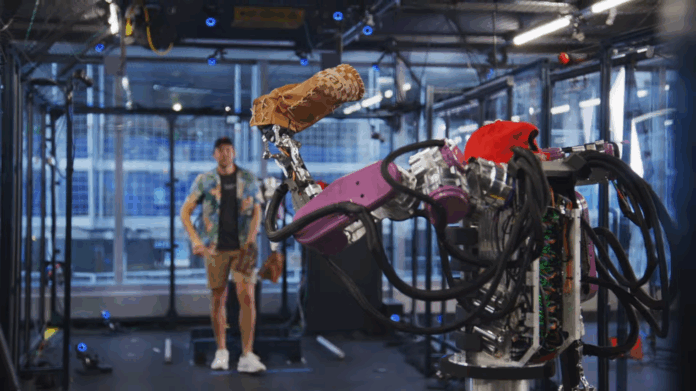
Robots Master Baseball Skills: Throwing, Catching, and Batting in Action
Each week, robotics enthusiasts are treated to a curated collection of captivating videos showcasing the latest advancements in robot capabilities. Alongside these visual highlights, a comprehensive calendar of upcoming robotics events is available, inviting community participation and event submissions.
High-Speed Robot Baseball: A New Frontier in Dynamic Manipulation
Researchers at the RAI Institute have engineered a cutting-edge, low-impedance robotic manipulation system designed to explore fast-paced, dynamic interactions. In a remarkable demonstration, robots engage in baseball drills, including batting practice and catch games with humans and fellow robots. These machines can pitch balls at speeds reaching 70 mph (112 kph), rivaling skilled high school pitchers. They exhibit impressive reflexes, catching balls thrown at up to 41 mph and batting balls pitched at speeds up to 30 mph (48 kph) from distances as close as 23 feet (7 meters).
The robots sport custom-designed “RAI” baseball gloves, adding a touch of realism to their athletic endeavors. Observers are left curious about how long these robotic duos can sustain their playful exchanges.
Innovative Robotic Arms with Extended Reach
One standout feature in recent robotics is the development of robotic arms with significantly enhanced reach capabilities, exemplified by the GIRAF (Greatly Increased Reach) system. This technology enables robots to perform complex manipulations with a seemingly magical fluidity. Careful frame-by-frame analysis reveals the sophisticated mechanics behind these movements, highlighting the blend of precision engineering and advanced control algorithms.
Revolutionizing Emergency Response: DARPA’s Triage Challenge
In October 2025, DARPA concluded the second year of its Triage Challenge, a three-year initiative aimed at transforming medical triage during large-scale emergencies where resources are limited. The competition recognized top performers such as DART and MSAI for their innovative systems and data solutions, pushing the boundaries of automated medical assessment and prioritization.
Advances in Robot Safety: Controlled Falls for Bipedal Robots
Recent research in reinforcement learning has introduced a robot-agnostic reward system that balances achieving target positions with minimizing impact and protecting vital robot components. By employing simulation-based sampling for initial and final poses, this approach enhances policy robustness and adaptability to unforeseen scenarios. Experiments demonstrate that bipedal robots can execute controlled, gentle falls both in simulations and real-world tests, marking a significant step toward safer humanoid robotics.
Humanoid Robots Showcase Agile Acrobatics and Dance
Humanoid robots continue to impress with their acrobatic and dance performances, pushing the envelope of robotic mobility and coordination. As these machines exhaust traditional human-like movements, the future promises even more unconventional and innovative motions that leverage robotic degrees of freedom beyond human capabilities.
Robotic Automation in Unique Applications
Robots are increasingly deployed in specialized tasks, such as constructing nesting boxes for selective bird species, demonstrating their versatility beyond industrial settings. Additionally, humanoid robots like the Walker S2 series have proven their authenticity and practical utility, showcasing advanced automation that blurs the line between traditional robotics and intelligent systems.
Collaborative Robots and AI: Shaping the Future of Industry
At the recent Human[X] conference, industry leaders discussed the rapid growth of collaborative robots (cobots) and the transformative impact of artificial intelligence on physical automation. Topics included the evolving role of humanoid robots, investment trends, and the integration of AI to enhance manufacturing efficiency and flexibility over the next decade.
Humanoids in Manufacturing: Challenges and Opportunities
The fascination with humanoid robots stems from their potential to perform diverse, labor-intensive tasks. Insights from factory floor observations emphasize the importance of pursuing generalized manipulation capabilities in both hardware and software. Boston Dynamics highlights ongoing AI research aimed at making humanoid robots practical, economically viable, and integral to the future of manufacturing.
Exploring Robotics and Social Justice
Upcoming seminars, such as the Michigan Robotics Seminar Series, delve into the intersection of robotics and social justice. Presentations like “Degrees of Freedom – On Robotics and Social Justice” explore how robotic technologies can influence societal equity and ethical considerations in automation.
Community Engagement: Open Q&A with OSRF Board
Engage directly with the Open Source Robotics Foundation (OSRF) Board of Directors through interactive Q&A sessions, fostering transparency and community involvement in the development of open-source robotics platforms.