Introducing the Centaur: A Revolutionary Hybrid Power Suit Inspired by Mythology
Exoskeletons powered by hydraulics have long been developed to assist users in lifting heavy loads or enhancing mobility. Recently, a team of engineers in China unveiled an innovative design that draws inspiration from the legendary centaur, blending human and robotic locomotion in a novel way.
A New Take on Wearable Robotics: The Bipedal Centaur Suit
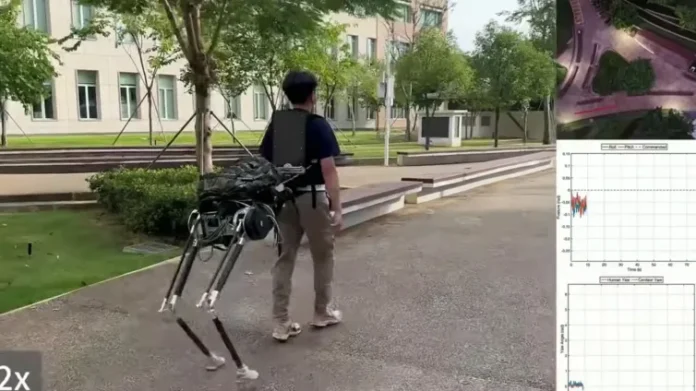
Dubbed the ‘Centaur’ power suit, this device functions as a robotic pair of legs that attach to the wearer’s back, effectively acting as an additional set of limbs. Unlike traditional exoskeletons that augment the user’s own legs and arms, the Centaur’s robotic legs trail behind, mirroring the wearer’s movements and adapting fluidly to changes in speed and direction. While this concept may initially seem unconventional, it offers distinct functional benefits.
Distinct Advantages Over Conventional Exoskeletons
Most existing power suits are designed to integrate directly with the user’s limbs, providing assistance by amplifying their natural movements. In contrast, the Centaur operates as an independent set of legs, which allows it to bear the entire weight of carried loads without restricting the wearer’s own mobility. This separation of function means the user can move more freely while the robotic legs handle the heavy lifting.
Innovative Attachment System for Comfort and Stability
The Centaur employs a sophisticated flexible coupling mechanism to connect to the wearer’s back. This system incorporates a nonlinear spring that remains stable under light forces but softens under heavier loads, ensuring both comfort and secure attachment. This design effectively isolates the forces generated by the wearer’s movements from those produced by the robotic legs, enhancing overall stability and reducing strain.
Significant Reduction in Energy Expenditure
According to the research team, using the Centaur suit to carry a load of around 20 kilograms can decrease the metabolic cost of walking by approximately 35%. This is a substantial improvement compared to typical exoskeletons, which generally offer energy savings between 5% and 12%. The suit not only supports the weight but also actively propels the wearer forward, easing the physical effort required for locomotion.
Human-Robot Collaboration: A Balanced Vision for the Future
While many envision a future dominated by fully autonomous robots powered by artificial intelligence, the creators of the Centaur advocate for a hybrid approach. They emphasize human control over navigation combined with robotic assistance for physical tasks, leveraging the complementary strengths of both to maximize efficiency and safety.
Public Reception and Concerns
Despite its technological promise, the Centaur power suit has sparked mixed reactions online. Some users express safety concerns, questioning the risks of falling while wearing the device and the potential for injury. Others have likened the suit to a “legged rickshaw,” highlighting skepticism about its practicality in everyday scenarios.
Looking Ahead: Potential Applications and Developments
As wearable robotics continue to evolve, designs like the Centaur open new possibilities for industries such as logistics, construction, and disaster response, where reducing physical strain is critical. Future iterations may incorporate advanced sensors and AI to enhance responsiveness and safety, addressing current public apprehensions and expanding usability.