
Summary
Foundation Future Industries, a San Francisco-based startup led by a CEO with a controversial fintech background, has landed $24 million in Pentagon contracts to develop humanoid robots for tactical breaching operations. In February, two Phantom MK-1 robots were deployed to Ukraine for frontline logistics and reconnaissance trials-the first known use of humanoid robots in an active conflict zone. With Eric Trump as chief strategy adviser, the company’s Pentagon deals have drawn criticism from Senator Elizabeth Warren, who labeled them as blatant corruption. Foundation aims to raise $500 million at a valuation exceeding $3 billion, despite ambitious production goals that require scaling from 40 to 50,000 units by 2027 on a modest funding base of about $21 million.
Innovative Robotics for Modern Warfare
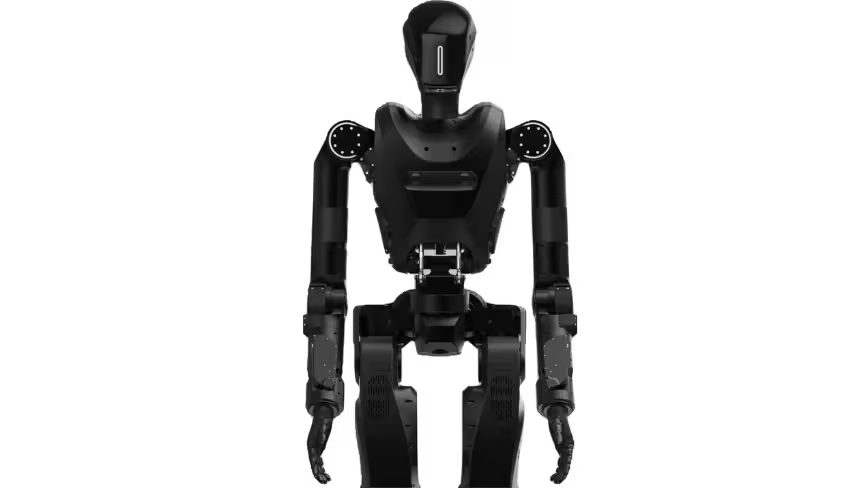
Founded in April 2024, Foundation Future Industries has quickly positioned itself at the intersection of robotics and defense by securing contracts with the US Army, Navy, and Air Force. Their flagship product, the Phantom MK-1, is a humanoid robot standing 5 feet 9 inches tall and weighing 176 pounds. It boasts 19 degrees of freedom in the upper body, dexterous five-fingered hands, and a vision system centered on eight cameras, deliberately avoiding bulky LiDAR sensors. Powered by proprietary cycloidal actuators capable of delivering up to 160 newton-meters of torque, the robot moves at speeds up to 1.7 meters per second and can carry payloads up to 44 pounds.
The robot’s autonomy is driven by a large language model (LLM) pipeline that converts high-level commands into precise motions, blending autonomous operation with supervised teleoperation. Operators maintain ultimate control over lethal actions, adhering to current ethical and military guidelines. The MK-1 is priced around $150,000 per unit, with leasing options available at $100,000 annually. The upcoming MK-2 model, expected imminently, promises enhanced durability with waterproofing, larger batteries, increased payload capacity of 175 pounds, and streamlined manufacturing through cast-molded body parts.
Ambitious Production Goals Amidst Funding Challenges
Foundation’s production roadmap is aggressive: 40 units in 2025, scaling to 10,000 in 2026, and reaching 50,000 by the end of 2027, with a long-term annual output of 30,000 units. Achieving this would require a 250-fold increase in manufacturing capacity within two years, a daunting task given the company’s current funding of approximately $21 million. The startup’s leadership includes Sankaet Pathak, formerly CEO of the now-bankrupt fintech Synapse; Arjun Sethi, CEO of Tribe Capital and lead investor in Foundation’s $11 million pre-seed round; and Mike LeBlanc, a Marine Corps veteran and co-founder of Cobalt Robotics, who lends military expertise and emphasizes the ethical imperative of deploying robots instead of soldiers in combat.
Controversies and Credibility Concerns
Foundation’s credibility has been questioned following reports that it overstated partnerships with General Motors, including claims of a $300 million purchase order and investment commitment, both denied by GM. LeBlanc publicly acknowledged the inaccuracies and expressed embarrassment over the misleading marketing materials. This credibility gap is significant, especially as the company seeks Pentagon trust to deploy robots in combat scenarios.
The $24 million Pentagon contracts include an SBIR Phase 3 designation, officially recognizing Foundation as a military vendor, and specific research agreements focused on humanoid robot breaching tests. Some contracts were acquired through the purchase of Boardwalk, including a $1.8 million Air Force SBIR award. Eric Trump’s role as chief strategy adviser and his public promotion of these contracts on Fox Business sparked political backlash, with Senator Warren questioning whether the Pentagon is being used as a “cash machine” for the Trump family. While the contracts are genuine, they pale in comparison to the multi-billion-dollar deals secured by competitors like Shield AI and Anduril, highlighting the gap between research funding and full-scale deployment.
Field Testing and Real-World Applications
The deployment of two Phantom MK-1 units to Ukraine for logistics and reconnaissance in February marks a milestone in real-world testing of humanoid robots in conflict zones. However, these robots have not engaged in combat or fired weapons, performing support roles instead. This distinction is critical, as Foundation’s marketing and fundraising heavily emphasize the vision of humanoid soldiers, a capability that remains technologically out of reach.
Meanwhile, NATO-backed ARX Robotics has secured €31 million to develop autonomous ground vehicles for battlefield logistics and reconnaissance, focusing on wheeled and tracked platforms that avoid the complexities of bipedal locomotion. ARX is already scaling production to 1,800 units annually at a new UK facility, demonstrating a manufacturing scale that Foundation has yet to approach.
Ethical and Regulatory Challenges
The international community continues to grapple with the ethical implications of autonomous weapons. Since 2013, the Campaign to Stop Killer Robots-a coalition of over 250 NGOs-has pushed for a global treaty mandating meaningful human control over lethal systems. Approximately 90 countries support such regulation, but key militarized nations, including the US and Russia, have resisted. In November 2025, the UN General Assembly’s First Committee passed a resolution with overwhelming support (156 in favor, 5 against) to begin negotiations on autonomous weapons regulation. The Group of Governmental Experts (GGE) on lethal autonomous weapons systems is scheduled to deliver a final report in November 2026, marking a pivotal moment for international governance.
Foundation asserts that human operators retain final authority over lethal decisions, aligning with the Pentagon’s Directive 3000.09, which mandates “human-in-the-loop” control for autonomous weapon systems. However, the company’s LLM-driven autonomy stack aims to progressively reduce teleoperation, potentially edging toward fully autonomous capabilities that international efforts seek to regulate. This tension underscores the broader challenge of balancing technological advancement with ethical constraints.
Global Competition in Military Robotics
China has showcased humanoid robots for military applications at international cadet events and invested heavily in quadruped robots like RoboWolf, backed by the state-owned NORINCO, with funding around $69 million. The US Department of Defense added Unitree, a Chinese consumer robot-dog manufacturer, to its list of Chinese military-linked companies in early 2026. Despite viral videos claiming to show Chinese humanoid robot armies, these were debunked as AI-generated fabrications, illustrating the role of perception in the global robotics arms race.
Russia has established a dedicated Unmanned Systems Forces branch and deployed autonomous mortar systems like Kurier, capable of loading and firing without human intervention. It is also expanding its ground drone fleet in Ukraine. However, neither China nor Russia has deployed humanoid robots in combat. Instead, wheeled, tracked, and quadruped robots dominate current military robotics due to their simplicity, cost-effectiveness, and reliability. In contrast, bipedal humanoids like the Phantom MK-1, priced at $150,000 and prone to instability on rough terrain, face significant operational challenges.
Market Dynamics and Future Outlook
Defense technology venture capital reached a record $49.1 billion in 2025, nearly doubling the previous year’s investment. Goldman Sachs forecasts that between 50,000 and 100,000 humanoid robots will be shipped worldwide across various industries in 2026. The surge in defense stocks and investor enthusiasm has created a fertile environment for startups pitching “humanoid robot soldiers.” However, the battlefield’s realities currently favor simpler robotic platforms over complex humanoid designs. Ultimately, the success of humanoid military robots will depend on technological breakthroughs and operational viability demonstrated in real combat scenarios.