This article is sponsored by Wetour Robotics.
Imagine a wind turbine technician, securely harnessed, both hands engaged with a wrench, needing to relay a command to a diagnostic device clipped to her belt. Or consider a logistics operator on a bustling loading dock, gloved and focused on a pallet, who must reroute a connected forklift. Even a person navigating a crowded street with an assistive mobility device might want to subtly propel it forward without pulling out a phone or speaking aloud. These scenarios don’t demand more intelligent robots-they require more intuitive ways for humans to communicate with existing machines.
Rethinking the Human-Machine Interaction Paradigm
Over the last few years, Physical AI has witnessed extraordinary advancements primarily on the robotic front. Innovators like Boston Dynamics, Figure, and Unitree have pushed the boundaries of actuators, mobility, and fine motor skills to levels once thought unattainable. Meanwhile, Google DeepMind’s Gemini Robotics has revolutionized vision-language-action models, enabling robots to operate effectively in unpredictable environments. The momentum in hardware and foundational AI models is undeniable and accelerating rapidly.
Yet, the human interface side of this equation has remained largely stagnant, relying on the same three input methods for over four decades: screens, buttons, and voice commands. These traditional interfaces assume users can pause, look down, and translate their intentions into structured inputs. This assumption falters in real-world environments-whether on a turbine, a dock, or a crowded sidewalk-where hands are busy, eyes are focused elsewhere, or speaking aloud is impractical. In such contexts, conventional interfaces quietly fail to meet user needs.
Enter Spatial Intent Fusion: a groundbreaking approach that simultaneously interprets three streams of human-centric data-spatial positioning, visual context, and gestural intent-transforming the human body itself into a dynamic interface.
The bottleneck in human-machine interaction is becoming as critical as the robotic capabilities themselves. Addressing this challenge requires a shift in perspective-not by asking how to make robots smarter, but by enabling humans to engage with computing systems as seamlessly and naturally as robots already do.
Wetour Robotics’ Vision: Integrating Humans as Core Computing Nodes
Wetour Robotics envisions the next major leap in Physical AI not as an enhancement of robotic abilities, but as the elevation of humans to first-class participants within the computing ecosystem. This means enabling humans to interact with machines with the same low-latency, high-fidelity responsiveness that connected devices currently enjoy.
The company’s engineers emphasize that simple gesture recognition via a wristband or scene analysis through a camera is insufficient. Human intent is inherently distributed across multiple channels: the body’s spatial orientation, the focus of the eyes, and the preparatory muscle activity. Observing any single channel in isolation leads to ambiguity. To reliably decode intent, these signals must be fused at the operating system level with minimal latency, creating a closed-loop experience that feels instantaneous rather than mediated.
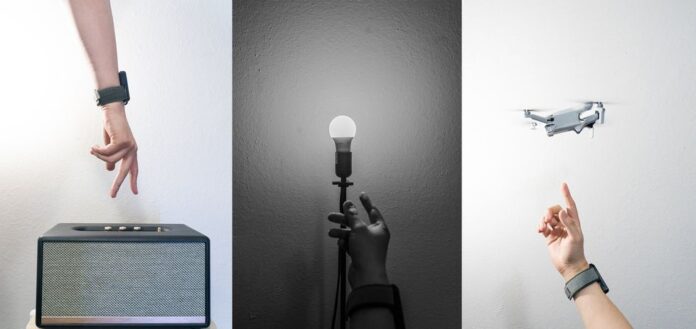
This methodology, termed Spatial Intent Fusion, merges spatial data, visual cues, and gestural signals into a unified, real-time command stream for any connected physical device. Simply put, it embodies the philosophy: your body is the interface.
Orchestra is a portable intelligent hub running the operating system that manages sensor fusion, intent inference, command translation, and safety arbitration. It leverages the NVIDIA Jetson Orin Nano Super platform, delivering sufficient on-device processing power to maintain the entire control loop locally, eliminating cloud dependency for critical operations.
Wetour Robotics
System Design: A Modular Platform with Multi-Layered Intelligence
Orchestra is not a standalone gadget but a sophisticated, layered platform engineered for sensor versatility and actuator neutrality. Its architecture is divided into three perception layers and four coordination engines, working in harmony.
Orchestra Core: This is the portable computational hub running the operating system responsible for integrating sensor data, inferring user intent, translating commands, and ensuring safety. Utilizing the NVIDIA Jetson Orin Nano Super, Orchestra performs all inference tasks on-device, maintaining end-to-end latency below 100 milliseconds-a threshold critical for natural, real-time control without perceptible lag.
VisionLink: This module processes visual and spatial information. Cameras feed into advanced vision models that identify objects, estimate distances, and monitor environmental context. Unlike passive recognition systems, VisionLink actively generates command inputs that feed directly into Orchestra OS, where they are combined with biosignal data.
Conductor: The biosignal processing pipeline captures raw surface electromyographic (sEMG) signals from a wrist-worn device, classifying temporal patterns into discrete gestures or continuous control inputs. Notably, sEMG signals precede actual motion by approximately 50 to 80 milliseconds, enabling pre-motion intent detection. This anticipatory capability allows Orchestra to predict user actions rather than merely react.
Above these perception layers, Orchestra OS orchestrates four key engines:
- Perception Engine: Normalizes and processes raw sensor inputs.
- Intent Engine: Executes Spatial Intent Fusion, integrating spatial, visual, and gestural data to accurately interpret user intent.
- Orchestration Engine: Converts inferred intent into device-specific command sequences compatible with a wide range of actuators.
- Safety Engine: Resolves conflicting commands, enforces operational boundaries, and ensures safe execution under dynamic conditions.
Wetour Robotics
Transparent Challenges and Pragmatic Solutions
Bridging the human body with digital systems is an evolving frontier, and Wetour Robotics openly acknowledges three ongoing engineering challenges, each addressed with thoughtful trade-offs rather than premature claims of perfection.
Signal Stability of sEMG During Movement: While sEMG-based gesture recognition is reliable when users are stationary, physical activity such as walking or climbing introduces motion artifacts and electrode shifts that degrade signal quality. To maintain robustness, Orchestra prioritizes a limited set of discrete gestures in dynamic environments, reserving continuous control for scenarios with favorable signal-to-noise ratios.
Edge AI Miniaturization: Achieving full on-device inference demands balancing computational power, battery longevity, and compactness. Wetour Robotics’ solution combines a compact carrier board with efficient thermal management and a battery designed for all-day wearability, enabling users to remain untethered while maintaining real-time control without cloud reliance.
Diverse Third-Party Device Protocols: The actuator ecosystem is fragmented, with varying command interfaces, communication protocols, and safety standards. Orchestra OS employs an adaptive AI-agent layer that negotiates connections and translates protocols dynamically, allowing seamless integration with a broad spectrum of devices.
Why This Innovation Matters for the Future of Physical AI
The evolution of computing has been marked by transformative interface revolutions-from command lines to graphical user interfaces, then to touchscreens and voice control. Each leap expanded accessibility and functionality. The forthcoming revolution transcends new screens or microphones; it envisions the human body itself as an active node within the computing network, capable of conveying intent with the speed and precision of any connected device.
This approach complements, rather than competes with, advancements in humanoid robotics, embodied AI foundation models, and dexterous manipulation. A significant hurdle for humanoid systems is the scarcity of naturalistic human-physical world interaction data, which is essential for training. By integrating humans as first-class nodes, these interactions become visible, structured, and invaluable for developing the next generation of embodied AI-including the humanoid robots of tomorrow.
In essence, embedding humans back into the computational loop not only enhances individual user interfaces but also generates rich, real-world interaction data critical for the broader Physical AI ecosystem’s progress. The future of robotics and human-machine collaboration is not a choice between two paths but a unified journey.
Wetour Robotics encapsulates this vision succinctly: Your body is the interface.
Discover more at wetourrobotics.com.