
Revolutionizing Robotics: From Domestic Helpers to Battlefield Allies
While many Silicon Valley innovators focus on humanoid robots designed to assist with everyday household chores like folding clothes or preparing coffee, a pioneering start-up is charting a radically different course. Foundation Future Industries, established in 2024 and headquartered in San Francisco, is developing autonomous humanoid robots tailored for military operations and heavy industrial tasks rather than service or domestic roles.
Led by CEO Sankaet Pathak, Foundation envisions these robots as tools to tackle humanity’s most perilous challenges, replacing humans in hazardous environments to save lives. “The technology has matured to a point where it can assume roles that are too dangerous for people,” Pathak explained, emphasizing the profound societal benefits of deploying robotics in high-risk sectors.
Origins and Early Deployments: Testing Ground in Ukraine
Pathak, previously known for his leadership at Synapse, a fintech company that filed for bankruptcy in 2024, co-founded Foundation alongside Arjun Sethi, ex-CEO of Tribe Capital, and Mike LeBlanc, a co-founder of Cobalt Robotics. Despite some controversy-such as unconfirmed claims of investment interest from General Motors-the company has rapidly gained attention for its innovative approach.
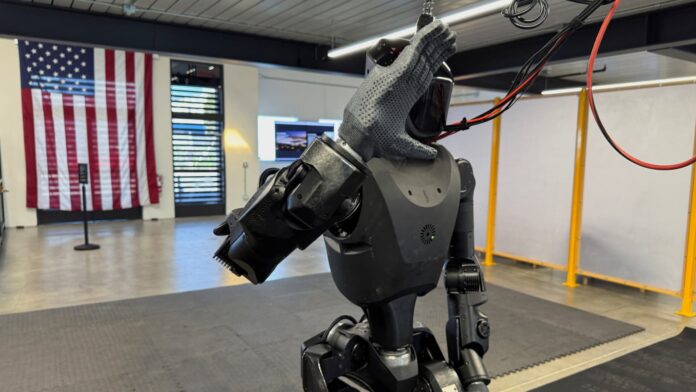
In a groundbreaking move, Foundation dispatched two Phantom MK-1 humanoid robots to Ukraine earlier this year, marking one of the first known uses of humanoid robots in an active combat zone. Supported by U.S. government funding and coordinated with Ukrainian officials, these robots have been trialed in logistics roles, such as transporting supplies through dangerous areas, thereby reducing soldiers’ exposure to harm.
Although the MK-1 models currently carry a modest payload of approximately 44 pounds and lack features like waterproofing and extended battery life, Foundation plans to introduce the Phantom 2 later this year. This next-generation robot promises enhanced capabilities, including doubled payload capacity and “superhuman” performance traits, aiming to better meet the demands of frontline operations.
Strategic Collaboration with U.S. Defense and Political Connections
Foundation’s ambitions extend beyond Ukraine, with the company securing $24 million in U.S. government contracts to explore applications in inspection, logistics, and weapons handling across the Army, Navy, and Air Force. Discussions with defense officials have evolved from preliminary research to scaling deployment, with plans to integrate these humanoid robots into active military service within 12 to 18 months.
Adding a political dimension, Eric Trump, son of the sitting U.S. president, recently joined Foundation as chief strategy advisor. His involvement has sparked debate, including criticism from Senator Elizabeth Warren, who labeled the firm’s government contracts as potential “corruption in plain sight.” Foundation representatives clarified that Trump was an investor prior to his advisory role and shares the company’s vision of revitalizing American manufacturing.
Pathak underscores the geopolitical stakes, positioning Foundation’s technology as a critical asset in the U.S.-China rivalry. “Our mission is to deliver the most advanced humanoid robots to the U.S. military-robots that surpass anything China can produce,” he stated. While China has invested heavily in humanoid robotics for industrial use and showcased AI-driven robotic soldiers and quadrupeds, the full extent of their military deployment remains opaque.
Advantages and Challenges of Humanoid Robots in Combat
Experts highlight that humanoid robots offer unique benefits in complex environments such as urban battlefields, where human-like mobility-navigating stairs, narrow corridors, and uneven terrain-is essential. Kateryna Bondar, senior fellow at the Wadhwani AI Center, notes that these robots’ dexterity and autonomy could provide tactical advantages over wheeled or quadruped robots in such settings.
However, the engineering complexity and high production costs of humanoid robots pose significant hurdles. Melanie Sisson, a senior fellow at Brookings, points out that rapid adaptability and cost-efficiency are critical in conflict zones, lessons underscored by the ongoing war in Ukraine. This raises questions about whether humanoid designs are the most practical solution compared to simpler robotic platforms.
Ethical Considerations and the Future of Autonomous Warfare
The integration of autonomous decision-making in military robots introduces profound ethical dilemmas, especially when human lives are at stake. Foundation asserts that while most weaponized functions of their robots will include human oversight, certain time-sensitive scenarios will require the robots to act independently.
The U.S. military has already begun incorporating AI to assist in strategic decisions, including recent operations in the Middle East. Yet, proving that humanoid robots can outperform existing robotic systems in terms of practicality and cost remains a significant challenge.
Looking ahead, experts like Toby Walsh, chief scientist at the University of New South Wales AI Institute, predict a future where a variety of autonomous robots-tracked, aerial, and underwater-will increasingly replace human soldiers. However, he cautions that the popular image of humanoid “terminator”-style robots remains largely speculative and more a product of science fiction than imminent reality.