
Introducing Kairos-HomeWorld: Revolutionizing Interactive Whole-Home 3D Environment Generation
Kairos-HomeWorld emerges as a groundbreaking platform designed specifically for embodied intelligence, offering the first-ever unified framework capable of creating fully interactive, entire home environments from a single textual description. Unlike traditional indoor scene generation methods that focus on isolated rooms, this system simulates complete residences where every object is manipulable within a cohesive simulation engine.
A Novel Four-Phase Hierarchical Framework for Realistic Home Simulation
The core of Kairos-HomeWorld’s innovation lies in its structured four-step architecture: floorplan synthesis, 2D-to-3D transformation, iterative refinement, and dynamic object placement. This pipeline ensures the generation of spatially consistent, physically accurate, and simulation-ready home scenes. Each virtual environment includes over 15 interactive objects and achieves a Footprint Object Density (FOD) of 4.16, surpassing existing benchmarks in object concentration and interactivity.
Comprehensive Dataset Tailored for Chinese Residential Settings
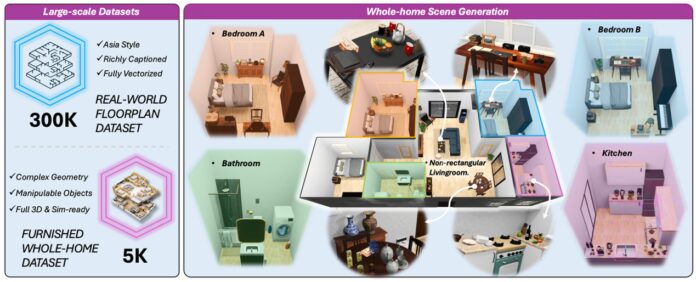
Complementing the framework is an extensive open-source dataset featuring 300,000 authentic residential floor plans from China, alongside 5,000 fully furnished, physics-enabled homes and 50,000 interactive object assets. This dataset supports ACE ROBOTICS’ daily robot training, significantly enhancing the efficiency of transferring simulation results to real-world applications.
Addressing the Challenges of Embodied Intelligence in Diverse Home Environments
Residential spaces are inherently varied and personalized, posing significant challenges for training robots to operate reliably across different households. High-fidelity simulation is the most scalable solution, yet existing methods often compromise between realism and interactivity. Synthetic environments tend to lack authenticity, while scanned real-world scenes offer limited manipulation capabilities. Kairos-HomeWorld bridges this divide by delivering both photorealistic and fully interactive home environments within a single, unified system.
Stage 1: Generating Coherent Floor Plans Using K-D Tree Representations
The process begins with a K-D tree-based technique that converts real-world floor plans into hierarchical textual data, optimized for processing by large language models (LLMs). This approach effectively eliminates common layout issues such as overlapping rooms and fragmented spatial arrangements, resulting in structurally sound and coherent home layouts.
Stage 2: From 2D Blueprints to 3D Spaces with Accurate Furniture Placement
Next, a hybrid “top-down global initialization” combined with a “first-person walkthrough” method anchors the 3D building shell and furniture layout. This strategy reduces geometric drift typical in conventional 2D-to-3D conversions, ensuring spatial consistency and stability throughout the scene.
Stage 3: Recursive Scene Refinement via Vision-Language Models
A fine-tuned vision-language model iteratively inspects and corrects the scene, resolving physical inconsistencies such as blocked doorways or object overlaps. This recursive validation significantly lowers furniture collision rates, achieving some of the best accuracy metrics in the industry.
Stage 4: Physically Realistic and Manipulable Object Integration
Finally, a surface-focused placement algorithm assigns detailed physical attributes-material type, density, friction, and support relationships-to each object. The resulting scenes feature an average of 15+ manipulable items, all fully compatible with simulation engines for realistic interactions like grasping, moving, and stacking.
Dataset Highlights: Extensive Coverage of Chinese Housing Typologies
The dataset includes 300,000 structurally annotated floor plans sourced from authentic Chinese residential listings, processed through an automated pipeline that labels spatial elements such as doors, windows, room functions, and connectivity. This scale dwarfs popular benchmarks like RPLAN and ResPlan, which contain roughly 80,000 and 17,000 floor plans respectively.
Additionally, 5,000 fully furnished homes are provided, each equipped with physics-enabled, interactive objects powered by the PhysX-Omni engine. These assets are simulation-ready, facilitating immediate deployment in robot training scenarios.
Unlike many existing datasets focused on Western-style open-plan homes, Kairos-HomeWorld’s dataset reflects the architectural diversity of Chinese residences, including features like north-south cross ventilation, enclosed kitchens, service balconies, separated wet and dry bathrooms, and irregular room shapes common in older buildings. The dataset spans from compact 30 m² studios to expansive 200+ m² apartments, ensuring broad applicability.
Demonstration: From Text Prompt to Fully Interactive Home Environment
Starting with a simple instruction such as “Generate a 90 m² neo-Chinese style two-bedroom apartment,” Kairos-HomeWorld constructs a spatially coherent layout incorporating realistic ventilation and zoning. The system then furnishes the home with stylistically consistent furniture and assigns physical properties to all objects, enabling full interactivity.
For example, a command like “tidy the whole home” is decomposed by the robot into multiple subtasks executed sequentially across rooms. The robot navigates efficiently, manipulating articulated objects (opening fridge doors), handling fluids (pouring detergent), interacting with soft bodies (drawing curtains), grasping irregular items (picking apples), and managing gravity-based tasks (placing snacks).
This level of integration surpasses conventional simulation environments that typically focus on navigation alone, enabling comprehensive training of complex household tasks within a virtual setting.
Advantages Over Real-World Data Collection and Industry Impact
While some initiatives, such as Figure AI’s collaboration with Brookfield, focus on collecting human activity data from over 100,000 homes, Kairos-HomeWorld offers scalable synthetic generation with embedded physical realism. This approach drastically reduces costs and accelerates training by eliminating the need for physical site operations, maintenance, and risk of property damage.
By enabling near-zero marginal cost scene generation and supporting a wide variety of home layouts and object interactions, Kairos-HomeWorld outperforms real-world data collection in both efficiency and scalability.
Currently integrated into ACE ROBOTICS’ embodied intelligence training workflows, the platform facilitates full-pipeline simulation of long-horizon tasks such as multi-room navigation and tidying. This capability shortens the simulation-to-reality transfer time, lowering barriers to deploying home robotics at scale, especially within the Chinese market.
About ACE ROBOTICS: Pioneering the Future of Embodied Intelligence
ACE ROBOTICS is at the forefront of developing intelligent robotic systems capable of autonomous understanding and interaction within physical environments. The company’s innovations include the ACE R&D paradigm and a comprehensive technology chain encompassing environmental data capture, real-world cognition, and generalized embodied interaction.
Leveraging Kairos 3.0-the first open-source, commercially viable world model in China-and the Embodied Foundation Model, ACE ROBOTICS addresses critical challenges such as data scarcity, knowledge gaps, and limited adaptability. Their flagship A1 Embodied Super Brain Module accelerates the deployment of embodied intelligence across diverse applications.
As both a technology innovator and ecosystem builder, ACE ROBOTICS collaborates with leading hardware manufacturers, cloud providers, and industry partners to overcome the “model-hardware-scenario” bottleneck, delivering tailored solutions that drive the growth of China’s embodied intelligence sector.