
Summary
At ILA Berlin 2026, ERC System introduced Victor, a heavy-lift cargo eVTOL designed to carry 250kg over 300km, aiming for 2028 deliveries focused on defence and logistics sectors.
ERC System Launches Victor: A New Era for Cargo eVTOLs in Europe
Munich-based startup ERC System has revealed its latest innovation, Victor, an unmanned hybrid-electric vertical takeoff and landing (eVTOL) aircraft tailored for defence, logistics, and emergency response missions. Presented at ILA Berlin 2026, Victor is engineered to transport payloads up to 250 kilograms across distances reaching 300 kilometers, cruising at speeds of approximately 250 km/h. The company anticipates initiating deliveries by 2028.
Innovative Hybrid Propulsion and Design Architecture
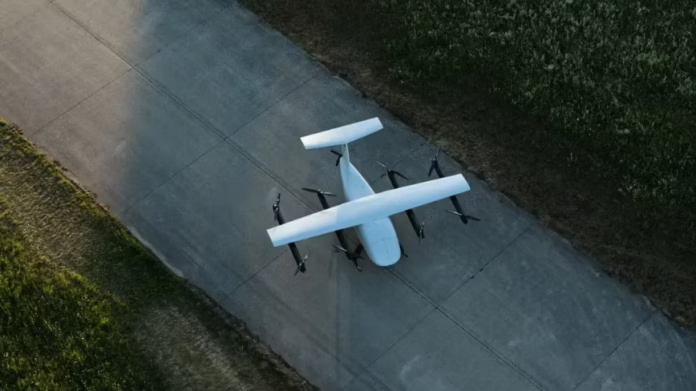
Victor employs a lift-and-cruise configuration, featuring eight vertical lift propellers for takeoff and landing, complemented by a rear-mounted pusher propeller for forward thrust. Its propulsion system integrates a piston engine as a range extender alongside the electric motors, a strategic choice reflecting ERC’s cautious approach to relying solely on emerging battery technologies. This hybrid setup prioritizes operational range and reliability over the simplicity of fully electric designs, addressing current limitations in battery energy density.
Proven Flight Testing with Romeo Prototype
The development of Victor builds upon the successful flight trials of ERC’s Romeo prototype, a 2.7-tonne aircraft with a 16-meter wingspan, recognized as one of the heaviest fully electric eVTOLs to have flown in Europe. Romeo commenced hover testing near Munich in late 2025, completing around ten flights that validated the aircraft’s flight control systems and lift-and-cruise mechanics, laying a solid foundation for Victor’s advancement.
Company Background and Strategic Partnerships
Founded in 2019 in Ottobrunn near Munich by Christopher Schrop, Maximilian Oligschläger, and three other co-founders, ERC System emerged publicly in mid-2024. The company benefits from significant backing by IABG, a German aerospace testing and certification firm closely linked to the Bundeswehr. IABG’s investment, reportedly in the tens of millions of euros, positions it as ERC’s primary institutional supporter, underscoring the strategic importance of Victor within Germany’s defence and aerospace sectors.
Cost Efficiency and Modular Design
ERC System projects that Victor’s direct operating expenses could be approximately 70% lower than those of comparable small helicopters, although this claim awaits independent verification. The aircraft’s interior is designed with modularity in mind, allowing rapid reconfiguration for various mission profiles such as cargo transport, medical supply delivery, or specialized equipment carriage. Loading is facilitated through rear clamshell doors, enhancing operational flexibility.
Market Position and Competitive Landscape
While Victor’s specifications-250kg payload, 300km range, and 250km/h cruise speed-have yet to be demonstrated in flight, they represent ambitious targets in the European eVTOL cargo market. Unlike lighter military surveillance drones, Victor is positioned as a heavier, slower platform optimized for sustained logistical operations. This differentiates ERC from companies like Quantum Systems, which focus on dual-use drones with different operational profiles.
Future Projects and Industry Challenges
In addition to Victor, ERC is developing Charlie, a piloted eVTOL intended for inter-hospital patient transfers, with expected service entry around 2031 in partnership with German air rescue operator DRF Luftrettung. Victor is envisioned as a near-term revenue source while the more complex certification process for crewed aircraft unfolds.
The 2028 delivery goal is notably ambitious given the eVTOL industry’s history of delays and financial instability. Since 2023, several European eVTOL firms, including Lilium and Volocopter, have faced insolvency. Although defence drone startups like Berlin-based Stark have attracted substantial funding, scaling from prototype to mass production remains a critical hurdle.
Outlook and Strategic Advantages
ERC System currently has no revenue, certified aircraft, or publicly announced customer contracts. It competes against established players such as Dronamics, which holds a European cargo drone license, and military drone manufacturers actively deployed in conflict zones like Ukraine. However, ERC’s possession of a full-scale flying prototype and its strategic investor with deep ties to the German defence sector may provide a competitive edge, especially as government procurement increasingly shapes the market.