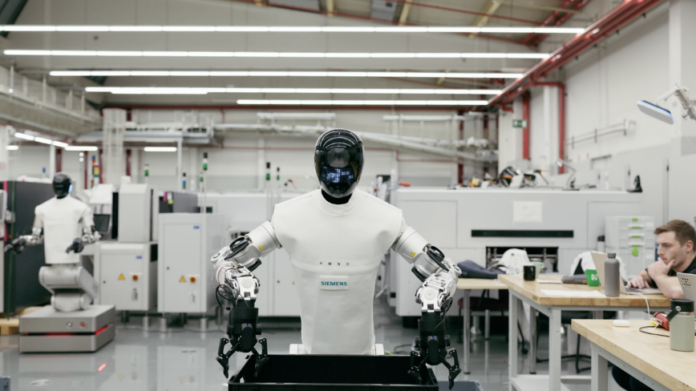
In a groundbreaking collaboration, Siemens, Nvidia, and the UK-based robotics innovator Humanoid have introduced an AI-driven wheeled humanoid robot into active logistics workflows at a Siemens electronics manufacturing site in Erlangen, Germany.
The HMND 01 Alpha robot autonomously executed tote-handling operations for over eight hours, achieving a throughput of 60 moves per hour and maintaining a pick-and-place accuracy exceeding 90%, seamlessly integrated with Siemens’ production infrastructure.
Revolutionizing Factory Logistics with AI-Powered Humanoids
Siemens, in partnership with UK robotics startup Humanoid and technology giant Nvidia, has successfully deployed an advanced AI-enabled humanoid robot within a live industrial logistics environment at Siemens’ Erlangen electronics factory. This marks a significant leap in the practical application of humanoid robotics on the factory floor.
Performance Highlights of the HMND 01 Alpha
The wheeled HMND 01 Alpha, developed by Humanoid and powered by Nvidia’s physical AI technology stack, autonomously managed tote destacking tasks continuously for over eight hours. It consistently moved 60 containers per hour while maintaining a pick-and-place success rate above 90%, demonstrating reliability and efficiency in a demanding production setting.
From Concept to Reality: The Significance of Live Factory Deployment
Unlike controlled laboratory tests, this trial took place in a fully operational factory environment, working alongside human operators and other automated systems. The robot’s ability to perform reliably in such a dynamic setting-with real production stakes-underscores the maturity of this technology.
The task itself, though seemingly straightforward-retrieving totes from storage, transporting them to conveyor belts, and positioning them for human workers-represents a class of repetitive, physically intensive jobs that have traditionally challenged automation due to variability and the need for real-time human-robot interaction.
Advanced Integration Through Siemens Xcelerator
The HMND 01 Alpha’s integration was facilitated by Siemens’ Xcelerator platform, which offers a comprehensive digital twin environment, AI-driven perception, programmable logic controller (PLC) interfaces, fleet management capabilities, and robust industrial communication networks. This infrastructure enabled the robot to synchronize its operations with production lines, other autonomous vehicles, and human collaborators in real time.
Technical Backbone: Nvidia’s AI and Simulation Tools
On the technology front, the robot leverages Nvidia Jetson Thor for edge computing, Nvidia Isaac Sim for high-fidelity simulation, and Nvidia Isaac Lab for reinforcement learning and policy optimization. This simulation-first development approach allowed Humanoid to reduce prototype development time dramatically-from the industry norm of 18-24 months to just seven months-by training and validating behaviors virtually before physical deployment.
Industry Leadership and Strategic Vision
Stephan Schlauss, Siemens’ Global Head of Manufacturing Motion Control, referred to the Erlangen facility as “customer zero,” highlighting Siemens’ strategy of piloting innovations internally before commercial release. Deepu Talla, Nvidia’s Vice President of Robotics and Edge AI, emphasized that this deployment “sets a new benchmark for humanoid robots achieving real-world production goals on active factory floors.”
About Humanoid and Its Robotics Portfolio
Founded in 2024 by Artem Sokolov, Humanoid operates from London with additional offices in Boston and Vancouver. The company employs over 200 engineers with backgrounds in leading technology firms. Besides the wheeled HMND 01 Alpha, Humanoid also develops a bipedal variant featuring 29 degrees of freedom and equipped with RGB cameras, depth sensors, and 6D force/torque sensors, designed for versatile manipulation tasks.
Previous Trials and Future Outlook
Prior to the Siemens deployment, the wheeled HMND 01 Alpha was tested in a proof-of-concept project with Schaeffler, where it handled metallic bearing ring picking. The Erlangen trial, conducted over two weeks in January 2026, represents the most rigorous real-world application to date.
While the companies acknowledge this milestone as a pivotal step toward industrializing physical AI, they have not committed to a specific commercial rollout timeline. Instead, Siemens envisions this as establishing a “factory-grade model” for humanoid robot deployment-a scalable reference architecture for the industry rather than a one-off demonstration.
Addressing Labor Challenges with Humanoid Robotics
This initiative aligns with a broader industrial trend where humanoid robots are increasingly viewed as vital solutions to labor shortages in manufacturing sectors. These robots excel in environments where fully automated production lines are impractical due to product diversity, safety considerations, or the necessity for close human-robot collaboration.
As manufacturing evolves, the integration of adaptable humanoid robots like the HMND 01 Alpha could redefine operational efficiency and workforce dynamics, offering a flexible alternative to traditional automation.