Agibot’s Vision: Integrating Advanced Robotics with an Open AI Ecosystem
In the rapidly evolving robotics industry, Agibot has emerged as a pioneer by simultaneously developing a robust hardware platform and fostering an open, collaborative ecosystem. This dual approach aims to accelerate the advancement of embodied intelligence-robots that not only perform tasks but also learn and adapt autonomously in diverse environments.
Milestones in Production and Software Innovation
By March 2026, Agibot celebrated a significant milestone with over 10,000 robots manufactured and deployed. Shortly after, at its April partner conference, the company shifted focus from hardware to unveiling a suite of innovative software solutions. These included six new AI models, seven productivity-enhancing applications, and the debut of the AIMA (AI Machine Architecture) full-stack ecosystem, designed to seamlessly integrate with Agibot’s physical robots.
“One Robotic Body, Three Layers of Intelligence” Framework
Agibot’s architecture is built around a single physical platform-the “one body”-enhanced by three distinct layers of intelligence:
- Motion Intelligence: The foundational layer responsible for precise and adaptive physical movements, enabling robots to navigate and manipulate their surroundings effectively.
- Interaction Intelligence: This layer facilitates natural, human-like communication, interpreting emotional cues, context, and environmental factors to engage users seamlessly.
- Task Intelligence: The highest cognitive layer, focused on planning, reasoning, and executing complex tasks to boost productivity across industrial, commercial, and domestic applications.
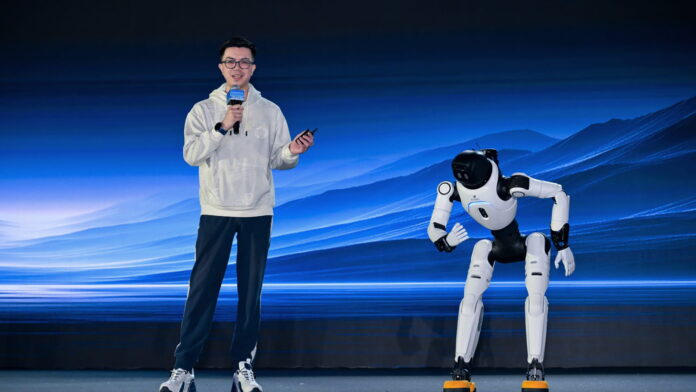
Peng Zhihui, Agibot’s president and CTO, emphasizes that without deep integration of intelligence with the robot’s physical form, machines remain mere tools rather than truly embodied agents.
Advancing Motion and Interaction Capabilities
Agibot is set to launch two groundbreaking foundation models in motion intelligence: a whole-body motion-control model that fuses sensory input with control mechanisms for adaptive movement, and a generative motion-control model capable of real-time action generation through multimodal interactions without relying on preprogrammed instructions.
In interaction intelligence, the upcoming WITA Omni 1.0 model promises to revolutionize human-robot communication. Building on the success of the original WITA model, it offers end-to-end multimodal interaction that retains nuances such as tone, context, and interruptions, enabling fluid and natural conversations.
Task Intelligence: The Core of Agibot’s Innovation
Task intelligence represents Agibot’s primary investment focus, where its top algorithm experts concentrate their efforts. The recently launched GO-2 model integrates a dual-brain architecture, the GE-2 action world model, and leverages the open-source Agibot World 2026 dataset alongside the Genie Sim 3.0 simulation platform and Genie Studio 2.0 development environment.
Looking ahead to Q3 2026, the GO-3 model will introduce the ViLLA architecture combined with an advanced world model, enabling sophisticated planning, simulation, reasoning, and execution capabilities. This model will operate on a data scale exponentially larger than its predecessor, enhancing robot autonomy and efficiency.
Strategic Growth Through the XYZ Curve Model
CEO Deng Taihua outlined Agibot’s growth trajectory using an XYZ curve framework:
- X Curve (2022-2025): The foundational phase marked by transitioning from prototypes to scaled production, culminating in the launch of the first humanoid robot and achieving 5,000 units produced by 2025.
- Y Curve (2026-2030): The expansion phase characterized by rapid deployment and scaling of interaction and task intelligence, with robot productivity nearing human levels and 10,000 units produced by early 2026.
- Z Curve (2030 and beyond): The maturity phase where robots become ubiquitous across industries, surpassing human productivity, accelerating learning rates, and potentially exhibiting swarm intelligence behaviors.
Agibot aims to generate revenues of approximately USD 146 million by the end of the X curve, escalate to USD 1.5 billion during the Y curve, and expand globally with ecosystem partners throughout the Z curve.
2026: A Pivotal Year for Robotics Intelligence
Peng Zhihui identifies three converging factors driving 2026 as a breakthrough year:
- Large AI Models: These models empower robots with enhanced perception and understanding, transitioning from isolated algorithms to components of an open-source ecosystem that accelerates innovation.
- Hardware Maturity: Agibot’s ability to mass-produce reliable robots capable of continuous operation underpins scalable deployment.
- Data Flywheel Effect: Increased robot deployment generates vast data, which in turn improves model training and performance, creating a self-reinforcing cycle expected to gain momentum this year.
This integrated strategy-mass production, iterative model development, open data sharing, and ecosystem building-is challenging but promises exponential returns.
Addressing the Data Bottleneck Through Openness
Despite advances, data scarcity remains a critical hurdle for embodied intelligence. Unlike language or image models that learn from abundant digital content, robots require extensive real-world interaction data, which is costly and complex to gather due to physical variables like friction and gravity.
To tackle this, Agibot’s subsidiary Maniformer launched a B2B data service platform aimed at pooling resources across robotics companies. Peng highlights that embodied agents consume more AI tokens than chatbots or image generators because they operate continuously in the physical world, demanding vast amounts of training data.
Yao Maoqing, Maniformer’s CEO, notes that while GPT-5 trained on approximately 100 trillion tokens, the total high-quality embodied intelligence data available globally equates to only about 500,000 hours-underscoring the urgent need for collaborative data collection.
Building a Collaborative Ecosystem for Standardization and Growth
Agibot advocates for an open ecosystem to collectively overcome data limitations, establish industry standards, and minimize redundant efforts. Peng stresses that increased open-source contributions facilitate ecosystem expansion and help set de facto standards, accelerating the entire field’s progress.
Conclusion
Agibot’s integrated approach-combining scalable hardware production, cutting-edge AI models, and an open data ecosystem-positions it at the forefront of the robotics revolution. As the industry moves toward more intelligent, autonomous machines, Agibot’s vision of embodied intelligence promises to transform manufacturing, logistics, services, and beyond.