Relu Robotics Unveils Advanced 9-Ton Robot for Solar Panel Installation in Harsh Environments
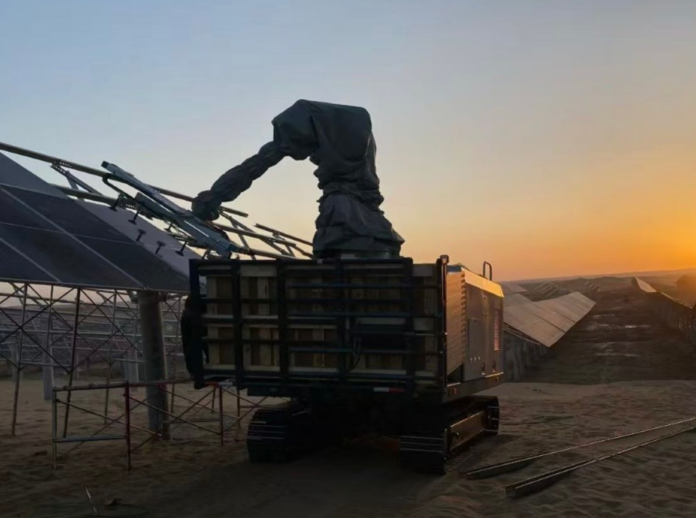
Beijing-based Relu Robotics has introduced a robust 9-ton robotic platform engineered to enhance precision in the handling and installation of photovoltaic (PV) modules. This cutting-edge machine is designed to operate seamlessly across challenging terrains such as deserts, sandy expanses, wastelands, hills, and slopes, even under extreme weather conditions.
Deployment in Algeria’s Large-Scale Solar Project
The company recently announced that its Bison Series robot is actively contributing to the construction of a major solar power facility in Algeria. This deployment highlights the robot’s capability to perform reliably in demanding outdoor environments characterized by intense sunlight, strong winds, sandstorms, rain, snow, and uneven ground.
Engineering Solutions for Extreme Outdoor Conditions
Operating in unpredictable natural settings requires overcoming significant technical hurdles. Relu Robotics addresses these challenges by integrating high-precision 3D sensing, advanced AI-driven decision-making, and adaptive motion control systems. These technologies collectively ensure the robot maintains stable, efficient, and accurate performance despite environmental uncertainties.
Technical Specifications and Performance Metrics
The Bison Series features a sturdy 9-ton tracked chassis that provides exceptional stability during outdoor operations. Its robotic arm supports payloads up to 50 kilograms and boasts an effective reach exceeding five meters. The proprietary 3D perception system achieves sub-3 millimeter accuracy in spatial recognition, with bracket-angle detection errors under 0.5 degrees. Installation precision is maintained within 5 millimeters, while repetitive positioning accuracy reaches sub-millimeter levels.
Designed for Remote and Rugged Solar Installations
Built to endure remote solar farm conditions, the robot can climb slopes up to 20 degrees and operate within a temperature range from -20°C to 60°C. It carries an IP54 rating for vehicle protection and IP65 for critical components, ensuring resilience against dust and water ingress.
Powertrain and Mobility Features
Measuring 5.2 meters in length, 2.1 meters in width, and 2.45 meters in height, the platform is powered by a hybrid system combining a 33.4 kWh CATL lithium battery with a 30 kW diesel range extender. Its steel track system, spanning 3.44 meters long and 0.4 meters wide, enables traversal over diverse surfaces including sand, desert terrain, and gentle slopes. The robot achieves a top speed of 4 km/h and can operate at altitudes up to 5,000 meters above sea level. Fuel efficiency is notable, with an average consumption of just 2 liters per hour.
Field Testing in Harsh Climates
Extensive field trials have been conducted in China’s Inner Mongolia and Xinjiang regions, areas known for extreme weather such as sandstorms, high heat, and wide temperature fluctuations. These tests validate the robot’s durability and operational reliability under severe conditions.
Extended Operation for Remote Construction Sites
Equipped with a 200-liter fuel tank, the Bison Series can sustain continuous operation for up to 10 days based on a standard 10-hour workday, consuming less than 20 liters of fuel daily. This endurance makes it ideal for remote solar installations where frequent refueling is impractical.
Integrated Workflow: Perception, AI, and Robotic Execution
The robot’s workflow is a three-phase process: first, its vision system detects PV modules, mounting structures, and environmental features; second, its AI control unit analyzes the data to plan optimal movement paths and precise positioning; finally, the robotic arm executes module pickup, transport, alignment, and installation with high accuracy.