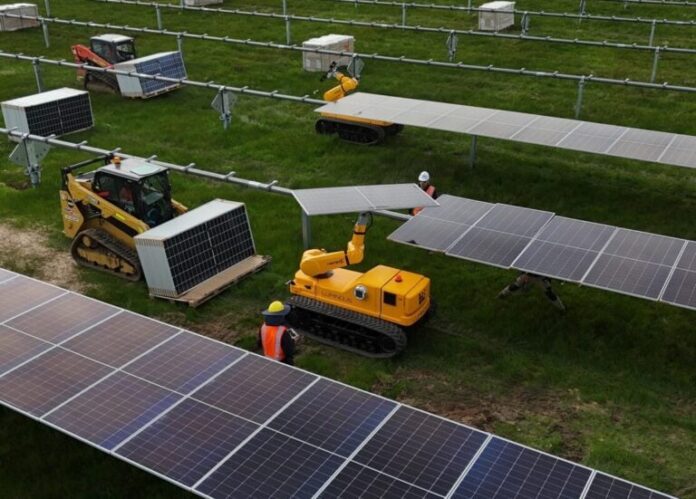
During the trial at the Goorambat East site near Benalla, the LUMI robot, which uses AI to place solar modules on racking structures, exceeded the target production rates.
Luminous stated that this deployment represents the Luminous Robotics technology’s first operation outside of the US, positioning Australia to be a testing ground for advanced construction automation. Engie confirmed, that with the AI-powered robotics, construction of the Goorambat East Solar Farm has advanced ahead of schedule.
The commissioning activities for the project began at the beginning of this month. First energisation is expected by the end October 2025. According to ENGIE, the full energisation is still scheduled for mid-2026.
Robotics demonstrates industry transformation.
LUMI system deployment was part of broader robotics tests at the Goorambat East location, which evaluated three robot systems including piling installer robots. The autonomous solar module placing technology demonstrated the potential to enhance productivity in utility-scale construction.
Justin Webb, Engie’s site representative, explained that the company had tested three robotic systems for installing pilings, and more recently, solar panels. The American company Luminous was testing its LUMI system outside the US for the very first time, and demonstrating the future in solar farm construction.
The productivity improvements of autonomous systems could lower renewable energy project costs, and enable faster construction timelines. This could potentially lower energy costs for consumers, and facilitate increased solar PV power plants development.
The robotics implementation addresses multiple industry issues including workforce safety and project efficiency. It also addresses construction in challenging environments.
“These robotics require skilled technicians to operate, upskilling current renewable energy workers and enabling greater productivity,” Webb said.
“The usage of autonomous robots could have large benefits for construction of solar farms, especially in remote and inhospitable locations, such as deserts, where climates can be dangerous for humans.”
According to Engie’s evaluation of the technology trial, long-term development robotic systems could reduce safety and health risks by reducing manual handling of heavy modules.
Luminous Robotics was awarded AU$4.9 (US$3.2) million by the Australian Renewable Energy Agency (ARENA) in July to support the development and deployment solar construction robotics. The funding allowed the company to conduct a first international trial on one of the most advanced solar markets in the world.
“By partnering with ARENA Bouygues and Equans Luminous was able deploy its first LUMI S4 Fleet during construction of ENGIE’s Goorambat East Solar Farm,” Jay M. Wong said, CEO and founder at Luminous Robotics.
Luminous’ Australian deployment enabled it to collect performance data and real world impact metrics that are needed to drive global adoption for automated solar construction technology.
Wong said, “We were delighted to showcase the future solar construction in Australia, the world’s most sophisticated solar market.”
Luminous Robotics plans to release solar construction’s biggest robotics dataset in the coming months as open source. The data sharing initiative is designed to accelerate the adoption of automated construction technology and support further innovation within solar installation robotics.
Wong explained that “deploying our LUMI Fleet in Australia allowed us capture the data, performance insight and real-world impacts needed to drive global adoption – the kind of scale we founded Luminous for.” Bouygues Construction Australia, Equans Solar & Storage Australia and Luminous are the primary contractors for Goorambat’s East Solar Farm. The partnership enabled robotics testing alongside conventional construction activities. Wong confirmed that “our LUMI robots have exceeded our target production rate, and with the support of ARENA we are eager to accelerate our next stage.”
ARENA announced the Solar ScaleUp Challenge, which will run for eight weeks starting on 19 June 2024. The initiative invited professionals across the international solar industry, including financiers, solar customers and engineers, to help remove barriers in installing, operating and maintaining solar PV systems.
The organisation launched its AU$1 billion Solar Sunshot Program later that year to support domestic module production. The first recipient of the scheme was revealed last month as 5B, a prefabricated ‘folding solar structure’ provider. PV Tech Premiumexamined the Solar Sunshot Initiative and Solar ScaleUp in PV Tech Power Volume 40.