
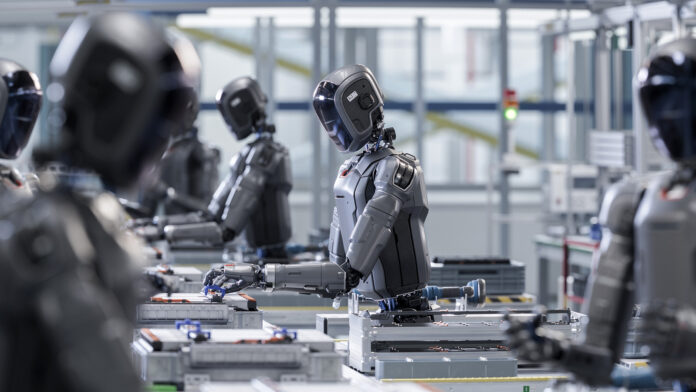
Humanoid robots are engineered machines crafted to mirror the human form and replicate certain human capabilities. Robotics engineers develop these systems with limbs and sensory equipment that enable them to operate effectively in environments designed for people.
Unlike conventional industrial robots confined to factory floors, humanoid robots are intended to collaborate directly with humans in everyday settings. Their anthropomorphic design allows them to perform tasks such as opening doors, utilizing tools, and engaging with human users.
Thanks to breakthroughs in artificial intelligence, machine learning, and robotic hardware, these robots are transitioning from speculative fiction to practical applications. Today, advanced humanoid robots are being trialed in homes, offices, and public venues.
Structural Design and Movement Capabilities of Humanoid Robots
Most humanoid robots are modeled after the human anatomy, featuring a head, torso, two arms, and legs that enable bipedal locomotion. This design facilitates natural, human-like movement patterns.
Advanced mechanical assemblies and actuators provide these robots with multiple degrees of freedom, allowing joints to move in various directions. This versatility is crucial for executing intricate tasks that demand fine motor skills.
Equipped with an array of sensors-including visual cameras, tactile feedback systems, and force/torque detectors-these robots can perceive their surroundings, modulate their grip strength, and maintain equilibrium in dynamic environments.
Integration of Artificial Intelligence and Control Mechanisms
Contemporary humanoid robots heavily depend on artificial intelligence to interpret their environment, track moving objects, and strategize their next moves.
AI training employs machine learning approaches such as imitation learning-where robots learn by observing human actions-and reinforcement learning, which enables them to refine skills through trial and error.
Real-time data processing pipelines and sophisticated control algorithms allow these robots to respond swiftly to sensory input, facilitating safe navigation in unpredictable settings and ensuring harmonious interaction with humans.
Leading Innovators in Humanoid Robotics
Numerous organizations and academic institutions are pioneering humanoid robot development. For instance, Boston Dynamics has engineered nimble robots capable of traversing challenging terrains with remarkable agility.
Agility Robotics has introduced Digit, a robot tailored for logistics tasks such as package delivery and warehouse material handling. Meanwhile, Pal Robotics focuses on humanoid platforms that serve as research and development bases.
Other notable contributors include SoftBank Robotics, Hanson Robotics, and Engineered Arts, which specialize in social robots designed for customer engagement, public interaction, and expressive communication through facial animations.
Practical Applications of Humanoid Robots
Humanoid robots are increasingly capable of undertaking manual labor traditionally performed by humans. Their robotic limbs and precise motor controls enable them to manipulate tools and handle various objects effectively.
In domestic environments, these robots are being trained to assist with chores such as tidying and organizing. Industrially, they support assembly lines by transporting components, assembling parts, and monitoring machinery performance.
Additionally, some humanoid robots can be remotely operated, allowing human controllers to leverage their mobility and strength in hazardous or remote locations, such as disaster zones or deep-sea exploration.
Prospects and Evolution of Humanoid Robotics
Experts anticipate that humanoid robots will initially find widespread use in sectors facing workforce shortages, where they can undertake repetitive or physically strenuous duties alongside human colleagues.
Ongoing research focuses on enhancing robots’ balance, autonomous movement, and fluidity of motion to enable seamless operation across diverse environments. Improvements in tactile dexterity and sensory perception are expected to foster more intuitive human-robot interactions.
Although fully autonomous humanoid robots are still emerging, steady advancements documented in recent robotics journals indicate a promising future. As AI technologies mature, these robots are poised to become indispensable aides in homes, healthcare facilities, and workplaces worldwide.