Presented by AGILINK.
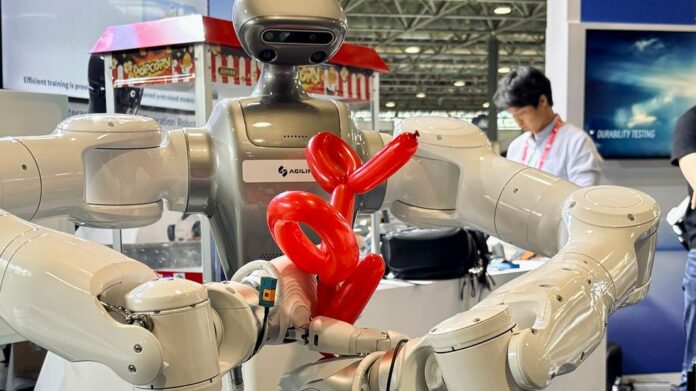
At the 2026 IEEE International Conference on Robotics and Automation (ICRA) in Vienna, one exhibit captivated attendees more than most: a pair of robotic hands meticulously crafting a balloon dog. The robots carefully twisted and looped a delicate balloon, avoiding any punctures, drawing crowds who often returned to witness the feat again.
AGILINK’s balloon animal demonstration captivated visitors at ICRA 2026.
While the activity might seem whimsical, balloon twisting is notoriously challenging for robotic systems. The balloon’s lightness, flexibility, slipperiness, and sensitivity to pressure make it a complex object to manipulate. Each twist alters its shape and internal tension, creating a dynamic interaction problem that evolves with every movement.
Humans perform these adjustments instinctively, rarely consciously managing grip force or slip. Robots, however, struggle to replicate this adaptability. The difficulty lies not just in positioning fingers correctly but in sustaining stable contact as the object’s properties continuously change.
Highlights from AGILINK’s ICRA 2026 showcase, featuring visuotactile sensing, intricate in-hand manipulation, balloon animal crafting, and other contact-intensive tasks powered by the OmniHand platform.
This demonstration underscored a pivotal insight in robotics: the most formidable challenges often arise after a robot makes contact with an object.
Integrating Motion Planning and Contact Dynamics in Robotic Manipulation
Balloon twisting exemplifies two intertwined challenges in robotics: executing extended sequences of precise movements and managing complex contact interactions.
First, the task demands long-horizon planning. Creating a balloon dog involves a series of carefully timed twists and folds, where early minor errors can cascade, jeopardizing the final shape. This requires the robot not only to perform individual actions accurately but also to maintain the viability of the entire manipulation sequence.
To tackle this, AGILINK collected motion data from expert balloon artists, translating their techniques into robotic control policies. However, mere replication of successful demonstrations was insufficient. The system also learned from moments when the robot’s actions began to falter, with human operators stepping in to correct errors in real time. These corrective interventions were integrated into reinforcement learning cycles, enabling the robot to develop resilience and recovery strategies.
AGILINK terms this capability motion intelligence: the proficiency to generate coordinated, bimanual actions and sustain complex manipulation sequences despite real-world uncertainties.
OmniHand 3 Ultra-M showcased at ICRA 2026.
Yet, motion intelligence alone does not solve the problem. The second critical aspect is managing contact forces and adapting to the object’s changing state. Robots must continuously modulate grip force, adjust contact points, and respond to subtle shifts in friction and deformation-tasks that are difficult to encode explicitly and often rely on human tactile intuition.
Analysis revealed that many failures stemmed not from incorrect action sequences but from loss of stable contact. To address this, AGILINK gathered data focused on contact interactions and incorporated it into the robot’s learning process. This enabled the system to understand how humans maintain stable contact and recover from instability.
This skill is defined as contact intelligence: the ability to establish, sustain, and adapt physical interactions as force distributions, friction, and object geometry evolve dynamically.
The distinction is crucial: motion intelligence plans what the robot aims to do, while contact intelligence ensures those plans remain physically feasible throughout execution.
YouTuber KhanFlicks studies OmniHand’s movements while learning balloon dog folding at the AGILINK booth.
Successful manipulation requires operating within a narrow window between slipping and bursting-a delicate balance of stability maintained through continuous sensory feedback and adjustment.
OmniHand 3 Ultra-M: Advancing Dexterity Through Enhanced Contact Sensing
While the balloon dog demonstration highlighted the potential of contact intelligence, it also raised questions about the limits of learning-based approaches. A robot’s ability to regulate contact depends heavily on its sensory inputs and mechanical responsiveness.
Recognizing this, AGILINK unveiled the OmniHand 3 Ultra-M at ICRA 2026, a robotic hand designed to push the boundaries of contact intelligence.
OmniHand 3 Ultra-M closely replicates the size and dexterity of a human hand.
About the size of an adult human hand, the Ultra-M integrates 20 active degrees of freedom within a compact form. Its standout feature is a fully direct-drive actuation system, which eliminates gear backlash and friction, enabling rapid and precise force control. This architecture allows the hand to respond swiftly to changing contact conditions, a critical factor in delicate manipulation.
Complementing its mechanical design, the Ultra-M is equipped with advanced tactile sensing across nearly its entire surface. Each fingertip houses a miniature vision-based tactile sensor, while over 300 three-dimensional tactile sensing points are embedded throughout the palm. This dense sensor array provides detailed data on contact location, pressure distribution, shear forces, deformation, and slip tendencies.
AGILINK reports that individual sensors can detect forces as subtle as 0.005 newtons-comparable to the weight of a single sheet of paper on a fingertip-with spatial resolution down to 0.04 millimeters and sensing densities reaching approximately 50,000 points per square centimeter.
OmniHand 3 Ultra-M discerning the texture of a feather through vision-based tactile sensing.
Traditionally, contact forces in robotic hands have been difficult to observe and quantify. The Ultra-M aims to make these interactions transparent, enabling robots to not only detect contact but also interpret how forces evolve and adjust manipulation strategies accordingly.
While the balloon dog showcased current capabilities, the Ultra-M represents a step toward the next generation of contact-aware robotic hands.
Why Mastering Contact is Essential for Real-World Robotics
The importance of contact intelligence extends well beyond balloon animals. Many tasks that remain challenging for automation-such as cable routing, garment folding, flexible packaging, precision assembly, connector insertion, tool handling, and household chores-involve unstable or deformable interactions.
These challenges arise not from reaching the correct position but from sustaining stable contact once interaction begins.
Historically, robotics has thrived in controlled environments where uncertainty is minimized. Factories are designed for predictable, repeatable motions. However, the real world is far less structured: objects shift, materials flex, friction varies, and contact conditions continuously change.
Consequently, a growing body of research is focusing on how robots can establish, maintain, and adapt physical contact in unpredictable settings. This shift recognizes that true robotic intelligence is measured by how well a system manages interaction dynamics, not just motion planning.
As robotic systems evolve to operate outside structured environments, mastering contact management will become as critical as motion control itself.