
When picturing robots in construction, many imagine the robotic arms on car assembly lines or humanoid machines mimicking human builders. Yet, these types of robots are not the most practical for efficiently constructing residential neighborhoods.
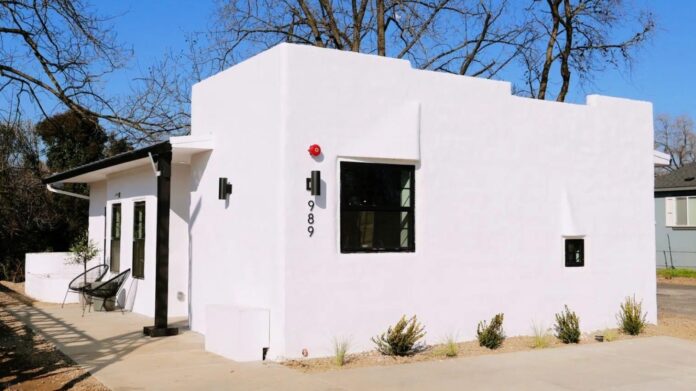
In California’s Yuba County, a groundbreaking approach is underway: massive 3D printers-each valued at approximately $1.5 million-are fabricating entire homes using concrete as their primary material. This innovative project is led by 4Dify (pronounced “fortify”), a company pioneering this technology. Nan Lin, the founder of 4Dify, shared that printing the initial 1,000-square-foot home took 24 days, but with experience, future homes could be completed in as little as 10 days.
As of early 2026, the first 3D-printed house in this community was listed for $375,000. Although this price is below Yuba County’s median home value of $450,000, the cost per square foot-$375-exceeds the county’s average of $268, reflecting the novel construction method’s current market positioning.
3D-Printed Neighborhoods: A Viable Path to Sustainable Housing?
Utilizing large-scale robotic 3D printers to build homes offers significant advantages, including reduced labor requirements, minimized material waste, and lower overall costs. While the Yuba County project is among the newest, the concept of 3D-printed housing has been gaining traction as a transformative force in construction for several years.
For instance, Icon, a company based in Austin, Texas, initiated the Wolf Ranch development in 2022, which now boasts 100 3D-printed residences-the largest such community globally. Icon’s portfolio extends to over 200 homes across five U.S. states and two countries. Notably, the first 3D-printed home in the United States to receive a certificate of occupancy was sold in 2021 for $299,999. This 1,400-square-foot, three-bedroom house includes two bathrooms and a 750-square-foot garage on a quarter-acre lot. That same year, Europe welcomed its first 3D-printed home, occupied by a pioneering couple.
The durability of these homes stems from their construction technique: concrete walls are extruded in continuous, layered ribbons, building up inch by inch from the foundation. According to Lin, these walls are robust enough to resist ballistic impacts from handguns and machine guns. Additionally, the structures are designed to be fireproof, pest-resistant, and impervious to mold. 4Dify’s founder also notes that insurance premiums for these homes tend to be lower compared to traditional houses, underscoring their resilience and safety.
While consumer acceptance of 3D-printed homes is still evolving, the combination of advanced materials, rapid construction, and sustainability features positions this technology as a promising solution to housing challenges worldwide.