Revolutionizing Ant Research with Advanced Imaging and AI Technologies
Leveraging cutting-edge X-ray technology, automated robotics, and artificial intelligence, entomologists have developed an extensive interactive digital archive featuring 212 ant genera and 792 species. This breakthrough offers unprecedented access to detailed 3D representations of ants, transforming the way researchers and educators study these insects.
Building a Comprehensive Digital Ant Repository
Julian Katzke, a researcher at the Okinawa Institute of Science and Technology, collaborated with global museums, academic institutions, and ant specialists to gather ethanol-preserved specimens. These samples were meticulously categorized by species and caste before being transported to the Karlsruhe Institute of Technology (KIT) in Germany for advanced imaging.
High-Resolution Imaging with Synchrotron X-ray Micro-CT
At KIT, the team utilized synchrotron-generated X-ray beams, which offer far greater intensity and resolution than conventional medical CT scanners. This technology enabled rapid, high-throughput micro-CT scanning of thousands of ant specimens. A robotic arm efficiently rotated and exchanged samples every 30 seconds, allowing the capture of detailed 2D image stacks that were later reconstructed into precise 3D models.
From Raw Data to Lifelike 3D Models
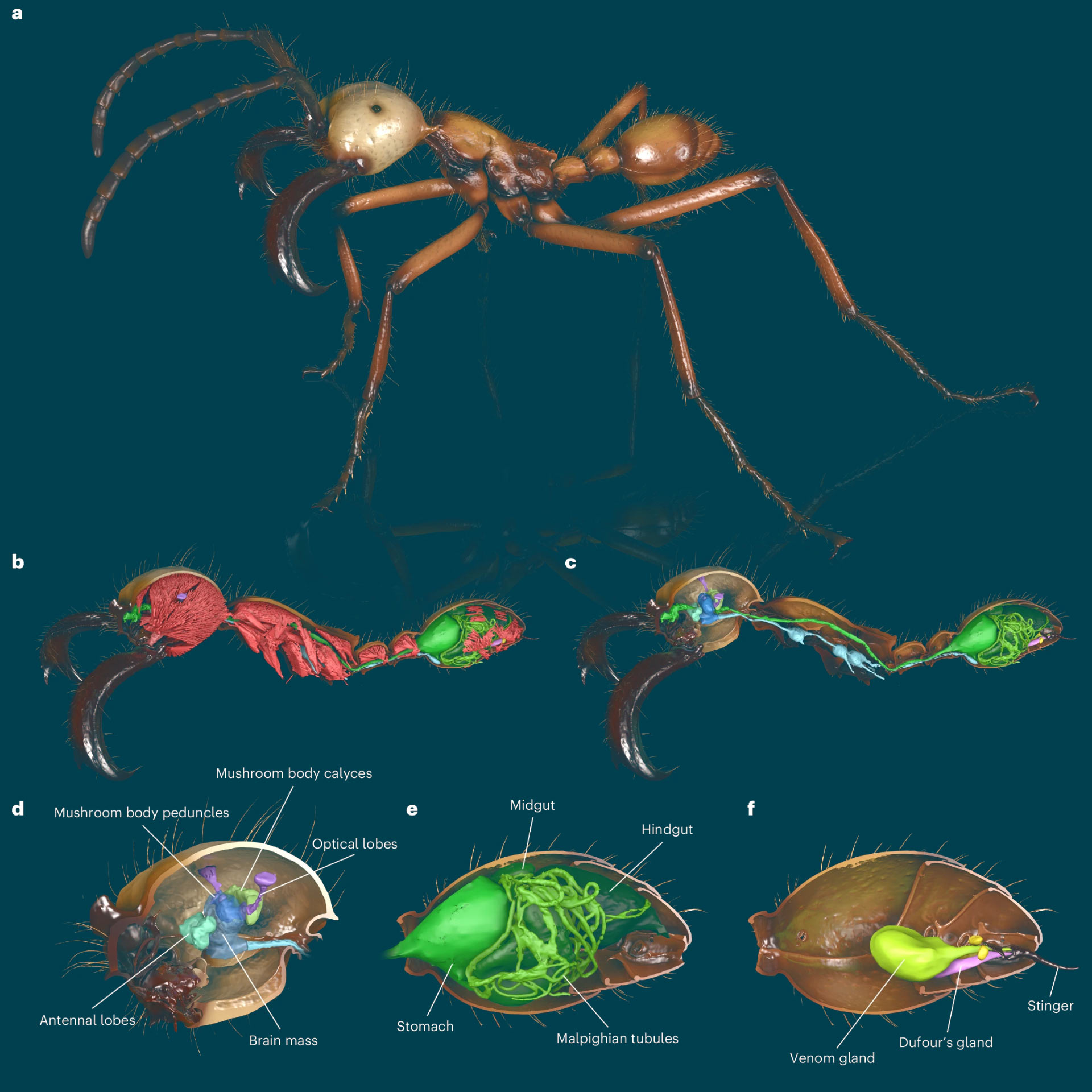
Initial scans produced images of ants in unnatural, contorted positions. However, through sophisticated computational processing, the researchers refined these into realistic 3D models that reveal intricate internal anatomy, including musculature, nervous systems, digestive tracts, and stingers, all at micrometer-scale resolution.
Applications Across Research, Education, and Entertainment
These detailed 3D ant models are not only valuable for scientific analysis but can also be animated or integrated into virtual reality environments. This versatility opens new avenues for educational tools, museum exhibits, and even digital media production.
Efficiency and Scale: A Leap Forward in Biodiversity Digitization
Dr. Katzke highlighted the remarkable efficiency of this approach: “Using a standard lab-based CT scanner, this project would have required six years of nonstop scanning. At KIT, we completed scans of 2,000 specimens within just one week.” Professor Evan Economo, affiliated with both Okinawa Institute of Science and Technology and the University of Maryland, emphasized the importance of automation and AI, stating, “Without these computational advancements, such a comprehensive digital archive would have been nearly impossible to achieve.”
Antscan: A Model for Future Biodiversity Projects
The initiative, named Antscan, sets a precedent for digitizing biological collections on a global scale. Professor Economo noted, “The implications extend far beyond ants. Digitized specimen libraries can revolutionize access to biodiversity data, benefiting scientific research, education, and even creative industries like film and gaming.”
The team’s findings were recently published in the journal Nature Methods, marking a significant milestone in the field of phenomics and biodiversity digitization.