From Robot Dogs to Humanoids : The Unexpected Rise of Unitree Robotics (19459000)
In 2025, Unitree Robotics will have completed its latest Series C funding round, attracting investments from Chinese tech giants such as Tencent, Alibaba and Ant Group. Its valuation will also surpass $1 billion. In February, just months before, a group of life-sized robots danced in sync with humans at the annual Spring Festival Gala. The humanoid robots, sleek black-and white figures that moved with uncanny accuracy, stole the show and captured a nation. Unitree Robotics was the young company that created those robots. It was a momentous occasion. Unitree Robotics, a young company that was born in a Hangzhou laboratory less than a year ago, has risen from obscurity to be at the forefront of an exploding robotics revolution. Its journey is a tech industry tale, a scrappy Chinese company taking on giants and betting on low-cost innovations to bring sci-fi robotics into the real-world.
Unitree’s CEO and founder, Wang Xingxing did not follow the typical script of a prodigy to founder. The Ningbo born Wang struggled in school – he repeatedly failed English exams and was at the bottom of the class. What he lacked academically, he made it up in his obsessive tinkering. Wang spent his meager allowance on parts to build model planes, homemade batteries and even a makeshift wind turbine. He almost caused a disaster when he left an electrolysis rig unattended in the family house overnight. The chlorine gas filled the air. This ingenuity, no matter how reckless, helped him find his true calling.
Wang discovered his passion for robotics at Zhejiang University and then in a masters program at Shanghai University. He was particularly interested in compact four-legged electric-motor-powered robots. In 2015, Wang entered a Shanghai robots design competition with a clunky canine prototype he fashioned from scrap metal and hobby engines. The “XDog” won second place and a RMB 80,000 (approximately $12,700) award. XDog also validated Wang’s belief that small, electrically actuated quadrupeds ( ) could be the future in robotics. He told Chinese media that “most innovations in society are amalgams”. You can combine the latest innovations from different industries to be cutting edge – and even be the best in world”
In 2016, Wang had already proven the concept to be a viable one in academia, but was worried that the market wasn’t prepared. He took a job at DJI as an engineer, putting aside his startup dreams. Then fate intervened. Videos of XDog performing trots, jumps and other tricks went viral on the internet. This attracted attention from tech circles as well as offers from companies that wanted to buy his design. The 26-year old decided to quit DJI instead of selling out and strike out on his own. Hangzhou Unitree Technology was founded in August 2016 with the help of an angel investor. The name is a combination of “universal” and “tree,” which reflects Wang’s vision for “growing” technology into all directions. The one-man-project was now a small company, with just three people in a tiny room. They were on a mission to democratize high performance robotics. Unitree has always been a company that focuses on cost-effective engineering. Laikago is a mid-sized quadruped robot named after Soviet space dog Laika. Laikago was immediately compared to the canine robots from Boston Dynamics. Unitree’s dog, unlike the DARPA prototypes of the American firm, was designed for mass production. It used off-the shelf electric motors and clever design to keep costs low – a radically differing philosophy from Boston Dynamics’ expensive, lab-bound machines.
Unitree’s core robotics timeline: Starting from Wang’s graduate project, “XDog”, (2013-2016), Unitree launched a series quadrupeds – Laikago (2017) AlienGo (2019),A1 (2020), and Go1 (2021), before venturing into the humanoids with H1 (2023) Unitree’s vertically-integrated engineering strategy reflects the fact that each generation has improved performance and reduced costs. Unitree’s early investment in vertical integration was crucial. Wang’s team, which consisted of just a few people, began developing their own core components, including high-torque motors, compact gear reductions, controllers and even LiDAR sensors, because there were so few suppliers who could provide affordable parts for cutting edge robots. Wang told investors that in 2021, “we optimized everything from mechanical structure and control algorithms to key hardware and supply chains under our control.” Unitree gained a manufacturing advantage by adopting this approach: By 2021, the company could sell a robot dog capable of performing tasks for as little RMB 16,000 ($2,500), which is roughly 1/20th of the price charged by Boston Dynamics’ Spot ($75,000+). The flagship Unitree go1, launched in mid-2021 was billed as “consumer grade” quadruped that anyone could purchase, complete with low-cost cameras and AI-powered following mode for jogging.
The gamble on affordability paid off. Unitree was the first company in the world to mass-retail high-performance quadruples, shipping hundreds to customers around the globe. By 2021, Unitree had shipped nearly 1,000 units worldwide – dwarfing the output of its older Western competitors. Researchers, tech enthusiasts and corporations from North America and Europe jumped at this opportunity to own a robot dog that was agile at a fraction the cost. The Wall Street Journal and the praised these low-cost robot dogs as a major accomplishment for Chinese tech. Many called Unitree the “Chinese Boston Dynamics”, as they marveled at the similar-looking machines emerging out of Hangzhou. Wang was offended by the comparison. He said, “When I made XDog between 2013 and 2015, [Boston Dynamics] had not even figured out electrical actuators,” he added, alluding the U.S. company’s reliance upon hydraulics at that time. We were the first to introduce four-legged robots…We might look like Boston Dynamics, but our path is different.”
Unitree’s path diverged because it prioritized pragmatism and not perfection. Robotics experts point out that Unitree’s real innovation is leveraging the Chinese supply chains to create low-cost high-performance and highly reliable versions of existing robot designs. Unitreehas essentially commercialized what was previously laboratory researchThis ethos was more Tesla than DARPA. It meant accepting some tradeoffs in cutting edge capability in exchange for immediate scaleability. It also encouraged a culture of constant improvement. Each new model incorporated lessons learned from the previous models, allowing it to close the performance gap between more expensive competitors. Unitree had a 60% share of the global quadruped market by 2023. They were also profitable every year since 2020, which is a rare feat for robotics startups. According to Wang, “quadruped robots are the best candidates to be the first bioinspired robots that enter everyday life”because of their balance between techiness and utility. Unitree was determined to make this prophecy a reality.
Unitree quietly sold robotics to researchers and early users, but it was the mass media moments which catapulted the company into the public consciousness. The first big break came on Chinese New Years Eve 2021. The show was the most watched in the country, and hundreds of millions tuned in that night to watch a skit featuring 24 robot “oxen” dressed in matching costumes. The horn-adorned performers, who were Unitree A1 quadrupeds nicknamed “Benben the Ox”, shared the stage with celebrities such as Andy Lau and Guanxiaotong. Their coordinated dance to ring-in the Year of the Ox won China’s hearts, earning Unitree an instant name recognition as the makers of the famous “robotbulls”. The Gala appearance triggered an interest and orders surge for the young company. Unitree’s showbiz adventure was just beginning. Unitree’s quadrupeds will be part of the high-tech display at the opening ceremony for the Beijing Winter Olympics in February 2022. This will symbolize China’s technological prowess. Unexpectedly, Unitree’s robotic dogs made their debut in the U.S. a year later. Jason Derulo, the pop star, was flanked during the 2023 Super Bowl’s pre-game show by a crew dancing robots who bopped and shuffled alongside human dancers. The nimble, electronic dancers were Unitree Go1 units. They were specially choreographed to perform at the NFL’s largest party. Unitree’s team was not surprised that a Chinese hardware company would be featured in “America’s Super Bowl”. The company proudly shared videos of its Go1s dancing on the Super Bowl stage. They noted how far their creations have come from Chinese factory floors to global pop culture arena. Unitree’s robots in action
: two Go1 quadrupeds retrieving a discus and javelin thrown during the athletics at the 2023 Hangzhou Asian Games. Unitree’s four legged robots were used as field assistants, fetching equipment. This task delighted spectators and demonstrated how robots could step in to mundane jobs at large events. *
Unitree’s fame is not all about games and fun. Robots from the company have been used in high-stakes situations. Unitree and the Chinese government worked together on pilot programs in 2022-2023 to use its quadrupeds as industrial inspectors and for emergency response. In one instance, the larger B2 model (an industry-grade, waterproof robotic dog) patrolled remote grid stations for State Energy Group. It navigated 500 kV Substations to check equipment measurements. Modified Unitree robots, which were used by a provincial fire department to test, scurried into dangerous zones that would have been too dangerous for firefighters. These early deployments showed that Unitree machines were more than just viral video fodder. They were becoming serious tools.
Unitree was a frequent visitor to tech expos, arenas and other events around the world by late 2023. The robots of Unitree appeared at the World Robot Conference and the World Artificial Intelligence Conference, both in Beijing. According to Chinese media, they even made a brief cameo at the 2024 Paris Olympics Handover Event. Each public appearance brought a mixture of astonishment, debate and a sense of wonder – were they mere gimmicks or glimpses of the robotic future? Wang acknowledged that showcase events have a dual purpose. They demonstrate real technological progress, while also generating buzz and “interim value” on the long road towards everyday robotics. He believes that having robots dance, perform flips, or even fight in robot combat tournaments, (another spectacle Unitree explored), helps fund and inspires the next phase where utility will be at the forefront.
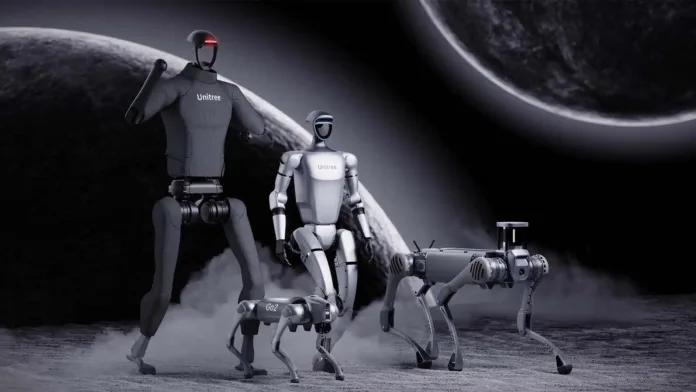
But nothing topped the spectacle Unitree put on in 2024. The company showcased its first humanoid robotic device to an international audience at the January CES technology show in Las Vegas. Attendees were able to test its balance by kicking it . The Unitree humanoid was a biped that stood 1.8 meters high. It walked and reacted to force. It impressed onlookers by being one of the few life-size humanoids on the CES floor. Tech vloggers were eager to stress-test H1 and found it to be remarkably robust. One proudly declared, “I kicked an 1.8-meter-tall humanoid robot!” Unitree’s humanoids arrived as pop culture guests in China the same month – appearing on CCTV to perform comedic roles during the 2024 Lunar New Year Gala. In a playful skit a H1 robot named “Fuxi”, introduced itself as a Gala comic, cracking jokes and dancing with human actors. The sight of an H1 robot bantering live on national television was both eerie and thrilling for viewers. Unitree’s bold evolution was also reflected in this video: from robot dogs trotting around the background, to humanoid robotics taking center stage. Unitree’s rapid and daring leap into humanoid robots was as fast as it was bold. Wang had been thinking about bipedal robots internally for years. He even built a crude one as a freshman at college in 2009, during winter break. The company waited until it had perfected its craft with quadrupeds (and improved its bank balance). This moment came in 2023. “We launched our project in 2023,” Wang stated, leveraging years of research and development on quadrupeds to develop the first bipedal protoype in just six month. Unitree H1, the full-size humanoid robotic dog, was unveiled in 2023. It was built with the same philosophy of its mechanical dogs, which is to keep it low-cost and iterate quickly. The specifications of
were ambitious. It was designed to be 1.8 m tall (5’11”) and weigh 47 kg. It could walk, run and sprint at speeds of up to 3.3m/s (7.4mph). This would set a new world record for full size humanoids. Internally, H1 used custom high-torque electric joints and an array of depth sensors, benefiting directly from Unitree’s experience in building agile quadruped limbs. In late 2023, Unitree quietly began small-batch production of H1 and shipped a few units to early clients . The company wasted no time pushing the envelope: within months, software updates enabled H1 to pull off feats like in-place backflips and aerial cartwheels, thanks to reinforcement learning algorithms and motion-capture training . Videos of a robot the size of a person doing somersaults – and “kip-up” jump-to-stand moves – went viral, blurring the line between science demo and Kung Fu film. By early 2024, Unitree declared that its humanoids had achieved “superhuman flexibility”, mastering martial arts-like sequences that garnered widespread attention online .
To broaden its reach, Unitree took a page from its quadruped playbook: it introduced a smaller, cheaper humanoid model aimed at research and education markets. In spring 2024, the company unveiled Unitree G1, a 1.27 m tall “mini-humanoid” priced around $16,000 – dramatically lower than the six-figure sums competitors were quoting for human-sized bots . The G1, essentially a scaled-down cousin of H1, made its debut at the ICRA academic conference in 2024 . With 13 degrees of freedom per leg and a 35 kg body, G1 isn’t meant to replace human laborers, but it offers labs and developers a robust bipedal platform at the cost of a mid-range car. Unitree began mass producing G1 by late 2024 , instantly positioning itself as a leading supplier of humanoid research robots by volume.
While heavyweights like Tesla have also promised general-purpose humanoids (Tesla’s Optimus project is famously in the works), Unitree’s head start in actually delivering units has made it one of the most watched players in this nascent field . By 2025, industry data showed Unitree’s humanoid shipment volume among the global leaders . In China, it is certainly the poster child of the trend. Wang believes the timing is right. “Within the next year or two, robots will acquire generalized capabilities for both commercial and household tasks,” he predicted in mid-2025, “such as tidying rooms and delivering items” . The company has already upgraded its bots with manipulator arms to, say, open doors or assemble simple components – incremental steps toward real utility . Still, Wang is realistic that the “ChatGPT moment” for humanoids – a breakthrough that truly brings robots into daily life – “still requires some time” . In the meantime, Unitree is content to push the envelope one demo at a time, confident that each spectacle (be it dancing or boxing robots) moves the needle on technology and public acceptance .
As Unitree scales up its humanoid ambitions, observers often draw parallels to other industry pioneers. One comparison is Tesla, in how both companies approach innovation through vertical integration and aggressive cost targets. Much like Elon Musk’s automaker rethought car manufacturing, Unitree has rethought how advanced robots can be built affordably. By designing nearly every part in-house – motors, chips, software – and owning its supply chain, Unitree controls costs and can iterate quickly . This strategy, combined with a willingness to embrace “good enough” components, allowed it to undercut competitors and sell robots by the thousand. “Our goal is to keep prices competitive while maintaining reasonable profit margins,” Wang told one interviewer, noting that as technology advances, the cost of quadrupeds (and now humanoids) will keep falling .
Another inevitable comparison is Boston Dynamics, the decades-old U.S. robotics lab famed for its jaw-dropping (and eye-wateringly expensive) machines. Wang has a nuanced respect for Boston Dynamics – admiring their technical feats but deliberately choosing a different path. “Boston Dynamics has been making robots for many years,” he said, “but I believed even before 2013 that hydraulic [actuation] couldn’t be commercialized – costs will never come down, and there’s always oil leakage.” For consumer and workplace robots, Wang insists electric motors are the only viable route, and on that front he feels Unitree had a head start. When Boston Dynamics announced in 2023 that it would retire its famous hydraulic humanoid (Atlas) to focus on an all-electric design, Wang wasn’t surprised – he wondered what took them so long . In effect, Unitree has tried to be to Boston Dynamics what a lean startup is to a government contractor: faster, cheaper, and more focused on real-world deployment.
Industry experts note that Unitree’s humanoids, while impressive, are not yet as advanced in autonomy or agility as Boston Dynamics’ showcase robots or Honda’s legacy Asimo. However, Unitree is narrowing the gap with astonishing speed, driven by China’s booming AI capabilities and its own engineering grit. “Previously, it took one to two years for a humanoid to learn to walk,” Wang said in 2024, “but now with large AI models, this can be achieved in a month.” He predicts that by the end of 2025, at least one company (perhaps his own) will unveil a general-purpose AI model for robotics, combining vision, language, and decision-making into a package that truly empowers autonomous helpers . If that happens, Unitree’s mix of good-enough hardware and improving AI could prove formidable, flooding the market with capable robots before more expensive rivals catch up.
Crucially, Wang’s vision extends beyond quadrupeds and humanoids: he speaks of an ecosystem of robots “of alternative forms” working together . Already, Unitree has branched into robotic arms (for fixed automation tasks) and even consumer gadgets like a motorized “fitness pump” device. In Wang’s ideal future, humanoids may build entire cities (he muses that governments could deploy 100,000 robots to construct a metropolis) while swarms of smaller bots handle microscale tasks, “even shrinking down to the size of cells” to transform our environment . It’s a sweeping techno-optimist view, one that aligns with his lifelong dream of “advancing society and human happiness through technology.”
For all the futuristic talk, Unitree’s credibility stems from tangible market traction – both in China and abroad. The company has proven adept at turning R&D into revenue. Since 2017, Unitree has deployed robots across dozens of industrial projects in China, carving out niches in energy, utilities, and public safety . Its robots patrol power plants and electrical substations, often in harsh outdoor conditions, transmitting real-time data and performing routine inspections that free up human technicians . In one pilot with State Grid, a Unitree dog autonomously navigated a 220 kV substation, using thermal cameras to check gauges and detect hotspots . And in a recent 5G-enabled “smart factory” trial, multiple humanoid robots were coordinated for assembly tasks over a wireless network – a demonstration of what multi-robot collaboration could look like on tomorrow’s shop floors . These early deployments, though limited, give weight to Wang’s claim that humanoids will first gain traction in industrial and commercial applications (not immediately in people’s homes) .
Internationally, Unitree has punched above its weight in reaching customers. It was the first company to sell quadruped robots directly online to the public, shipping to overseas buyers through its website and distributors as early as 2018 . By 2021, the Go1 model had pre-orders from over 30 countries . Academic labs from MIT to ETH Zurich bought Unitree robots as affordable research platforms; tech hobbyists in Silicon Valley and Berlin proudly unboxed their own robot dogs, sharing feedback that in turn helped Unitree refine its designs. The company’s global footprint is evident in its media coverage: Unitree devices have been featured by BBC and CNN, and reviewed by countless YouTubers. This grassroots adoption helped Unitree quietly dominate unit sales. According to an early investor, Unitree’s quadrupeds by 2025 made up more than 60% of the world’s installed base of legged robots . In other words, out of every 10 four-legged robots out there, at least six are likely from Unitree – an astonishing statistic for a firm barely nine years old.
One reason for this success is that Unitree cultivated multiple market segments. It sells slightly different robot variants for consumer, educational, and industrial use, tailoring price points and support accordingly . A tech enthusiast can buy a Go1 or Go2 dog and have it running within minutes of unboxing . A university might opt for an AlienGo or B1 model with open APIs for research, accepting a bit more setup time. For industry clients, Unitree offers on-site integration services (hence why an industrial deployment can take weeks to implement) . This segmentation ensures that from a high school robotics club to a state-owned enterprise, there’s a Unitree product to fit. The company’s aggressive pricing has forced others to respond – a dynamic much like how Chinese drone makers undercut competitors in the 2010s to dominate that market.
Unitree’s growing clout hasn’t gone unnoticed by China’s leadership and tech establishment either. In early 2025, Wang Xingxing was invited to Beijing for a high-profile private-sector summit hosted by President Xi Jinping, sharing the front row with titans like Huawei’s Ren Zhengfei and Xiaomi’s Lei Jun . The 35-year-old Wang was by far the youngest of the bunch, a symbolic inclusion signaling the government’s support for next-generation innovators. After the meeting, Wang spoke to media about the rapid progress of AI-powered robots and emphasized the need for AI models tailored to robotics . Around the same time, Hong Kong’s Chief Executive made a point to visit Unitree’s Hangzhou headquarters, even encouraging the company to consider a future IPO in Hong Kong . These nods from officials underscore how strategic China views humanoid robotics – as a frontier to conquer in the broader tech race.
The market momentum and strategic importance of Unitree have translated into a flood of investor interest, especially in the past two years. The company’s funding journey reads like a who’s-who of Chinese tech finance. It reportedly raised a small angel round in 2016 (just RMB 2 million) to get off the ground . By 2019, it secured a pre-Series A led by Sequoia Capital China’s seed fund, injecting several million RMB to ramp up production . A larger Series A followed in mid-2021 – Shunwei Capital (Xiaomi founder Lei Jun’s fund) led a multi-million dollar investment that valued Unitree as a rising star in frontier tech . At that point, Unitree had already delivered on its Gala fame and global shipments, making it one of the most promising robotics startups in China.