
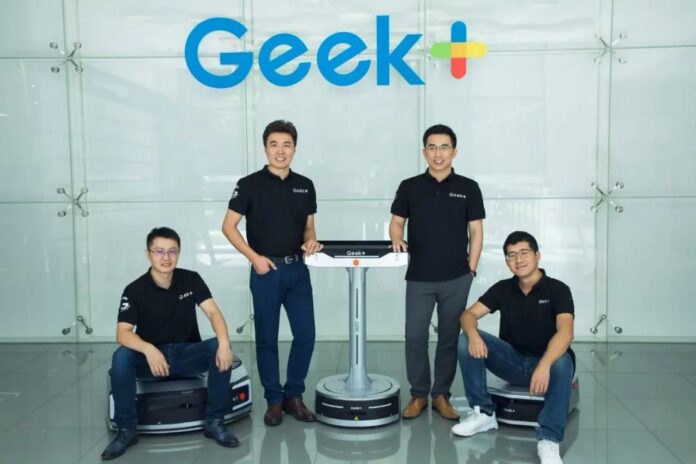
Ten years after founding Geek+ Yong Zheng took his company public at the Hong Kong Stock Exchange. The IPO raised a total of HKD 2.2 Billion (USD 281 million) at HKD 16.8 a share. This gives the company a market cap of more than HKD 22.18 Billion (USD 2.8B). Geek+ was among six companies that debuted on the exchange, highlighting a strong start for Hong Kong’s IPO industry. In the first half 2025, 44 companies were listed, raising more than HKD 100 billion ($12.7 billion).
Geek+ attracted a lot of investor interest. The Hong Kong public offer was oversubscribed 133.62-fold, and the international tranche 30.17-fold. This puts it among the three most oversubscribed international placements of the year, and sets a record for tech sector listing. The deal attracted investors from hedge funds, sovereign wealth funds, global long only investors, and tech-focused funds. The shares opened at HKD 16,96 (USD 2.2), an increase of 0.95%. This brings the company’s value to HKD 22,96 billion (USD 2.8).
Making of Geek+.
Zheng visited Amazon’s warehouse in 2014 as part of his job at New Horizon Capital. He was impressed by the sight and sound of robots working together. He returned to China to find a startup that did similar work. When he couldn’t find one, he decided he would build one. Zheng was well positioned by his background. Graduated from Tsinghua University, he worked for ABB, a global leader in robotics. He later served as factory manager at Saint-Gobain. He believed that logistics would be the sector to adopt robotics at a large scale.
In the same year, Amazon rebranded Kiva into Amazon Robotics and started internal deployment. It operates more than one million robots today, which is roughly equal to the number of warehouse workers.
Zheng recruited Li Hongbo as a co-founder. Li is a former Tsinghua Professor. Li, who has more than 15 years’ experience in robotics and holds over 130 patents became and remains vice president and CTO. He is the second-largest shareholder, with 25.71%.
Tsinghua FIT Building’s basement was the first location for the company. Later, two co-founders were added: Liu Kai was a former engineer from the Beijing Institute of Control Engineering and Chen Xi was a fiber optics and wireless communication specialist at Raisecom. Both hold 18.08% in the company. Zheng is still the largest shareholder, with 38.14%. The founding team has been together for the past decade.
Building From Scratch
Geek+ has received its first investment from Alog of RMB 10 Million (USD 1.4 Million). Volcanics Ventures and Gaorong Ventures each invested RMB 21,25 million (USD $3 million), pushing the valuation up to RMB210 million (USD 29,4 million).
Investors set a strict deadline for the team: launch a goods to person system by Singles’ Day in that year. The 20-person team managed to deliver in less than three months with only one prototype.
A Tmall supermarket was the first place where the robots were deployed as a proof-of-concept. Geek+ had already signed contracts with several e-commerce platforms by 2016, and was testing its autonomous mobile robots (AMR) commercially.
2017 was the company’s breakthrough year. It had completed its first international project, in Japan, and raised four funding rounds. It was one of China’s early AMR exporters. The company’s valuation was then between RMB 600 and 700 million (USD 84 to 98 million).
Geek+ entered Germany in 2019 and the US in 2019, building local teams. It closed a USD116 million Series C1 funding round, doubling the company’s valuation to USD560 million. Zheng explained the company’s global vision: “In each market we enter, it is not about whether we can win. We ask how long will it take to become the number one?
In 2020, the company raised USD 59 millions in Series C2 and USD 120 in Series D funding. The valuation reached USD 970 millions. Geek+ sold over 10,000 units that year.
Pandemic accelerated sales. The company sold 10,000 more units between 2020-2021. This was supported by a RMB225 million (USD31.5 million) Series-D+ round. The valuation rose to RMB 8.12 billion (USD 1.12billion).
In late 2021, Geek+ doubled its valuation again to RMB 15 Billion (USD 2.1 Billion) and closed Series E1 totaling RMB 1,195 billion (USD 167.3 Million), plus an extra USD 45 million. The IPO was the last capital raise.
The fund’s shareholders include major investors Warburg Pincus (11,86%), Granite Asia (6.19%) Ant Group (4.93%) and the China Greater Bay Area Technology and Innovation Fund (4.60%).
The other backers are V Fund, D1 Capital Partners (Vertex Ventures China), Redview Capital (Volcanics Venture), Gaorong Ventures (Sailing Capital), China Internet Investment Funds, Morgan Stanley, B Capital Group Hefei SASAC Focus Capital Qingyue Capital Yili, Haier ABC Capital Management CICC Capital and Hong Kong Science and Technology Parks Corporation.
Behind the robots: The business
Geek+ was the world’s leading provider of warehouse fulfillment AMR systems by revenue in 2024. It held a 9% share globally for the sixth consecutive year. Yet, its share of the warehouse automation market is still modest at just 1%.
It has over 800 clients in more than 40 countries and areas, including 63 Fortune Global 500 companies. It operates 48 service centers and 13 spare parts centres worldwide. In Hong Kong, a deployment for logistics company Stork Up was completed in just 12 days in order to meet peak shopping demand.
Geek+ will have delivered 56,000 units by the end of 2024. Over 70% of its revenue will come from overseas. The key verticals are e-commerce and fast-moving consumer products, as well as third-party logistics.
Local delivery and support has increased customer loyalty. In 2024, the company’s overall repurchase rates reached 74.6%. The rate for its key customers was 84.3%. This rate exceeded the industry standard.
US clothing distributor S&S Activewear upgraded its five fulfillment centers over three years using Geek+. UPS deployed over 1,000 AMRs on both US coasts.
The backlog is an important performance indicator for the robotics industry. Geek+ reported RMB 1.96 billion (USD 289.4 million), RMB 2.64 billion (USD 377.2 millions) in 2023, RMB 3.14 (USD 443.9 million) for 2024, and RMB 4.39.6 billion (USD 439.5 million) for 2025 (up 16.6%).
Revenues in 2022 were RMB 1.45 billion (USD 203.3 millions), RMB 2.143 (USD 301.9 millions) in 2020, and RMB 2.99 billion (USD 349.2 million) for 2023. This represents a compound annual rate (CAGR), of approximately 45%, from 2021-2024.
The net losses are decreasing: RMB 1.567 (USD 219.4 millions) in 2020, RMB 1.127 (USD 157.8 millions) in 2030, and RMB 832 (USD 116.5 Million) in the year 2024. In 2024, adjusted net losses fell to RMB 92 (USD 12.9) million with a loss margin of only 3.8%.
Zheng identified two key milestones – surpassing 50,000 units annually and using robots in three out of ten warehouse projects. Both seem to be within reach.
Geek+ is the leader of all B2B robots companies listed on Hong Kong’s exchange with revenue of RMB 2,4 billion (USD 336, million) in 2024. Regionally, revenue was divided between Asia Pacific (28.1%), the US (26.1%), and EMEA (17.9%).
The overseas gross margins were over 46% and the warehouse AMR margins were above 39%. Due to price competition, the industrial handling AMR margins dropped from 18.4% to just 12.1%.
According to Geek+, its main global competitors are Hikrobot Exotec and Locus Robotics. Hikrobot is still the main competitor in industrial logistics in China, while Geek+ has a significant advantage in warehouse fulfillment and global reach.
According to the global warehouse AMR market, it grew from RMB 7,9 billion (USD 1,1 billion) in 2020 up to RMB 24,3 billion (USD 3,4 billion) by 2024. It is expected to reach RMB 1 trillion in 2029, with a CAGR exceeding 32.4%.
Commercializing robots in a difficult market
Startups that specialize in robotics and AI must likely overcome four hurdles: product reliability, cost-efficiency, and market readiness. Many startups never make it past all four hurdles.
Boston Dynamics, despite its high visibility, had to go through multiple owners, and spent more than USD 500,000,000 before it focused on logistics robots.
Few B2B robotics companies have scaled in China. Consumer brands such as DJI and Roborock have a better reputation. In B2B the landscape is still changing.
Companies like Hai Robotics and Horizon Robotics as well as UBTech and Seer Robotics continue to chase commercialization and scale. Some have turned to humanoid robotics and embodied intelligent, but most efforts are still in the early stages.
The Geek+ is an outlier. It offers a blueprint for scaling AMR into a sustainable business.
KrASIA Connection includes translated and adapted material that was originally published 36Kr. This
Xiao Xi wrote the article for 36Kr.