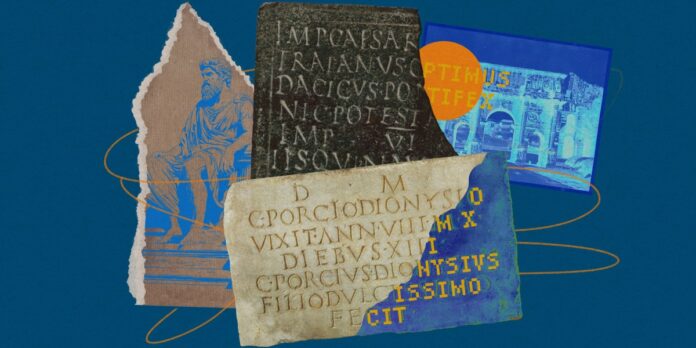
Google DeepMind has unveiled new artificial-intelligence software that could help historians recover the meaning and context behind ancient Latin engravings.
Aeneas is able to analyze words in old-weathered stones and determine when and where they were inscribed. It is a follow-up to Google’s previous archaeology tool
Ithaca (19459009), which used deep learning for the same purpose, to reconstruct and contextualize ancient texts, in this case Greek. While Ithaca uses similar systems to Aeneas, Aeneas promises to provide researchers with jumping-off points for more analysis. Aeneas uses a combination of partial transcriptions and scanned images to do this. It can then provide possible dates and locations of origin for the engraving as well as fill ins for missing text. Aeneas would guess that a slab with … us populusque Romanus and Senat before us creates the phrase Senatus populusque Romanus“The Senate and people of Rome.” This is similar to the way Ithaca works. Aeneas compares the text to a database of 150,000 inscriptions from all over the world, including Britain and Iraq today, to find possible parallels. This database, along with a few thousand images, is used to train Aeneas’s deep neural network. It may seem like an impressive number of samples but it pales in contrast to the millions of documents that are used to train large language models for general-purposes like Google’s Gemini. There are simply not enough scans of inscriptions in high quality to train a model to perform this task. Aeneas is a good example of a specialized solution.
According to Yannis Assael a Google DeepMind researcher who worked on the Aeneas project, the Aeneas Team believes that it could help researchers “connect the past”. Assael and his colleagues, rather than automating epigraphy – the research field that deals with deciphering inscriptions – are interested in “crafting an tool that will integrate into the workflow of a history” he said in a recent press briefing.
The goal is to provide researchers with many hypotheses from which to work when analyzing a particular inscription, saving them time and effort in sifting records by hand. To validate the system the team gave 23 historians inscriptions which had already been dated. They then tested their workflows with and without Aeneas. The findings were published inNaturetoday. They showed that Aeneas sparked research ideas for 90% of the inscriptions, and it helped determine where and when they originated.
The researchers also tested Aeneas against the Monumentum Ancyranum, a famous inscription inscribed into the walls of an Ankara temple. Aeneas was able to provide estimates and parallels which reflected the existing historical analysis. The paper claims that in its attention to details, it closely matched the way a trained historian would tackle the problem. Thea Sommerschield said, in a press briefing, “That was jaw dropping.” She is an epigrapher from the University of Nottingham, who worked on Aeneas.
But much remains to be determined about Aeneas in the real world. It can’t read texts and therefore cannot interpret newly discovered engravings. According to Kathleen Coleman, professor of classics at Harvard, it is not yet clear how useful the software will be in the future for historians. Aeneas is able to read the Monumentum Ancyranum, which is one of the most studied and well-known epigraphic inscriptions. This raises the question of whether it can handle more obscure samples. Google DeepMind now has made Aeneas available as open-source. The interface is also freely available for teachers, museum workers, academics, and students. The group is working closely with Belgian schools to integrate Aeneas in their secondary history curriculum.
“To be able to have Aeneas by your side in a museum or archaeological site where you just found a new inscription–that’s our kind of dream scenario,” Sommerschield stated.