
Unveiling the Enigma of the Queen’s Chamber Shafts in the Great Pyramid
Deep within the Great Pyramid of Giza lies the Queen’s Chamber, home to a pair of narrow shafts, each scarcely wider than a small dog, that ascend diagonally into the pyramid’s shadowy interior. These shafts, discovered in 1872 by a British engineer, have long baffled archaeologists and historians alike. Both the northern and southern shafts were sealed with bricks and appeared to terminate inside the pyramid, with no visible exits on the exterior walls. This raised enduring questions: What was their destination? What purpose did they serve? And how could they be explored?
Innovative Robotic Exploration: The Pyramid Rover Mission
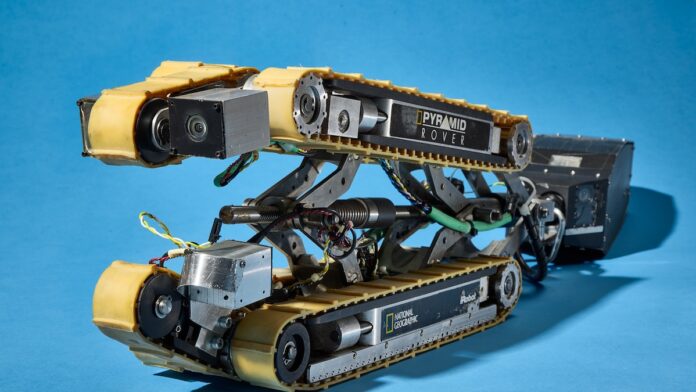
It wasn’t until 2002 that a breakthrough came, thanks to a collaboration between National Geographic and engineers from iRobot. They deployed the Pyramid Rover, a versatile robotic crawler equipped with treads capable of gripping both the floor and ceiling of the shafts. The team arrived in Giza armed with over a dozen cases of equipment, including a milling machine for on-site fabrication of custom parts. The shafts’ uneven surfaces posed significant challenges, prompting the engineers to design and attach miniature ramps to help the rover navigate obstacles.
When the rover encountered a limestone block approximately 210 feet up the southern shaft, it was outfitted with a specialized drill to bore a small exploratory hole. This patient, step-by-step approach involved continuous upgrades and adaptations, with the milling machine often set up on the hotel patio to manufacture new components overnight, as recalled by Christian Weagle, a former iRobot engineer involved in the project.
Discoveries Beyond the Obvious: A Hidden Chamber and Ancient Marks
In September of that year, after weeks of meticulous probing, the rover was sent once more to the shaft’s end, this time carrying a fiber-optic camera. The camera was carefully guided through the drilled hole, unveiling a small, empty chamber to a live television audience. Although the chamber’s function remains a mystery, the mission yielded a remarkable find: red ocher masons’ marks etched into the limestone walls, dating back to the pyramid’s original construction over 4,500 years ago.
Weagle describes the profound impact of witnessing these ancient inscriptions firsthand, emphasizing how they serve as a tangible connection to the pyramid’s builders-testaments to their ingenuity and problem-solving during an era of monumental architectural challenges.
Continuing the Legacy of Exploration
These findings highlight the fusion of modern technology and ancient history, demonstrating how robotics can unlock secrets hidden for millennia. The Pyramid Rover’s journey not only advanced our understanding of the Great Pyramid’s internal architecture but also inspired new methods for archaeological investigation worldwide.
For those interested in exploring these discoveries further, the National Geographic Museum of Exploration, opening June 26, offers an immersive experience showcasing artifacts and stories from this groundbreaking mission. Visit natgeo.org/moe for more information.