
Revolutionizing Robotics: How a Chinese Startup is Outpacing Global Competitors
In 2023, a modest Chinese startup launched with an initial capital of just 1 million yuan (approximately $142,000), setting out to challenge the global robotics landscape. Despite its humble beginnings, this company has rapidly advanced in the field, showcasing innovations that rival those of industry giants.
From Startup to Industry Leader in Under Two Years
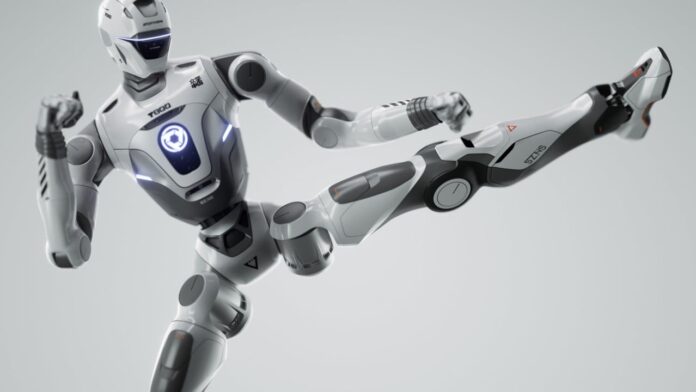
EngineAI Robotics, under the leadership of CEO Zhao Tongyang, has developed the T800 robot, a machine capable of delivering powerful roundhouse kicks reminiscent of martial arts legend Bruce Lee, with force comparable to that of a small vehicle. This impressive feat was first tested on the company’s own CEO, highlighting the confidence in their technology.
Surpassing Expectations: A New Benchmark in Robotics Performance
While Elon Musk’s Optimus robot recently made headlines for managing a few jogging steps before falling during a live demo, EngineAI’s T800 has already demonstrated peak torque of 450 Nm, showcasing superior strength and agility. The startup introduced the SA01 model last year, and plans are underway to mass-produce a solid-state power source by 2026, promising four to five hours of continuous operation combined with human-like dexterity.
China’s Robotics Ecosystem: A Powerhouse of Talent and Manufacturing
Backed by China’s extensive engineering expertise and the efficient supply chains of the Pearl River Delta, EngineAI Robotics exemplifies how the country is rapidly transforming science fiction into reality. Unlike many American robotics projects that remain confined to laboratories and factories, Chinese companies are actively deploying robots in diverse environments such as stadiums, manufacturing plants, and martial arts arenas. This approach is fueling an industrial revolution characterized by unprecedented scale, speed, and system integration.
Real-World Applications and Industry Impact
Chinese robotics firms are not only pushing technological boundaries but also demonstrating practical applications that resonate with everyday users. For example, Guangdong Xiaopeng, another prominent manufacturer, recently addressed misconceptions about its humanoid robots, emphasizing their role in enhancing productivity and safety rather than replacing humans.
Looking Ahead: The Future of Robotics in China and Beyond
With continuous advancements and increasing investment, China’s robotics sector is poised to lead the next wave of automation and intelligent machines. By 2026, the integration of long-lasting power sources and refined dexterity will enable robots like the T800 to perform complex tasks in dynamic environments, potentially revolutionizing industries ranging from manufacturing to entertainment.