
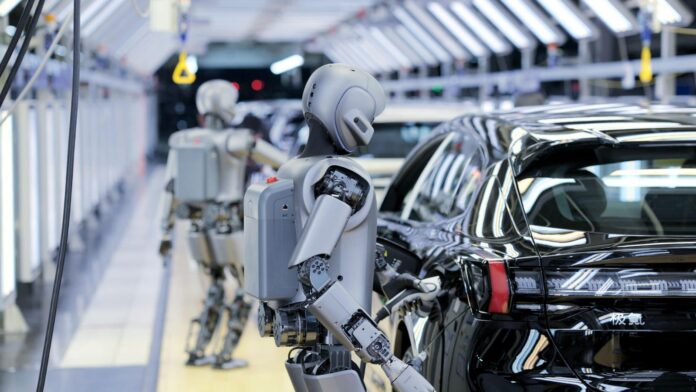
UBTECH humanoid robot operating within Zeekr’s advanced manufacturing facility in China.
VCG via Getty Images
Are Humanoid Robots Poised to Revolutionize Factory Work?
Investment in humanoid robotics is surging, with global spending on this ecosystem approaching an estimated $300 billion. Leading companies such as NEURA Robotics, which recently secured $1.4 billion in funding, alongside Figure, Apptronik, and a newly minted European unicorn, are spearheading this wave. Meanwhile, prominent Chinese manufacturers like Agibot, UBtech, and Unitree are actively deploying humanoid robots in industrial environments, often through pilot programs. Notably, Agibot’s G2 model is already integrated into a live production line, a milestone the company has publicly showcased via live streaming.
Humanoid Robots and Labor Unrest: A New Dimension
Concerns about humanoid robots replacing human workers have already sparked labor tensions. For instance, a recent strike at Hyundai was partly fueled by apprehensions over humanoid automation threatening jobs. This raises a critical question: are humanoid robots genuinely the future backbone of manufacturing, or are they simply another overhyped technological trend destined to fade?
Insights from Industry Veteran Jeff Burnstein
Jeff Burnstein, president of the Association for Advancing Automation (A3) for nearly two decades and a veteran of over 40 years in robotics, offers a balanced perspective. Having witnessed the evolution from rudimentary industrial robot arms to today’s AI-powered machines, Burnstein acknowledges the current excitement but tempers expectations.
“We’re definitely in the midst of a hype cycle,” Burnstein explains. “So far, the only humanoid robot I know of in active U.S. production is an Agility robot operating at a GXO Logistics facility.”
Despite this, he recognizes the rapid technological strides made recently. Robots have evolved from simple grippers to machines capable of delicate tasks like frying eggs or wiring components.
“Artificial intelligence is accelerating progress dramatically,” he adds. “The potential for enhanced dexterity and smarter robots is closer than many anticipate.”
Evaluating the Current State of Humanoid Robotics in Industry
Most humanoid robot deployments remain in experimental phases, with pilot projects achieving only 20% to 50% operational efficiency, according to Burnstein. This falls short of the near-perfect reliability manufacturers demand-typically above 99%-to justify widespread adoption.
Interestingly, UK-based startup Humanoid Robotics is closing the gap, reaching approximately 80% of human speed in certain manual tasks and aiming to surpass full human equivalence soon.
Crucially, manufacturers prioritize functionality over form. Whether a robot walks on two legs or rolls on wheels is secondary to its ability to deliver dependable, cost-effective solutions.
“Clients want proven, reliable technology that improves their operations,” Burnstein emphasizes. “The humanoid shape is less important than performance and affordability.”
However, the most significant barrier to scaling humanoid robots is safety. Currently, no standardized safety protocols exist specifically for humanoid robots, causing hesitation among insurers and regulatory bodies like OSHA. Most operational humanoids are physically segregated from human workers by barriers, and a single accident could stall the entire sector’s growth.
Traditional industrial robots-large, fast, and highly precise-continue to dominate manufacturing tasks and will expand their role. Humanoids will find niches in factories, warehouses, logistics centers, agriculture, and even domestic settings, but it’s unlikely we’ll see factories staffed by thousands of humanoid robots anytime soon. The question remains: how many will be integrated?
Reframing the Robots and Employment Debate
The impact of robots on jobs is a perennial concern. On my Next with John Koetsier podcast, I often discuss how AI threatens white-collar roles while robots target blue-collar jobs, potentially leading to universal basic income scenarios.
Burnstein’s extensive data, however, tells a different story. The Association for Advancing Automation has tracked U.S. robot sales alongside employment trends for over 30 years, revealing that increased robot adoption correlates with lower unemployment rates. The rationale is straightforward: automation boosts productivity, enabling companies to grow and hire more staff.
“The real threat to jobs isn’t robots-it’s losing competitive edge,” Burnstein asserts.
He recalls the 1980s dilemma companies faced: automate, relocate production overseas, or disappear. Many chose offshoring but still failed. Today, nearly 500,000 manufacturing positions remain unfilled in the U.S., a figure projected to rise to 1.9 million by 2033. The challenge lies in attracting workers willing to perform physically demanding tasks like warehouse labor.
Consequently, job roles are evolving toward supervising, installing, and maintaining robotic systems-professions that didn’t exist a generation ago, much like SEO specialists or mobile app developers.
Geopolitical Stakes in the Race for Humanoid Robotics
National strategy plays a pivotal role in the robotics landscape. China currently operates approximately 54% of the world’s industrial robots-around two million units-achieved through decades of strategic five-year plans aimed at dominating both usage and production of robotics technology.
The U.S. pioneered robotics, with the first industrial robot installed by Unimation in 1961 and over 100 American companies active in the 1960s and ’70s. However, Japan’s national robotics strategy in subsequent decades led to a migration of the industry, leaving the U.S. with a single major robotics firm.
Burnstein believes emerging technologies like humanoid robots, autonomous mobile robots, and collaborative robotic arms represent a fresh opportunity for the U.S. to reclaim leadership. Legislative efforts to establish a National Robotics Commission are underway, though their future remains uncertain.
Humanoid Robots in the Home: A Tough Market to Crack
When asked if he would welcome a humanoid robot into his own home, Burnstein is skeptical.
“I find it hard to justify,” he admits.
Decades after the debate between robotics pioneer Joe Engelberger and iRobot’s Colin Angle, only one home robot has achieved mass-market success: the robotic vacuum cleaner. Angle’s strategy of creating affordable, single-purpose devices proved winning.
In contrast, a $20,000 humanoid robot designed to fold laundry faces a steep uphill battle. “I can fold my own laundry,” Burnstein notes. “That’s not a compelling enough reason for most consumers.”