
Humanoid Robots in 2026: Focusing on Practical Roles and Commercial Viability
As we approach 2026, the true test for humanoid robots lies not in flashy demonstrations but in their ability to perform well-defined tasks with measurable results, serving customers who see tangible value and are willing to invest.
Investor Buzz vs. Real-World Utility
The field of embodied intelligence has attracted significant investment this year, with numerous funding announcements and impressive showcases featuring robots walking, dancing, or playing sports. However, beneath these captivating displays is a critical question: how many of these robots can reliably perform useful work on a large scale?
Many companies remain preoccupied with perfecting human-like appearance and movement, yet the path to scalable commercial deployment-one that delivers consistent returns and dependable operation-remains elusive.
Keenon Robotics: Grounding Innovation in Customer Needs
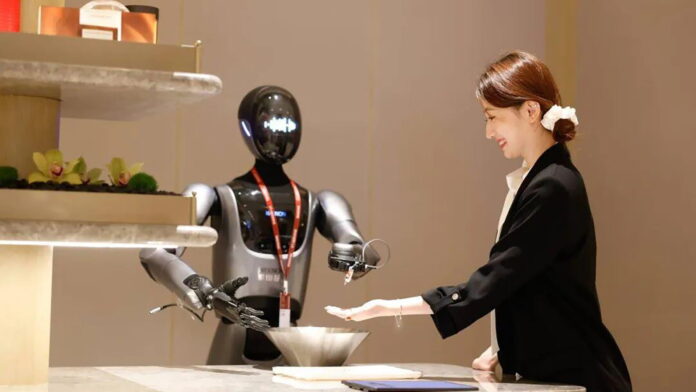
With 16 years of experience and over 100,000 units deployed worldwide, Keenon Robotics offers a pragmatic approach. Their recent launch of the compact humanoid robot Xman-L1 at a streetwear event fills a niche between their full-size humanoid models, which handle core service functions, and smaller robots designed for lightweight interaction and agile movement.
Li Tong, CEO of Keenon Robotics, emphasizes that customers prioritize solutions that address their challenges cost-effectively, regardless of whether the robot is humanoid or not. “Our focus is on deploying the most effective tools to solve customer pain points, even those they may not explicitly express. Humanoid robots are simply another option in our toolkit,” he explains.
Demand-Driven Development: Starting with Real Problems
Unlike many startups that chase technological breakthroughs first and then seek applications, Keenon reverses this process. Their strategy begins with identifying specific customer challenges, then applying technology to address those needs, selecting the robot form best suited for the task.
This customer-centric approach is informed by extensive experience in high-density service environments such as hotels, restaurants, supermarkets, and hospitals. While specialized robots excel in delivery, cleaning, and transport, they fall short in handling dynamic, interactive, and multi-task roles that require mobility, manipulation, and communication simultaneously.
Bridging the Service Gap with Role-Based Robots
Service settings are inherently unpredictable. For example, hotel guests may request directions or report issues; restaurant patrons might ask for extra utensils or inquire about menu items; supermarket shoppers often need assistance locating products. These tasks demand flexibility and real-time interaction, areas where specialized robots struggle.
Li notes that these service gaps are increasingly difficult to fill with human labor due to rising costs and workforce shortages. “Specialized robots handle repetitive tasks efficiently, but the more complex, flexible roles still rely on people. This gap is widening as labor becomes more expensive,” he says.
Balancing Specialized and General-Purpose Robots
Keenon advocates a hybrid model combining specialized robots optimized for repetitive, standardized tasks with general-purpose humanoid robots capable of handling diverse, interactive roles. Specialized robots operate on an efficiency model, focusing on single tasks with minimal redundancy, while humanoid robots follow an amortization model, performing multiple roles throughout the day to maximize utilization.
For instance, a humanoid robot might greet guests in the morning, assist diners at lunch, manage interactive displays in the afternoon, and deliver items in the evening. Although less efficient at any one task compared to specialized robots, their versatility can improve overall return on investment.
A Tiered Product Strategy for Diverse Service Needs
- Specialized robots continue to dominate standardized tasks like delivery and cleaning, providing steady revenue streams.
- Full-size humanoid robots address core commercial roles in complex environments such as hotels, supermarkets, and restaurants, offering capabilities in mobility, manipulation, and interaction.
- Compact humanoid robots focus on lightweight, flexible applications including greeting, customer interaction, and dynamic displays.
This layered approach allows Keenon to meet a broad spectrum of service demands, from high-frequency routine tasks to more nuanced, flexible roles.
Prioritizing Safety and Stability with Wheeled Designs
While many companies invest heavily in bipedal humanoid robots for their human-like appeal, Keenon favors wheeled platforms for commercial deployment. Their extensive operational experience shows that wheeled robots offer superior stability and safety, especially in crowded public spaces where falls could cause injury and liability issues.
Li explains, “If a bipedal robot loses power, it risks falling and potentially harming people. Wheeled robots, however, remain upright and stationary, making them safer and more practical for large-scale use.”
Commercialization: The Ultimate Benchmark
Technical sophistication and lifelike movement may generate buzz, but true competitive advantage in robotics comes from end-to-end commercialization-mass production, reliable deployment, ongoing support, and profitability in real-world settings.
Keenon’s 16 years of industrial experience have built a robust foundation in scenario adaptation, engineering-driven manufacturing, global logistics, cost management, and customer service. Their deployment of over 100,000 units worldwide has generated invaluable operational data, fueling continuous algorithm improvements and product refinement.
Global Reach and Iterative Improvement
Operating in more than 70 countries, Keenon leverages its extensive field data and customer feedback to iterate rapidly and enhance product reliability. This global footprint creates a significant barrier to entry for newcomers and supports scalable humanoid robot deployment with proven commercial value.
Looking Ahead: Practical Robots for Real Needs
The humanoid robot market in 2026 is transitioning from concept-driven excitement to a phase demanding tangible commercial results. Mass production alone does not guarantee success; what matters most is delivering machines that solve genuine problems, replace repetitive labor, and generate measurable returns.
Keenon’s strategy-anchored in customer needs, role-based deployment, and a pragmatic product lineup-demonstrates a viable path forward for embodied intelligence. By focusing on reliability, safety, and economic viability, the company aims to transform humanoid robots from experimental novelties into indispensable tools for service industries worldwide.