
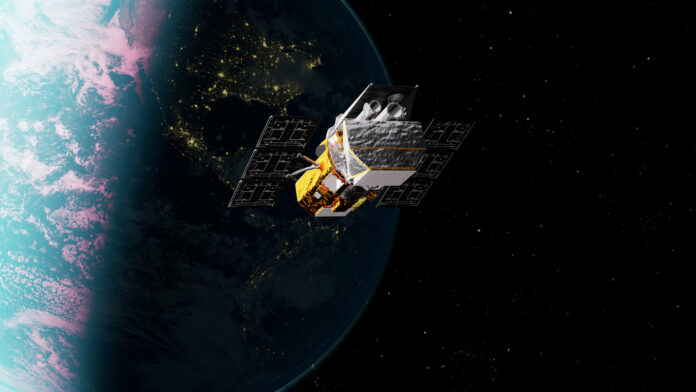
NASA Partners with Katalyst Space Technologies to Elevate Swift Observatory’s Orbit
Extending the Life of a Pioneering Space Telescope
NASA is spearheading advancements in the U.S. aerospace sector by awarding a contract to Katalyst Space Technologies, based in Flagstaff, Arizona, to perform an orbital boost for the Neil Gehrels Swift Observatory. This robotic servicing mission will rendezvous with Swift and raise its orbit, showcasing a critical technology that promises to enhance future space exploration efforts while prolonging the observatory’s scientific contributions.
Swift’s Mission and the Challenge of Orbital Decay
Launched in 2004, the Swift satellite was designed to investigate gamma-ray bursts-the universe’s most energetic explosions. Like all satellites in low Earth orbit, Swift’s altitude gradually decreases over time, a process accelerated recently due to heightened solar activity. Instead of allowing Swift to succumb to atmospheric reentry, NASA is leveraging this situation as an opportunity to demonstrate innovative spacecraft servicing technologies that could redefine satellite longevity.
Innovative Industry Collaboration Driving Space Leadership
Nicky Fox, Associate Administrator of NASA’s Science Mission Directorate, emphasized that this partnership exemplifies NASA’s commitment to fostering American leadership in space through rapid adoption of commercial innovations. “By swiftly transitioning from concept to execution, we are not only extending Swift’s mission but also honing capabilities essential for upcoming crewed missions to the Moon, Mars, and beyond under the Artemis program,” Fox stated. This mission will mark a historic first: a commercial robotic spacecraft capturing and servicing a government satellite that was neither manned nor originally designed for in-orbit servicing.
Addressing the Urgency of Swift’s Orbital Decline
Shawn Domagal-Goldman, Acting Director of NASA’s Astrophysics Division, highlighted the time-sensitive nature of the mission. “Swift’s orbit is deteriorating rapidly, so we are racing against the clock. By utilizing existing commercial technologies, we are tackling this challenge head-on with a risk-tolerant and forward-thinking approach.” Swift acts as a cosmic “dispatcher,” detecting sudden high-energy events and alerting other observatories to investigate further. Over two decades, Swift has revolutionized our understanding of phenomena ranging from stellar explosions and galactic flares to near-Earth high-energy events.
Funding Innovation Through NASA’s SBIR Program
NASA’s Small Business Innovation Research (SBIR) program, managed by the Space Technology Mission Directorate, awarded Katalyst a $30 million contract to accelerate the development and deployment of the orbit-raising technology. This funding mechanism enables NASA to rapidly respond to Swift’s orbital decay, a timeline that would be impossible under traditional contracting methods.
Building a Sustainable Space Economy Through Public-Private Partnerships
Clayton Turner, Associate Administrator of NASA’s Space Technology Mission Directorate, remarked, “The American space economy is brimming with cutting-edge solutions. Collaborations like this allow NASA to harness commercial innovation to solve real-world challenges.” Extending satellite lifespans through orbital servicing could transform how space assets are managed, reducing costs and increasing mission durations. Orbital degradation is an inevitable process, but agile partnerships accelerate the development of technologies that will benefit current and future missions alike.
Empowering Small Businesses to Propel Space Technology
NASA’s SBIR program is a cornerstone of America’s Seed Fund, the nation’s premier source of non-dilutive early-stage financing for breakthrough technologies. It supports entrepreneurs and small enterprises (fewer than 500 employees) by providing funding and resources to mature and commercialize innovations that advance NASA’s objectives and address broader societal challenges.
Collaborative Management and Global Partnerships
The Swift mission is managed by NASA’s Goddard Space Flight Center in Greenbelt, Maryland, in partnership with Penn State University, Los Alamos National Laboratory, and Northrop Grumman Space Systems. International collaborators include the UK Space Agency, University of Leicester, Mullard Space Science Laboratory, Brera Observatory, and the Italian Space Agency, reflecting the mission’s global scientific impact.
Discover More About the Swift Observatory
For additional information on the Swift mission and its groundbreaking work, visit: https://www.nasa.gov/swift