Advancing Planetary Exploration: NASA’s ERNEST Rover Breaks New Ground
Introducing ERNEST: A New Era in Robotic Mobility
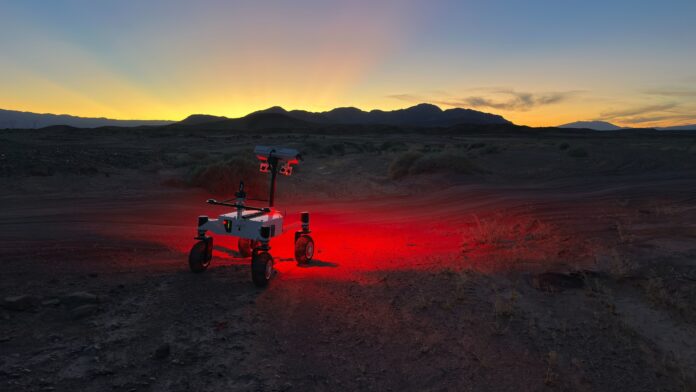
In the harsh expanse of Southern California’s Colorado Desert, NASA’s latest rover prototype, ERNEST (Exploration Rover for Navigating Extreme Sloped Terrain), recently completed an impressive 16-mile (26-kilometer) journey with minimal human control. This compact, four-wheeled vehicle is designed to push the boundaries of robotic autonomy and terrain navigation, aiming to overcome obstacles that have challenged previous Mars rovers.
Innovative Design and Enhanced Autonomy
Crafted at NASA’s Jet Propulsion Laboratory (JPL), ERNEST measures approximately 4 feet (1.2 meters) in length. Unlike the six-wheeled Curiosity and Perseverance rovers, ERNEST’s unique mesh wheels can be individually lifted to surmount difficult terrain. This capability, combined with advanced onboard decision-making algorithms, equips ERNEST to independently navigate complex landscapes. These technological breakthroughs are poised to inform the design of future missions targeting the Moon and Mars, especially in regions previously deemed inaccessible.
Field Testing: Paving the Way for Long-Range Lunar Missions
ERNEST’s recent field trials served as a proving ground for a potential lunar rover mission that demands higher speeds and extended travel distances than current rovers can achieve. Over seven days of intermittent testing, ERNEST maintained speeds up to 0.6 mph (1 kph) for a total of 37 hours, significantly surpassing the maximum speeds of NASA’s existing Mars rovers by an order of magnitude.
“This rover could enable a scientific expedition across the Moon or Mars, covering vast distances efficiently,” explained James Keane, a planetary scientist at JPL involved in lunar mission planning.
Revolutionizing Suspension Systems for Planetary Rovers
The ERNEST team’s initial focus was mechanical innovation, aiming to enhance the proven rocker-bogie suspension system that has been a staple of Mars rovers since Sojourner. This passive suspension maintains consistent wheel contact with uneven terrain through a system of pivots and struts.
ERNEST introduces an active suspension system that dynamically adjusts weight distribution across its wheels. Featuring two powered joints at the front, the rover’s gimbal allows it to employ various locomotion styles such as squirming, wheel-walking, and climbing over obstacles. A clutch mechanism enables switching between active suspension, which offers superior terrain adaptability, and passive suspension, which conserves energy. Additionally, ERNEST’s four steerable wheels provide omnidirectional movement, including lateral driving.
From Concept to Reality: Prototyping and Testing
Before finalizing ERNEST’s design, engineers developed two smaller prototypes, each about 2 feet (0.6 meters) long, to evaluate 11 different active suspension configurations. These tests, conducted in a trailer filled with lunar soil simulant at varying slopes, spanned several months and informed the rover’s current design.
The full-scale ERNEST includes a rectangular sensor head mounted on a 4.5-foot (1.4-meter) mast. Although initially operated via joystick commands, the rover’s autonomy capabilities have since been enhanced through advanced machine learning techniques.
Harnessing Artificial Intelligence for Autonomous Navigation
To enable ERNEST to independently navigate challenging terrain, the team employed reinforcement learning-a form of AI where the rover learns optimal behaviors through trial and error. Utilizing JPL’s Dynamics and Real-Time Simulation Laboratory, engineers created a high-fidelity virtual environment that mimics the rover’s physical responses to diverse terrains. By running thousands of simulation hours on powerful computing clusters, the rover’s autonomous algorithms were rigorously trained before real-world deployment.
Subsequent tests at JPL’s Mars Yard, an outdoor terrain testing site, demonstrated ERNEST’s ability to autonomously traverse complex obstacles such as sand ripples, rubble, steps, and steep inclines. These successful trials mark a significant step toward fully autonomous planetary exploration.
Future Directions: Integrating Intelligent Path Planning
Building on these achievements, the ERNEST team is developing new autonomy features that combine active suspension control with long-range navigation intelligence. This integration aims to empower the rover to strategically select routes that overcome manageable obstacles while avoiding hazardous terrain, optimizing mission efficiency on the Moon, Mars, or other celestial bodies.
Project Background and Support
Initiated in 2022 with internal funding from JPL, the ERNEST project now receives support from NASA’s Mars Exploration Program and the Exploration Science Strategy and Integration Office within the Science Mission Directorate. Managed by Caltech in Pasadena, JPL continues to lead the development of this promising technology.