Curiosity Rover’s Encounter with a Stubborn Martian Rock
NASA’s Curiosity rover recently experienced an unusual challenge while exploring the Martian surface: a rock became firmly lodged on the drill at the end of its robotic arm. This rare event was documented through a series of images captured by the rover’s black-and-white hazard cameras located on its chassis front, as well as the navigation cameras mounted on its mast.
The Incident: Rock Stuck on the Drill
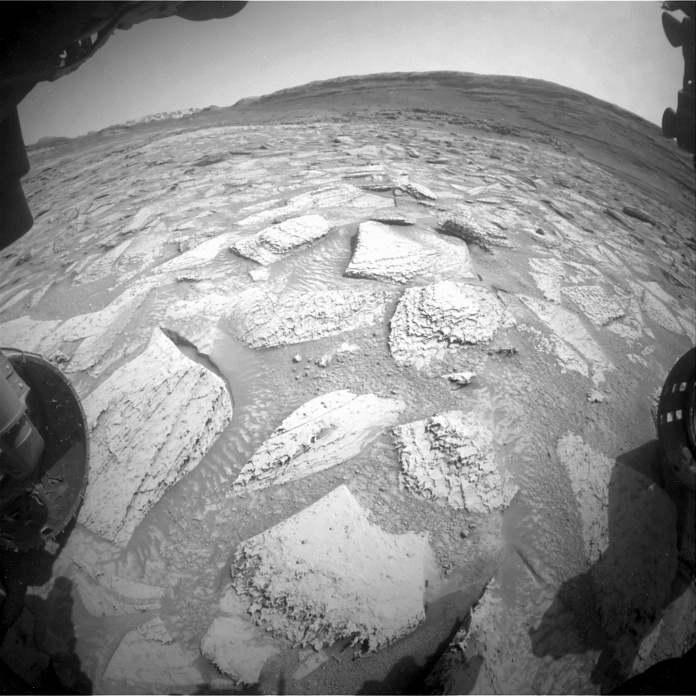
On April 25, 2026, Curiosity drilled into a rock dubbed “Atacama,” measuring approximately 1.5 feet in diameter at its base, about 6 inches thick, and weighing close to 28.6 pounds (13 kilograms). When the rover retracted its arm after drilling, the entire rock unexpectedly lifted from the ground, clinging to the drill’s fixed sleeve that encircles the rotating bit. While previous drilling operations have fractured rock surfaces, this was the first time a rock remained attached to the drill sleeve itself.
Efforts to Dislodge the Rock
Initially, the mission team attempted to free the rock by vibrating the drill, but this had no effect. On April 29, they adjusted the position of Curiosity’s robotic arm and repeated the vibration process. Although sand particles fell from the rock during this attempt, the rock itself remained stuck.
Persistence paid off on May 1, when the team combined several maneuvers: tilting the drill at a steeper angle, rotating and vibrating the drill bit simultaneously. These coordinated actions successfully detached the rock on the first try, causing it to fracture upon hitting the Martian surface.
Visual Documentation of the Event
The entire sequence was recorded in two perspectives. Figure A presents a time-stamped GIF from the hazard cameras, highlighting the timeline of the rock’s release. Figure B offers an alternative viewpoint from the navigation cameras on Curiosity’s mast, providing a broader context of the rover’s arm movements during the operation.
About Curiosity and Its Mission
Curiosity was engineered by NASA’s Jet Propulsion Laboratory (JPL), managed by Caltech in Pasadena, California. JPL oversees the rover’s mission on behalf of NASA’s Science Mission Directorate, as part of the Mars Exploration Program. Since its landing in 2012, Curiosity has been instrumental in analyzing Martian geology and assessing the planet’s past habitability.
Significance and Future Implications
This incident underscores the unpredictable nature of robotic exploration on other planets. It also highlights the importance of adaptive problem-solving techniques in remote operations. As Mars missions continue to evolve, lessons learned from Curiosity’s experience will inform the design and operation of future rovers, such as Perseverance and upcoming sample-return missions.