
Summary
The Pentagon has expanded its 1260H list to include Alibaba, Baidu, BYD, and Unitree, raising the total number of Chinese firms linked to military support to 188.
The U.S. Department of Defense announced on Monday the addition of Alibaba, Baidu, BYD, and the robotics firm Unitree to its 1260H list, which identifies Chinese companies believed to contribute to the country’s military-civil fusion efforts. This updated roster now comprises 188 entities operating within the United States, signaling increased scrutiny and potential restrictions on American businesses engaging with these firms.
Understanding the 1260H List and Its Implications
Named after Section 1260H of the 2021 National Defense Authorization Act (NDAA), this list mandates the Pentagon to pinpoint Chinese companies with direct or indirect affiliations to the People’s Liberation Army (PLA). While inclusion does not immediately trigger sanctions, it imposes significant operational constraints. Starting June 30, 2026, the FY 2024 NDAA forbids the Department of Defense from initiating or renewing contracts with these entities, with indirect contracting prohibitions set to follow a year later.
Background on the Recent Update
This latest revision was initially published in the Federal Register in February but was subsequently withdrawn without explanation. Investigations by various sources confirmed that the earlier draft contained many of the same companies. The current release appears to be the finalized and expanded version of that earlier document.
Key Additions Reflecting China’s AI and Automotive Sectors
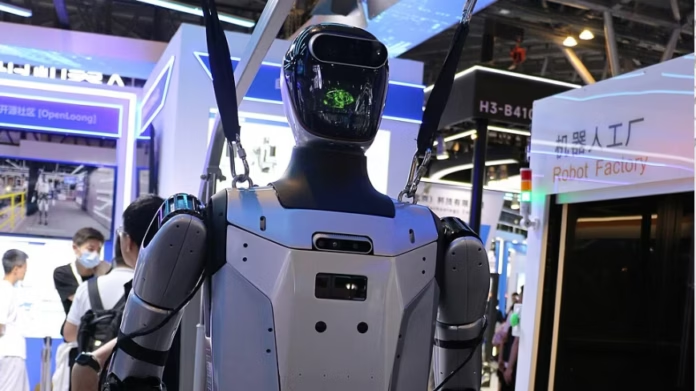
Most of China’s leading artificial intelligence companies are now included. Earlier in January 2025, Tencent, battery manufacturer CATL, chipmaker CXMT, and drone producer Autel Robotics were added. The current update incorporates Baidu, a frontrunner in AI and autonomous driving technologies, and Alibaba, whose cloud computing infrastructure underpins a large portion of China’s AI ecosystem. Notably, both Alibaba and Tencent have invested in Unitree, a Hangzhou-based robotics company that outpaced Tesla in humanoid robot shipments in 2025 and is preparing for a $7 billion initial public offering on the Shanghai Stock Exchange.
The automotive industry also features prominently. BYD, which surpassed Tesla as the world’s top electric vehicle (EV) seller in 2025, joins the list alongside Nio, CALB Group, and EVE Energy, a battery manufacturer. Additionally, Robosense, a leading Chinese lidar sensor producer, has been added, joining its competitor Hesai, which was already listed.
Trade and Legal Challenges Surrounding BYD
BYD currently faces a 100% tariff on its vehicles imported into the United States. In January, its American subsidiaries challenged these tariffs at the U.S. Court of International Trade, arguing the duties are unjustified. The 1260H designation introduces an additional layer of regulatory scrutiny for any U.S. company contemplating commercial ties with BYD, even as consumer interest in Chinese EVs continues to rise on social media platforms despite ongoing trade barriers.
Semiconductor and Biotech Firms on the List
The semiconductor sector remains well represented. CXMT, China’s largest memory chip manufacturer, was added in the January 2025 update and remains listed alongside YMTC, the country’s leading NAND flash producer. Both companies are aggressively expanding their production capacity, aiming to nearly double wafer output. The latest update also includes WuXi AppTec, a prominent biotech contract research organization.
Context Amid U.S.-China Relations and Technology Competition
The timing of this list’s publication is significant. It coincides with discussions in Washington about the U.S. government potentially acquiring equity stakes in leading domestic AI companies, a move aimed at bolstering national competitiveness. This development also occurs during a delicate phase of U.S.-China relations, where a tentative trade truce exists alongside escalating technology restrictions. The 1260H list is one of several tools the U.S. employs to exert pressure on Chinese technology firms, alongside export controls on semiconductor equipment, tariffs, and the Commerce Department’s Entity List.
Responses from Affected Companies and Broader Implications
Companies named on the list have consistently contested their inclusion. Tencent described its addition as “a mistake” when announced last year, and CATL denied any military involvement. As of this update, Alibaba, Baidu, BYD, and Unitree have not publicly commented on their designation.
The Pentagon is not obligated to disclose public evidence supporting these listings. The criteria, centered on the broad concept of military-civil fusion, encompass companies primarily engaged in consumer technology sectors.
Impact on U.S. Businesses and Future Outlook
The practical consequences of the 1260H list hinge on the rigor of enforcement and whether further legislative or executive actions follow. For firms like Alibaba and Baidu, whose U.S. operations include cloud services, advertising, and research collaborations, the designation introduces compliance risks for American partners. For companies such as BYD and Unitree, whose products involve physical goods and supply chains linked to U.S. components and customers, the effects could be more immediate and tangible.
Importantly, the list does not prohibit trade outright. Instead, it requires U.S. companies to carefully assess the risks associated with engaging in transactions involving entities the Pentagon has formally identified as supporting China’s military apparatus.