
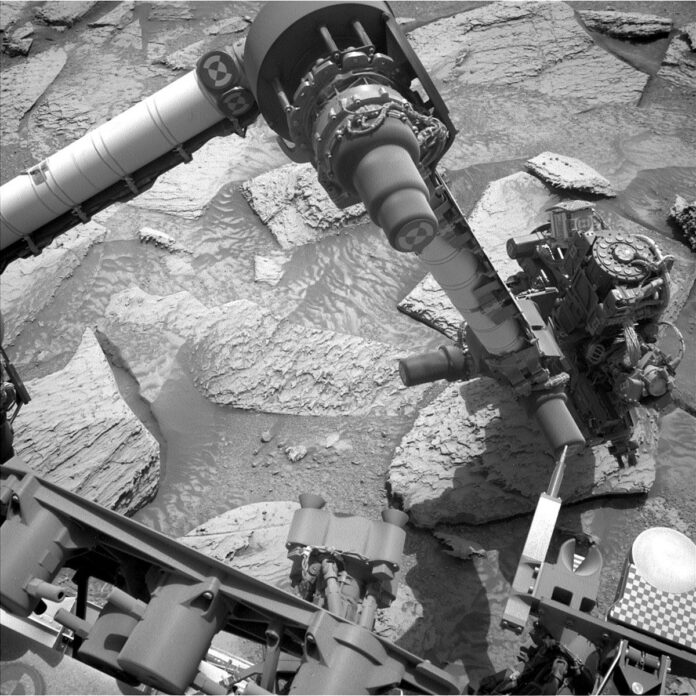
Despite challenges and setbacks, NASA’s Curiosity rover continues its relentless exploration of Mars, demonstrating resilience even after a recent hiccup involving its drill getting stuck in a rock.
By Adam Kovac edited by Claire Cameron
NASA/JPL
Become Part of Our Science Enthusiast Network!
NASA’s Curiosity rover remains steadfast in its mission to explore the Martian surface, only briefly hindered when its drill became lodged in a stubborn rock.
The incident occurred on April 25, during what was planned as the rover’s second drilling session on a 28.6-pound, 18-inch-wide, and 6-inch-thick rock named Atacama. When Curiosity attempted to retract its drill arm, the rock unexpectedly adhered to the protective sleeve encasing the drill bit, causing it to be pulled along.
Mission engineers on Earth initially tried to dislodge the rock by gently shaking the drill arm, akin to a mechanic trying to free a stuck bolt with careful taps, but this approach failed. Subsequent attempts involved activating the drill’s vibration mechanism to loosen the rock, which also proved ineffective. Finally, on May 1, a combination of tilting, rotating the drill, and spinning the bit successfully freed the rock, which fragmented upon release.
Why Supporting Science Reporting Matters
If you find value in articles like this, consider subscribing to support high-quality science journalism. Your subscription helps sustain in-depth coverage of groundbreaking discoveries and the scientific ideas shaping our future.
NASA/JPL-Caltech
The fragments from the Atacama rock will be examined by Curiosity’s Chemistry and Mineralogy (CheMin) instrument. These samples will be compared with those collected from Mineral King, a site located approximately 525 feet downhill from the rover’s current position.
With the drill now operational, Curiosity resumes its scientific investigations within Gale Crater, where it has been conducting research for over 14 years-equivalent to nearly a decade and a half of Martian seasons. Presently, the rover’s Earth-based environmental team is leveraging its instruments to monitor Martian atmospheric dust levels, track cloud formations, and observe transient dust devils-small whirlwinds that briefly stir the planet’s surface.
Championing Science in Critical Times
If this article resonated with you, I invite you to support our mission. For 180 years, Scientific American has been a steadfast advocate for science and innovation, and today, that role is more vital than ever.
As a lifelong subscriber since childhood, I can attest to how Scientific American has shaped my understanding of the universe, sparking curiosity and wonder. I hope it inspires you as well.
Your subscription ensures that we continue delivering insightful coverage of pivotal research, report on policy decisions impacting scientific institutions nationwide, and support scientists at all stages of their careers-especially when the importance of science is frequently undervalued.
Subscribers gain access to exclusive news, engaging podcasts, stunning infographics, essential newsletters, compelling videos, interactive science games, and some of the finest science writing available. Subscriptions also make thoughtful gifts for fellow science enthusiasts.
Now more than ever, it is crucial to stand up for science and its role in society. I hope you will join us in this endeavor.