
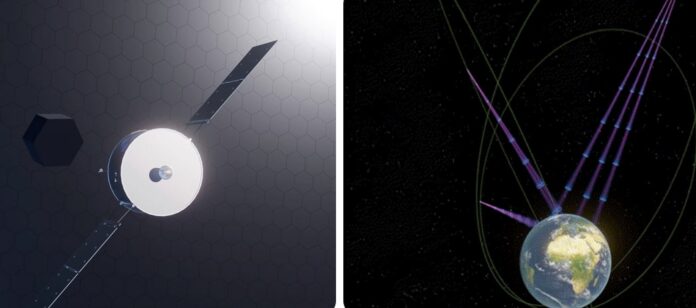
Virtus Solis is looking to group satellites in massive arrays – 100,000 satellites for 100MW – allowing for an energy platform that can be scaled up. Arrays are capable of growing to 20 Gigawatts or more. Virtus Solis, a Silicon Valley startup, and Orbital Composites prepare to start robotic assembly of hexagonal solar tiles in 2027. The goal is to transmit more than 1 kilowatt of power to Earth. Virtus Solis was awarded a contract worth $1.92 million in January by the Advanced Research Projects Agency Energy to develop technology that wirelessly transfers radio-frequency energy. Tate said that highly efficient miniature RF components would benefit SBSP campaigns and unrelated space programs.
Space-based solar will have greater availability than 90%, and 5-20x more sunshine than terrestrial solar due no weather or nighttime. Sunlight is 40% stronger in orbit.
There are several verticals that struggle to be electrified, especially heavy duty use cases like marine and aircraft. Using synfuels as energy storage is a great idea, and Virtus Solis Technologies could help bring synfuels to market at costs lower than digging oil out of the ground.
Orbital Composites, a Silicon Valley startup, and Virtus Solis Technologies of Michigan announced plans on Feb. 1, to conduct a space-based demonstration of solar power in 2027. This 2027 mission will showcase key power-generation technologies, including in-space assembly and transmission of over one kilowatt back to Earth. The 2027 mission is a precursor for large-scale commercial megawatt solar installations in space.
According to a news release, the demonstration is destined for a medium-Earth orbit where Earth’s atmospheric will not interfere with “continuous generation of solar power.” Virtus Solis was founded in 2019 and plans to deploy 1,65-meter solar panels in a Molniya medium-Earth orbit. Virtus Solis intends to build gigawatts worth of modular arrays by robotic assembly.
Virtus Solis’ CEO John Bucknell stated that the combination of Orbital Composites advanced manufacturing expertise and his company’s architectural innovations would “unlock an future of limitless, renewable power, both in space as well as on Earth.”
Brian Wang, a Futurist and Science Blogger with over 1 million monthly readers. His blog Nextbigfuture.com has been ranked as the #1 Science News Blog. It covers a wide range of disruptive technologies and trends, including Space, Robotics and Artificial Intelligence. Medicine, Anti-aging Biotechnology and Nanotechnology are also covered.
He is known for identifying cutting-edge technologies. He is currently a co-founder of a startup, and a fundraiser for high-potential early-stage companies. He is the Head for Research for Allocations for Deep Technology Investments and an Angel Investor with Space Angels.
He is a frequent speaker for corporations. He has also been a TEDx Speaker, a Singularity University Speaker, and a guest on numerous radio and podcast interviews. He is available for public speaking and advisory engagements.