
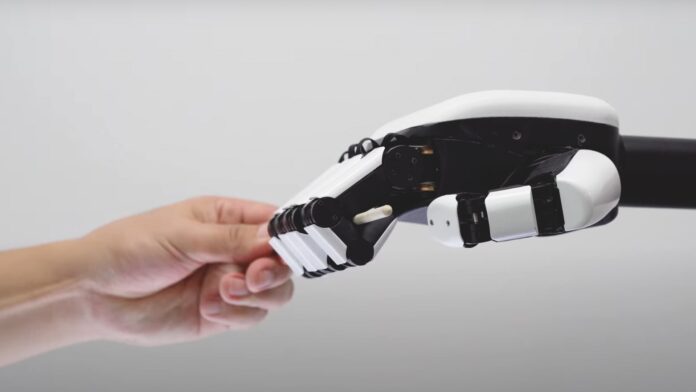
Dexcel Robotics Unveils Apex Hand: A Breakthrough in Robotic Dexterity
Introduction to the Apex Hand
Shenzhen-based startup Dexcel Robotics has introduced its inaugural product, the Apex Hand, a robotic hand system designed to replicate the intricate movements and capabilities of the human hand. This innovative device boasts exceptional freedom of motion, dynamic responsiveness, and precision, positioning itself as a pioneering solution in the robotics industry. Notably, the Apex Hand is among the first robotic hands capable of operating a smartphone single-handedly, alongside performing tasks such as pulse monitoring and mouse control.
Founders and Expertise Behind Dexcel Robotics
The company was founded by CEO Yang Sicheng, an alumnus of Beihang University and Tsinghua University, who previously contributed to Tencent Robotics X. Co-founder and CTO Li Wangwei holds a PhD from the National University of Singapore. Together, the founding team has authored over 50 scholarly articles and secured more than 100 patents related to dexterous robotic hands and tactile sensing technologies, underscoring their deep expertise in the field.
Funding and Investment Highlights
In August, Dexcel Robotics successfully closed an angel-plus funding round, raising a substantial eight-figure sum in RMB. The round was spearheaded by Fibonacci VC, with participation from Xunshang Venture Capital and returning investor Kinzon Capital, providing the company with robust financial backing to accelerate product development and market entry.
Technical Specifications and Capabilities
The Apex Hand features a five-fingered robotic design with 21 degrees of freedom (DoF), enabling it to perform a wide array of everyday tasks with remarkable dexterity. Its dynamic attributes, including response time and acceleration, closely mirror those of a human hand. Each finger can exert a force of approximately 2.5 kilograms, while the entire hand can lift objects weighing up to 30 kilograms.
Engineered for durability, the Apex Hand can endure impacts and function reliably in unfamiliar or challenging environments. It achieves a precision level of 0.1 millimeters with virtually no backlash. A proprietary electronic skin made from flexible materials provides tactile feedback, enhancing sensitivity without sacrificing resilience, unlike traditional rigid electronic skins.
Advanced Dexterity and Practical Applications
Thanks to its high degree of freedom, the Apex Hand excels in complex manipulations such as single-handed smartphone operation and has earned a perfect score on the Kapandji Test, which evaluates finger-to-finger mobility. Beyond digital device control and pulse detection, it can grasp objects in confined spaces and handle various tools. The design strategically balances internal rigidity with external flexibility, ensuring both load-bearing strength and safe interaction with its surroundings.

Innovations in Tactile Sensing
Dexcel Robotics has developed a brain-inspired tactile processing system with ultra-high spatiotemporal resolution. This technology enables sub-millisecond latency in data transmission and supports simultaneous sensing of thousands of tactile points at refresh rates exceeding 1,000 Hz. Unlike conventional electronic skins that rely on rubber deformation and suffer from durability issues, Dexcel’s proprietary materials offer enhanced flexibility and robustness, significantly improving the longevity and performance of tactile sensors.
Historical Context and Industry Challenges
Research into dexterous robotic fingers dates back to the 1960s, with institutions like Stanford University and MIT pioneering early developments. Despite decades of progress, no dexterous robotic hand has yet achieved widespread commercial adoption. Many academic projects have focused on isolated performance metrics but have struggled to deliver comprehensive, practical solutions suitable for real-world applications.
For robotic hands to be viable in general-purpose or household robots, they must integrate reliable hardware with sophisticated data acquisition, modeling, and scalable deployment strategies. Key performance factors include degrees of freedom, size proportionality, tactile perception, load capacity, responsiveness, precision, and adaptability to unpredictable environments.
Design Philosophy and Future Outlook
Yang Sicheng emphasizes that 21 degrees of freedom sufficiently replicate nearly all human hand functions, cautioning that increasing this number would inflate costs and complicate control without significant benefits. The Apex Hand’s modular architecture facilitates mass production by ensuring reliability and simplifying assembly and maintenance.
While hardware stability in complex environments remains a challenge, Yang anticipates that within two to three years, the Apex Hand will find applications in semi-structured settings such as advanced manufacturing tasks that exceed the capabilities of traditional automation but are less variable than domestic environments.
Dexcel Robotics deliberately avoids narrowing its focus to a single application prematurely, aiming instead to develop a versatile dexterous hand rather than a specialized automation tool.
Market Potential and Technological Synergies
The development of dexterous robotic hands has long been a critical bottleneck in embodied intelligence. Various drive mechanisms-including cable-driven, direct drive, and linkage systems-have yet to fully resolve the challenges of stability and performance. Elon Musk has noted that nearly half of the engineering effort behind Tesla’s humanoid robot, Optimus, is dedicated to hand development.
The current market lacks a high-performance, stable, and dexterous robotic hand, creating opportunities for innovative startups. Since 2024, advances in artificial intelligence and reinforcement learning have demonstrated promising capabilities in managing complex hand movements through trial-and-error learning, offering a powerful alternative to traditional programming methods. Yang cites this convergence of cutting-edge technology and market demand as the driving force behind Dexcel’s inception.
Moreover, robotic hands serve as critical interfaces for environmental interaction and data collection, helping to address the scarcity of data in embodied intelligence research.
Industry Growth and Competitive Landscape
Despite entering the market later than some competitors, Yang believes the dexterous hand industry remains in its early stages with vast potential for growth. Market research forecasts suggest the global dexterous hand market could surpass USD 5 billion by 2030. The race to commercialize reliable, high-performance products will likely determine the leaders in this emerging sector.