
13.4 C
New York

The 2028 Cadillac Escalade IQ is a vehicle that doesn’t require your eyes to drive

Published:

General Motors CEO Mary Barra, along with other top executives, announced a series high-tech announcements in New York City at a special technology event dubbed “GM Forward,” . The announcements covered the company’s vehicle, battery, energy home, and robotics businesses. The biggest news for car enthusiasts is that “hands off, eyes off” debuts in 2028 in the Cadillac Escalade IQ. The new technology allows drivers to completely disengage from steering, monitoring, and other functions under certain conditions. This is different from GM’s Super Cruise system which allows drivers remove their hands from steering wheel while the system is active, as long as they are looking ahead. Eyes off systems, also known as Level 3 autonomous by the Society of Automotive Engineers, represent the next phase of GM’s longstanding effort to expand vehicle automaton safely and at scale.

Built by Super Cruise

The upcoming system builds on the nearly a decade-long experience of Super Cruise, GM’s hands-free driving assistance suite. Super Cruise, which was introduced in 2017, has been expanded to 23 different vehicle models. GM claims Super Cruise has logged over 700 million miles without a single accident. This operational foundation, along with the learnings from more than five million miles of fully driverless driving accumulated by Cruise (GM’s now-defunct robotaxi startup), forms the backbone for this new approach to personal car autonomy.

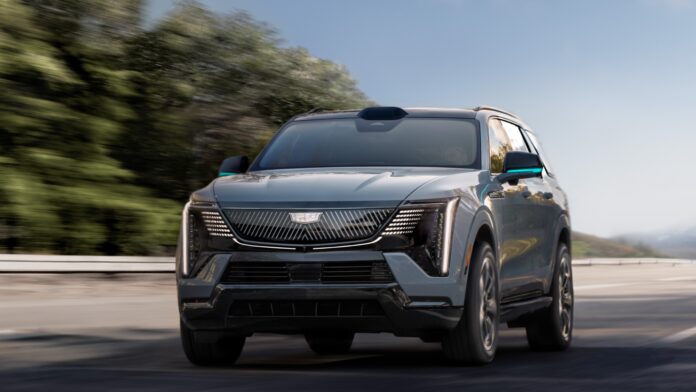
The 2028 Escalade IQ, starting on highways, will be the first GM car to offer eyes-off driving. Unlike “vision only” systems, which rely on cameras alone, such as Tesla’s “Full Self-Driving” vehicle, GM plans to integrate a redundant array that includes lidar, radar and cameras into the vehicle’s structural design. The hump on top of the Escalade iQ concept car, located just behind the windshield and presumably housing a lidar, is easily visible. Sensor fusion is a process that combines data from all sensors to create a highly accurate image of the environment. This perception data is used to train the system’s algorithms for making decisions, which are then validated by extensive real-world testing and simulations, including rare and dangerous scenarios.

The dashboard will have a turquoise lighting strip that will indicate the system’s status. This will let the occupants know it is safe to relax or read while the vehicle is driving. A GM spokesperson said that the side mirror housings will have a turquoise lighting element on the outside. This indicates that the vehicle is autonomous. It’s not yet clear if such exterior lighting is legal in all 50 US states. California Vehicle Code 2950 prohibits forward-facing lights from being any other color than white or yellow. This is one of the many details that will need to be worked out before the 2028 Escalade-IQ system goes live.

Centralized Computing Architecture (19659002)

The digital foundation of the vehicle is also being redesigned to support this leap in autonomous driving. The 2028 Escalade IQ will also feature a new centralized computing system that GM claims will combine propulsion, steering and braking systems, infotainment and safety systems, on a single high-speed core.

The platform consolidates dozens or control modules into a central computing unit that is connected to “zone-controllers” located around the vehicle by a high-speed Ethernet network. This structure reduces the complexity of hardware, eliminates miles and miles of wiring, enables faster and more efficient software updates. The liquid-cooled computing unit, powered by NVIDIA Thor and other next-generation processors, manages each vehicle subsystem in real-time. This design is said by GM to provide enormous computing headroom, up to 35 times more AI and 1,000 times the bandwidth of its previous system

.

In practice, this means that vehicles can process sensor information faster, perform real time safety analysis in milliseconds and deliver up to 10 times as many feature updates over the air as before.

The system is not only more efficient, but also offers what GM calls “hardware freedom”: engineers can replace or update sensors, actuators or displays without having to rewrite core code. This simplifies long-term support, and allows for scalability.

GM claims that its new architecture can be used for electric, hybrid and internal combustion vehicles. This is a big deal, which should improve GM’s efficiency in manufacturing and how its software defined vehicles improve over time. Standardizing the underlying computing and software environment allows GM to deploy innovations developed for a specific vehicle type more quickly across its broader fleet, ensuring consistency in feature growth and security updates.

AI Upgrade Arrives Sooner

GM claims that drivers will be able to experience a significant update to artificial intelligence by next year, even though the eyes-off system or centralized computing architecture won’t be available until 2028. GM vehicles from 2026 will feature conversational artificial intelligence powered by Google Gemini. This system allows occupants to interact with their vehicles naturally, such as asking for directions, writing messages, or finding charging stops along a preferred path, without relying on rigid commands.

GM plans to deploy its proprietary AI in the future, which will be fine-tuned for each vehicle’s onboard intelligence, and driver preferences, through OnStar connectivity. With the owner’s permission, it can explain vehicle features, detect service needs, or provide personalized trip recommendations.

Together, these developments indicate a near-term GM future where vehicles are not just connected and updateable, but intelligent – able to drive you when you wish, converse with you when needed, and continuously improve through software.

www.roboticsobserver.com

Related articles

spot_img

Recent articles

spot_img