
Forging a New Path in Robotics
When Maja Matarić embarked on her career, the specialized field she envisioned-socially assistive robotics-had yet to be established. In 2005, she was instrumental in defining this innovative domain, which focuses on robots designed to support humans through social interaction rather than physical assistance.
Currently a professor at the University of Southern California (USC), Matarić holds appointments in computer science, neuroscience, and pediatrics. Her pioneering work centers on developing robots that deliver personalized therapeutic support, particularly for individuals facing mental health challenges such as anxiety and depression. These robots engage users in cognitive behavioral therapy (CBT), a widely recognized approach aimed at reshaping negative thought patterns and emotional responses.
Academic and Professional Milestones
Matarić’s academic journey began in Belgrade, Serbia, where her early exposure to engineering came from her father, an engineer, and her uncle, an aerospace engineer who introduced her to computer science. After relocating to the United States as a teenager, she pursued a bachelor’s degree in computer science at the University of Kansas, graduating in 1987.
She then advanced to MIT’s Artificial Intelligence Laboratory (now CSAIL), where she was captivated by Rodney Brooks’s work on behavior-based robotics. Under his mentorship, she developed Toto, the first robot capable of navigating complex environments using distributed models and sonar sensors to map and traverse spaces autonomously.
Matarić earned her Ph.D. in AI and robotics in 1994, pioneering distributed algorithms that enabled coordinated teamwork among multiple robots. She began her faculty career at Brandeis University before joining USC’s Viterbi School of Engineering in 1997, where she co-founded the Robotics and Autonomous Systems Center (RASC) in 2002, fostering interdisciplinary research on human-centered robotics.
From Curiosity to Compassion: Shaping Research with Purpose
Matarić’s research focus shifted profoundly after becoming a mother in 1998. Seeking to articulate the real-world impact of her work beyond academic accolades, she committed to creating robots that genuinely improve lives. This led to the formal introduction of socially assistive robotics alongside her doctoral student David Feil-Seifer at the 2005 International Conference on Rehabilitation Robotics. Their work emphasized robots that aid people through social engagement rather than physical task execution.
Her USC Interaction Lab has since concentrated on designing robots that provide emotional and cognitive support, blending engineering with psychology to address human needs.
Innovations in Socially Assistive Robotics
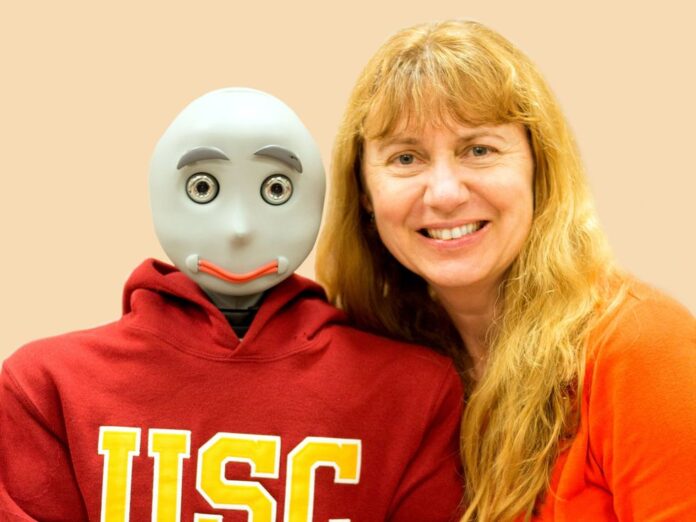
One of Matarić’s landmark projects involves Bandit, a 56-centimeter-tall robot with expressive facial features and interactive capabilities, designed to enhance social communication skills in children with autism spectrum disorder (ASD). ASD affects approximately 1 in 36 children in the U.S. as of 2023, according to the CDC, making such interventions increasingly vital. Bandit engages children through games and positive reinforcement, encouraging behaviors like initiating play and mimicking social cues.
Beyond pediatric applications, Bandit has been adapted to support elderly individuals and stroke survivors by guiding them through daily physical exercises, promoting rehabilitation and well-being.
Other notable robots developed in Matarić’s lab include Kiwi, an owl-inspired robot that motivates physical activity and facilitates family interactions, and Blossom, a customizable robot originally created at Cornell University. Blossom is currently being tested in clinical trials to assist college students coping with anxiety and depression through CBT practice.
Advancing Mental Health Support with Robotics and AI
Matarić’s recent research explores the comparative effectiveness of large language model (LLM)-powered chatbots versus socially assistive robots in delivering mental health interventions. In a controlled study conducted in USC dormitories, students practicing CBT with Blossom showed significant improvements in mental health metrics, whereas those using chatbot-only interfaces did not experience comparable benefits.
Building on these promising results, Matarić secured a 2024 grant from the U.S. National Institute of Mental Health to conduct a six-week clinical trial involving 120 students. Participants wear Fitbits to monitor physiological responses, while the study evaluates engagement, motivation, and therapeutic outcomes. The trial also investigates how to tailor the robot’s behavior and feedback to individual users, enhancing personalization and effectiveness.
Mentorship and Multidisciplinary Collaboration
Matarić emphasizes the importance of integrating engineering with human-centered disciplines such as psychology. She takes pride in mentoring graduate students who embrace this interdisciplinary approach, preparing them to address complex challenges in socially assistive robotics.
“Engineering students often don’t anticipate the need to understand human behavior and psychology,” she notes. “Those who do are compassionate and dedicated, and they make a real difference.”
Building Connections Through IEEE
Since joining IEEE in 1992, Matarić has found a vibrant community that supports her professional growth. Her first IEEE publication detailed her work on Toto, and she remains an active member of the IEEE Robotics and Automation Society. Attending flagship conferences such as ICRA, IROS, and the ACM/IEEE Human-Robot Interaction conference keeps her connected to cutting-edge developments and peers in her field.
She credits IEEE Life Fellow George Bekey for facilitating her USC faculty appointment and encourages her students to engage with IEEE for networking and career advancement.
About Maja Matarić
- Current Position: Professor of Computer Science, Neuroscience, and Pediatrics, University of Southern California
- Education: B.S. in Computer Science, University of Kansas; M.S. and Ph.D. in AI and Robotics, MIT
- Research Focus: Socially assistive robotics, cognitive behavioral therapy delivery, human-robot interaction
- Honors: 2025 Robotics Medal from MassRobotics, IEEE Fellow