Revolutionizing Robotics: The Emergence of a Universal AI Controller
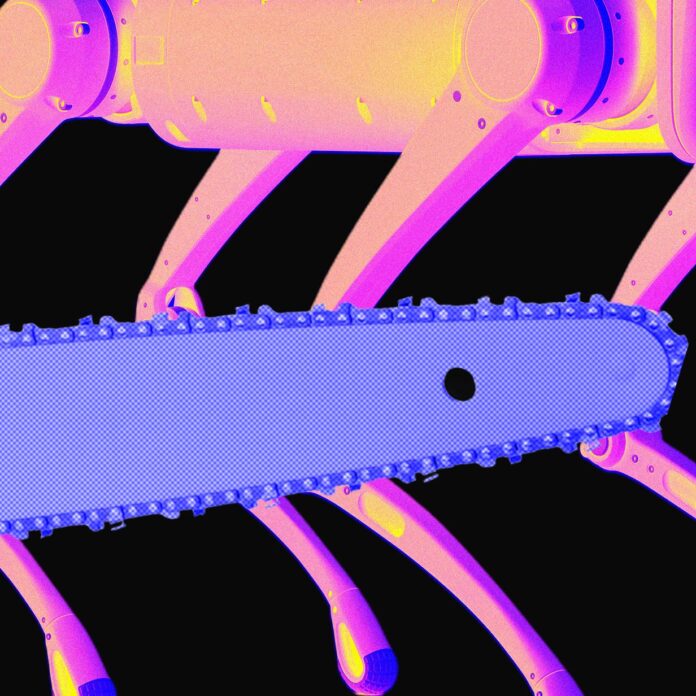
Imagine a robot with four legs that continues to crawl even after its limbs are severed-a scenario that might evoke unsettling images for many. Yet, for Deepak Pathak, cofounder and CEO of Skild AI, this remarkable adaptability exemplifies a groundbreaking advancement in robotic intelligence. Pathak refers to this capability as an “omni-bodied brain,” a versatile AI system designed to master any robot and any task with a single, unified algorithm.
Introducing Skild AI’s Generalist Algorithm
Skild AI has developed a pioneering artificial intelligence framework aimed at overcoming one of robotics’ most persistent challenges: creating a single control system that can operate across diverse robotic platforms and tasks. This approach, encapsulated in their “Skild Brain” model, is engineered to generalize across different physical forms, including those it has never encountered before. The company’s research team also introduced a compact variant named LocoFormer, which serves as the academic foundation for their methodology.
Data-Driven Adaptability: The Key to Robotic Versatility
Traditional methods for training robot control systems-such as teleoperation or simulation-based learning-often fall short in generating sufficient, diverse data. Skild AI’s strategy involves deploying a single algorithm to govern a wide array of physical robots performing various tasks, thereby amassing a rich dataset that enhances the model’s adaptability. This enables robots to respond effectively to unexpected challenges, like missing limbs or navigating uneven terrain.
Pathak draws a parallel between this robotic learning process and the way large language models solve complex problems by iteratively refining their understanding within a contextual framework, a technique known as “in-context learning.”
Competitive Landscape and Skild’s Unique Position
While organizations such as the Toyota Research Institute and startups like Physical Intelligence are also striving to develop more generalized AI models for robotics, Skild AI distinguishes itself through its focus on cross-hardware generalization. Their algorithm has been tested on a variety of walking robots with differing morphologies, including bipedal and quadrupedal systems that were not part of the original training data.
Real-World Demonstrations of Omnibody Intelligence
In practical experiments, Skild’s omnibody brain enabled a four-legged robot to adapt by walking on its hind legs when flipped over, effectively controlling the robot dog in a humanoid manner by sensing the terrain beneath its rear limbs. The LocoFormer model continuously refines its control policies through online learning, using data from initial trials to enhance performance in subsequent attempts.
Moreover, the algorithm demonstrated resilience to significant physical alterations, such as tying together or removing legs, and even disabling motors on a hybrid wheeled-legged robot. In one instance, the robot compensated for motor failures by balancing on two wheels, akin to a riderless bicycle maintaining equilibrium.
Extending Adaptability to Robotic Manipulation
Skild AI’s approach is not limited to locomotion. Their system was also trained on a variety of simulated robotic arms, showing proficiency in controlling unfamiliar hardware and adapting swiftly to environmental changes like diminished lighting conditions. The company has already partnered with industrial clients utilizing robotic arms, underscoring the commercial viability of their technology.
In 2024, Skild AI secured $300 million in funding, valuing the company at $1.5 billion, reflecting strong investor confidence in their vision.
The Future of Physical Superintelligence
While some may find the capabilities of Skild’s multi-talented robotic brain unsettling, Pathak views these developments as the early signs of a new era in physical superintelligence. “It’s incredibly thrilling to witness this evolution firsthand,” he remarks.
As robotics continues to advance, the concept of a universal AI controller capable of adapting to any machine and task could redefine the boundaries of automation and intelligent systems.