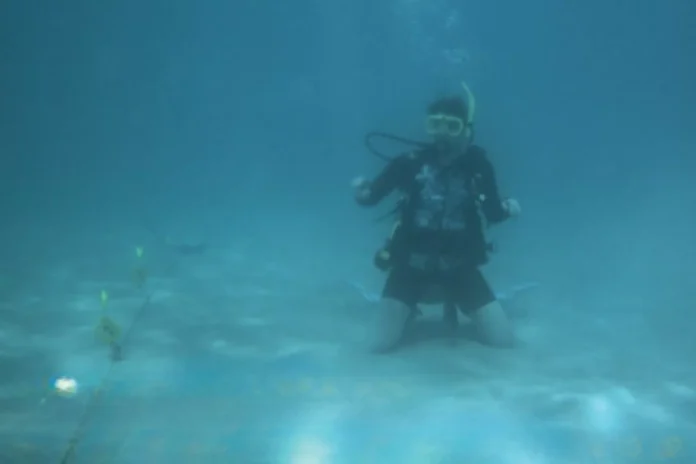
Scuba diving in extreme environments pushes the human body to its limits, from sheer exhaustion to dangerous breathing problems. Now, robots equipped with cameras can “read” the bubbles rising from a diver’s regulator, tracking their size and rhythm to spot stress, hyperventilation, or fatigue in real time.
Researchers at the University of Minnesota Twin Cities have built the first AI system that lets underwater companion robots monitor a diver’s health simply by watching their exhaled bubbles. Published in The International Journal of Robotics Research, the study marks the first time robotic vision has been used to measure a diver’s breathing rate.
Conventional sensors and wearables usually fail submerged, a thick wetsuit prevents cutaneous contact, and there is limited wireless signal transmission through water. As such, this method of tracking bubbles eliminates the issues discussed above entirely; it provides a contactless way to measure some aspects vital for diving.
Junaed Sattar, Associate Professor in the Department of Computer Science and Engineering and senior author on the paper, said, “Our goal was to give divers a dedicated robotic safety partner to provide a second set of ‘eyes’ capable of reading physiological stress underwater. This work is a first step towards assessing not just one but a group of divers in the robot’s field of view.”
Artificial blubber protects divers in frigid water
To train the AI, the team had to get creative. Because underwater footage is often cloudy, they built a “fuzzy labeling” system, manually sorting thousands of images and pairing them with the distinct sound of regulator breaths to teach the robot what a real exhalation looks like.
“Monitoring breathing is routine on land, but underwater it’s a huge technical challenge,” explained lead author Demetrious Kutzke, a Ph.D. student at the University of Minnesota.
To overcome this, the researchers gathered a vast dataset of audio and video recordings across different waters, from the chilly depths of Lake Superior and Square Lake in Minnesota to the clear Caribbean off Barbados, ensuring the robot could adapt to varied conditions.
At the heart of the field trials was a system called HREyes, which let the robot signal a diver’s breathing status, whether below normal, normal, or above normal, by translating bubble patterns into breaths per minute. This gave divers real-time feedback on whether they might be under stress.
The researchers are looking forward to combining breathing data with movement analysis, creating a fuller “wellness profile” to maximize safety during deep-sea exploration.
Journal Reference:
- Demetrious T. Kutzke, Vennela Dupati, Junaed Sattar. Robotic estimation of single scuba diver respiration rate for safety in underwater human-robot collaboration. The International Journal of Robotics Research. DOI: 10.1177/02783649251411466