
Revolutionizing Quantitative Trading with Ultrafast Optical Computing
In a groundbreaking advancement, scientists have engineered an optical computing platform that dramatically accelerates feature extraction processes essential for quantitative trading, achieving record-low latency. This innovative chip harnesses the power of light to enable rapid parallel data processing, significantly enhancing the speed and efficiency of critical computational tasks.
Limitations of Conventional Digital Processors in Data-Intensive Applications
Modern artificial intelligence systems, including those deployed in robotic surgery and high-frequency trading, depend on the swift analysis of vast data streams to identify vital patterns in real time. However, traditional electronic processors are approaching their physical performance ceilings, struggling to meet the demands of next-generation applications that require ultra-high-speed data handling. This bottleneck results in increased latency and slower response times, impeding the effectiveness of time-sensitive operations.
Optical Computing: A Light-Speed Solution
To overcome these challenges, researchers are turning to optical computing, a technology that utilizes photons instead of electrons to perform complex calculations at extraordinary speeds. Among the most promising components in this field are optical diffraction operators-thin, plate-like devices that manipulate light waves to execute mathematical operations as light passes through them. These systems offer remarkable energy efficiency and the ability to process multiple data channels simultaneously.
Despite their potential, achieving operational frequencies beyond 10 GHz has been difficult due to the necessity for highly stable and coherent light sources, which are challenging to maintain consistently.
Innovative Optical Feature Extraction Engine (OFE²) from Tsinghua University
A research team led by Professor Hongwei Chen at Tsinghua University has introduced a novel optical feature extraction engine, dubbed OFE², designed to perform high-speed optical analysis across diverse real-world scenarios. This system was detailed in the journal Advanced Photonics Nexus.

Advanced Data Preparation for Coherent Optical Processing
A key breakthrough in OFE² lies in its sophisticated data preparation module. Delivering high-speed, parallel optical signals within a coherent environment is notoriously difficult, as traditional fiber-based components introduce phase disturbances that degrade signal integrity. The team addressed this by integrating tunable power splitters and precise delay lines on a single chip, enabling the input data stream to be deserialized into multiple stable parallel channels. Additionally, an adjustable integrated phase array allows dynamic reconfiguration of the system to meet varying computational demands.
Optical Diffraction for Real-Time Feature Extraction
Once prepared, the optical signals traverse the diffraction operator, where the computation is modeled as a matrix-vector multiplication-a fundamental operation for feature extraction. The diffracted light converges into a focused bright spot at the output, whose position can be finely controlled by adjusting the phase of the incoming light waves. This precise manipulation enables OFE² to capture temporal variations in the input signal effectively.
Operating at an impressive 12.5 GHz, OFE² completes a matrix-vector multiplication in under 251 picoseconds, setting a new benchmark for optical computing latency. Professor Chen emphasizes, “Our work marks a significant leap forward in integrated optical diffraction computing, surpassing the 10 GHz threshold for practical applications.”
Demonstrated Applications: From Image Analysis to Financial Trading
The research team validated OFE²’s versatility through multiple applications. In image processing, the system successfully extracted edge features, generating complementary ‘relief’ and ‘engraving’ maps that enhanced image classification accuracy and improved semantic segmentation performance, such as organ identification in CT scans. Remarkably, AI models incorporating OFE² required fewer electronic parameters, highlighting the potential for more efficient hybrid optical-electronic AI architectures.
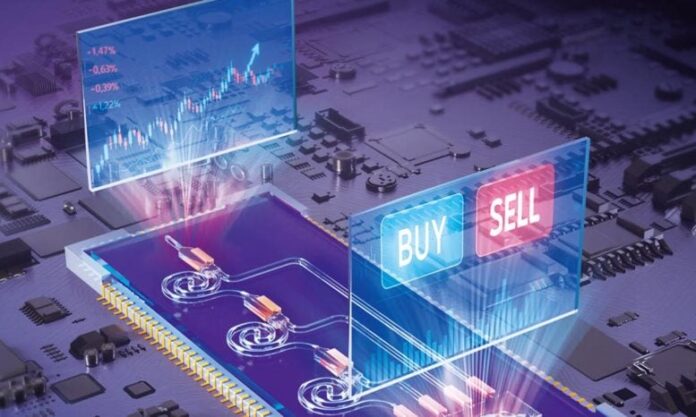
In the realm of digital finance, OFE² processed real-time market data streams to recommend profitable trading actions based on optimized strategies. By converting optical outputs directly into buy or sell decisions, the system achieved consistent profitability with minimal latency, leveraging the speed of light to gain a competitive edge in high-frequency trading environments.
Implications and Future Prospects
This pioneering work signals a paradigm shift where computationally intensive tasks migrate from energy-hungry electronic processors to ultrafast, low-power photonic systems. Such a transition promises to revolutionize real-time AI decision-making across sectors including healthcare, finance, and autonomous systems.
Professor Chen concludes, “Our advancements elevate integrated diffraction operators to new performance levels, supporting demanding computational services. We eagerly anticipate collaborations with industry partners seeking to harness data-intensive optical computing solutions.”