
Origins of a Humanoid Robot Built in a Home Workshop
In 1987, Richard Greenhill, a British photographer with a passion for robotics but no formal training, embarked on an ambitious project: to create a life-sized humanoid robot capable of practical tasks such as carrying luggage. Employed at a startup named Intergalactic Robots, Greenhill found no support for his vision there, prompting him to begin constructing the robot independently in his attic.
To advance this endeavor, Greenhill gathered a group of enthusiasts who met weekly. Every Wednesday evening, his wife Sally prepared a large pot of spaghetti, while the group-dubbed the Shadow Group-assembled robots using parts salvaged from discarded printers and junkyards. Their primary focus became the development of a two-legged robot named Shadow Walker.
Design and Mechanics Inspired by Human Anatomy
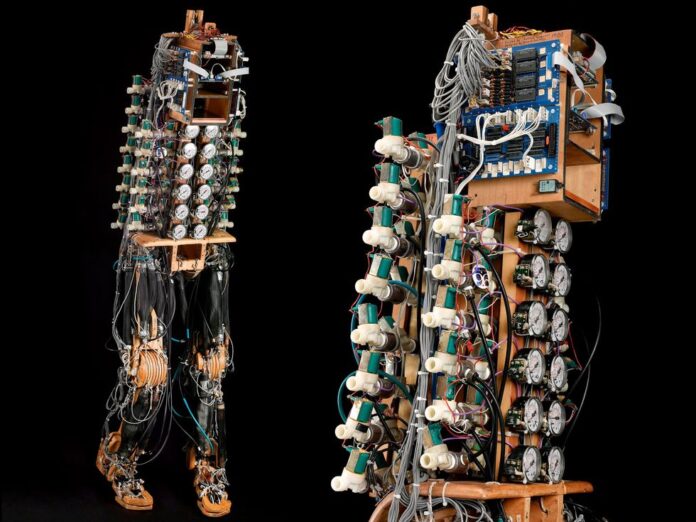
Greenhill collaborated with David Buckley, a robotics and animatronics specialist he met at Intergalactic Robots. Buckley designed the robot’s framework drawing inspiration from medical literature on human skeletal and muscular systems. The robot’s simplified maple skeleton featured a single bone in the lower leg and a broad toe on each foot. Its ankle joint allowed two degrees of freedom through a double-axis mechanism, while the knee was designed without a kneecap to reduce complexity.
Rejecting conventional electric motors, Greenhill opted for pneumatic actuation. The robot’s movements were powered by 28 compressed-air-driven “air-muscles,” pneumatic actuators modeled after the McKibben muscle concept from the 1950s, which emulate natural muscle contraction and extension. These air-muscles spanned eight joints-including hips, knees, ankles, and toes-providing a total of 12 degrees of freedom.
Technical Specifications and Early Achievements
The Shadow Walker stood 168 centimeters tall, measured 46 centimeters in width, and weighed approximately 38 kilograms. Its headless torso housed the control valves, electronics, and computer interfaces. The team succeeded in enabling the robot to stand steadily and maintain balance, even recovering its center of gravity after minor disturbances. However, achieving autonomous walking proved to be a formidable challenge.
Teenager Rich Walker joined the project, focusing on programming the robot’s balance using neural networks. Despite his efforts, hardware limitations such as sensor unreliability, valve inconsistencies, and the robot’s delicate build hindered progress. Over time, the team developed a comprehensive software library to manage the robot’s movements.
Context: Robotics Landscape in the Late 20th Century
By the late 1980s, robotics had been evolving for decades. The first industrial robot, Unimate, debuted in 1961, and early research into machine intelligence was underway with projects like the Freddy robots in the 1960s. The IEEE established its Robotics and Automation Council in 1984, which became the IEEE Robotics and Automation Society in 1987. That same year, the International Federation of Robotics was founded to foster global collaboration in robotics research and development.
Meanwhile, industrial humanoid robots were advancing rapidly. Honda initiated its humanoid robot program in 1986, culminating in the P2 prototype in 1996-a 183 cm tall, 210 kg robot capable of stable, autonomous walking. This breakthrough paved the way for the renowned ASIMO robot.
Public Perception and the First International Robot Olympics
During this era, robots evoked a mix of fascination and apprehension. Industries anticipated productivity gains, workers feared job displacement, children saw robots as toys, and people with disabilities viewed them as empowering tools. Military strategists hoped for safer combat options, while philosophers and religious thinkers debated the implications of intelligent machines.
Against this backdrop, Peter Mowforth, cofounder of the Turing Institute in Glasgow, organized the inaugural International Robot Olympics on September 27-28, 1990. The event aimed to showcase the capabilities of the world’s best robots in a competitive setting, providing a realistic assessment of their strengths and limitations.
Highlights and Challenges of the 1990 Robot Olympics
The competition welcomed over 50 robots from universities, industries, and hobbyist groups across Canada, France, India, Japan, Mexico, the Soviet Union, the United States, the United Kingdom, and Yugoslavia. Instead of fixed categories, robots were grouped based on their declared abilities, with awards for overall performance, innovation, commercial potential, and youth participation.
Despite high hopes, many robots struggled with the uneven arena surface, which was covered in a pile rug rather than smooth flooring. For example, Trolleyman, a wheeled robot designed to carry the Olympic torch, experienced a power failure during the opening ceremony. David Buckley later reflected that the event’s challenges may have been too ambitious, limiting its impact on advancing robotics.
Among the winners, a remarkable highlight was the 19th-century fully mechanical Japanese Archer automaton from the Museum of Automata in York, England, which secured gold in the javelin event, outperforming much younger competitors. The overall champion was Yamabico, a robot from the University of Tsukuba, Japan, which excelled in obstacle avoidance and wall-following tasks but was disqualified in the speech category for not speaking English.
Shadow Walker, despite its innovative design, was unable to take a step during the competition. The bipedal walking prize was claimed by the Cardiff University Biped. Today, Shadow Walker is preserved in the Science Museum’s collection in London.
Enduring Impact and Evolution of Shadow Robot Company
In 1997, driven by a client’s request for a robotic leg, the Shadow Group formalized into a registered company, now known as Shadow Robot-the oldest robotics firm in the UK. Rich Walker, after completing degrees in mathematics and computer science at Cambridge, rejoined the company in 1999 as technical director and currently serves as its director.
Shadow Robot shifted its focus from walking robots to developing highly dexterous robotic hands. This transition reflects the group’s legacy, as their first humanoid hand in the late 1990s was notable for its ability to grasp a pint glass-a challenging task due to the glass’s smooth surface. Modern Shadow Robot hands employ precise actuators instead of pneumatic muscles, featuring 20 motors that enable complex finger movements with 24 degrees of freedom, including abductive and adductive motions.
Sejal Parsotomo, senior marketing executive at Shadow Robot, recently emphasized that while humanoid robots capture public imagination, true industrial transformation comes from robots with specialized dexterity capable of reliably manipulating objects in real-world environments.
Progress and Ongoing Challenges in Humanoid Robotics
The difficulties faced by Shadow Walker in mastering basic locomotion underscore the complexity of humanoid robotics. Fast forward to August 2025, when Beijing hosted the World Humanoid Robot Games, featuring competitions in gymnastics, soccer, track events, and practical tasks like hotel cleaning and medicine sorting. These robots demonstrated capabilities far beyond those seen in the first Robot Olympics 35 years earlier, yet significant hurdles remain for robots to seamlessly navigate and operate within human-centric spaces.
Despite remarkable advancements, the goal of creating truly useful humanoid robots that can function autonomously in everyday environments remains a work in progress.
This article is part of an ongoing series exploring historical technological milestones and their influence on future innovations.