
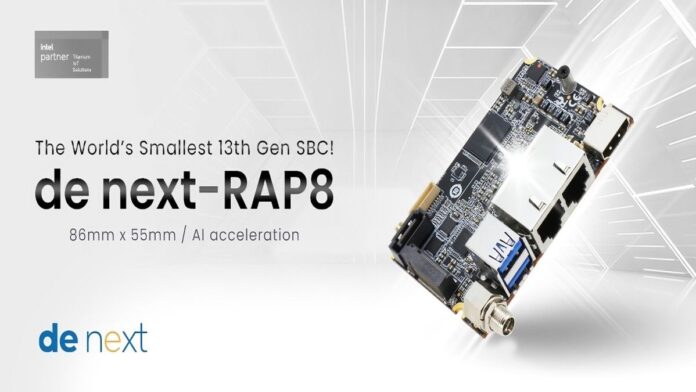
This board is available with Intel Core i3-1315UE or i5-1335UE and each runs at 15W.
Designed for industrial and robotic systems
This model has up to 12 cores and 10 threads, paired up with up to 16GB LPDDR5x Memory and integrated Intel Iris Xe Graphics.
These specs suggest that the board can handle lightweight multitasking, media processing and other tasks. However, performance will still be limited by thermal limitations and the lack a discrete graphics card.
Although it offers more performance than most embedded systems, the layout and expansion options do not match those of workstation PCs.
Its connections include dual Intel RJ45 Ethernet ports supporting both 2.5GbE & 1GbE as well as two USB 3.2 Type-A ports. HDMI 1.2a output and a 12VDC jack are also included.
Additional functions are accessible via a 40-pin header that supports 8-bit GPIO interfaces, USB 2.0 and RS-232/422/485. Optional support is available for SMBus/I2C. These features indicate that the board is designed for integration into custom hardware platforms, such as drones and robots.
Additional expansion is possible via an M.2 M-Key slot, which can be used for Wi-Fi, storage, or 4G modules, as well as an FPC connector that offers PCIe x4 Generation 3. AAEON’s adapter cards such as the PER T642 and PER R41P extend functionality by adding AI acceleration, additional storage, or graphics capture capabilities. The de next RAP8 is a good fit for industrial systems, such as robots, drones and kiosks that require custom integration. The need for add-on card adds complexity to the setup that is not required in a typical office, making it unsuitable for a business computer, which should have built-in features and greater scalability.
Check out the latest Raspberry Pi distros
Efosa is a technology writer who has been writing for more than 7 years. Initially driven by curiosity, he now writes with a passion for the subject. He has a PhD and a Master’s degree in sciences. This gave him a solid foundation for analytical thinking. Efosa has a keen interest for technology policy. He is particularly interested in the intersection between privacy, security and politics. His research focuses on how technological advancements affect regulatory frameworks and social norms, especially in regards to data protection and cybersecurity. In addition to privacy and technology policies, he will also be focusing on B2B products. Efosa can be contacted at this email: udinmwenefosa@gmail.com