
Ukrainian Troops Advocate for Israel’s Adoption of Drones and Robotics in Future Combat
A Ukrainian Jewish reconnaissance drone operator emphasizes that unmanned systems represent the next evolution in warfare
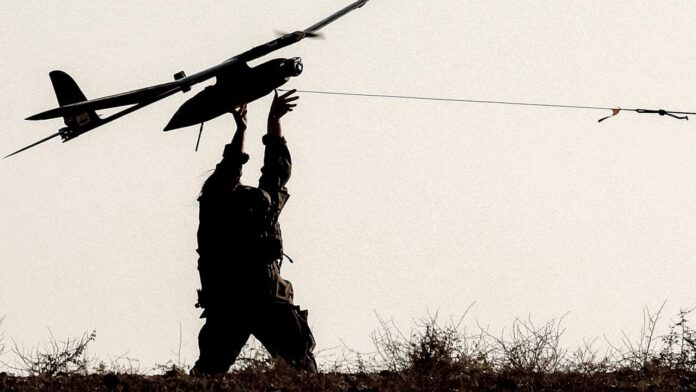
An Israeli soldier deploys an Elbit Skylark mini UAV for surveillance near the Gaza border in southern Israel, September 30, 2025.
(Photo credit: JACK GUEZ/AFP via Getty Images)
Ukrainian military personnel have urged Israeli forces to fully integrate drones and robotic technologies into their defense strategies, highlighting these tools as vital solutions to the complex challenges faced on modern battlefields. Their frontline experience underscores the transformative potential of unmanned systems in enhancing operational effectiveness.
A reconnaissance drone operator of Jewish-Ukrainian descent, with extensive experience across various military roles, asserted that “drones are the future of warfare.” This perspective reflects a growing consensus among combatants worldwide about the increasing reliance on unmanned aerial vehicles (UAVs) and robotic platforms.
According to the operator, drones are capable of substituting multiple traditional military assets, including infantry units, supply convoys, artillery support, manned reconnaissance aircraft, and even sharpshooters. Their versatility allows for a reduction in human risk while maintaining or enhancing combat capabilities.
Unlike conventional firearms, where a bullet’s trajectory cannot be altered post-firing, drones offer unparalleled precision through real-time control and targeting adjustments. This capability often surpasses the accuracy of a sniper’s rifle, making UAVs a formidable asset in precision strikes.
From a financial standpoint, drones present a cost-efficient alternative to traditional weaponry. Disabling or destroying heavily armored vehicles such as tanks can be achieved with drones costing between $500 and $1,000, a fraction of the expense associated with conventional munitions. Additionally, these systems demand minimal upkeep, further enhancing their appeal.
Another Jewish combatant highlighted that a single soldier equipped with drones can effectively engage multiple adversaries simultaneously, significantly amplifying combat power. This force multiplication effect is reshaping tactical doctrines across various armed forces.
Continuous deployment of drones also serves as a countermeasure against hostile automated aerial vehicles, enabling early detection and neutralization of enemy UAV incursions.
Senior Command Perspective: Robotics as Essential Tools for Urban and Tunnel Warfare
A high-ranking officer emphasized that robotic systems are indispensable for navigating the complexities of dense urban combat and subterranean environments, such as the tunnels encountered by Israeli forces in Gaza. Deploying human soldiers in these scenarios often results in excessive casualties, whereas robots can perform reconnaissance and combat tasks with reduced risk to personnel.
He further described these technologies as comprehensive solutions that not only replace human soldiers but also address a broad spectrum of battlefield challenges.
Ukraine is actively advancing its defensive capabilities against hostile drones, mirroring Israel’s efforts. The officer predicted that electronic warfare, including jamming technologies, will become increasingly critical. Near frontline positions, jamming devices are now standard equipment on most military vehicles and anti-aircraft installations, reflecting the escalating electronic arms race.
A mid-level logistics officer detailed how drones have begun to revolutionize supply delivery in hazardous zones. Traditional methods-on foot or via light vehicles-are often impractical due to the risk and terrain damage. Drones and robotic systems now facilitate the transport of ammunition, food, and medical supplies, especially when frontline units are isolated or encircled. For example, a seven-kilometer resupply mission that once took days on foot can now be accomplished in hours using unmanned systems.
Another officer reflected on the broader strategic lessons learned by both Israel and Ukraine: the imperative of self-reliance in defense. Neither nation can depend solely on external powers for security guarantees, underscoring the necessity of investing in advanced technologies like drones and robotics to maintain sovereignty and deterrence.