
Innovative Robotics in Action: A Showcase of Cutting-Edge Developments
Each week, the robotics community is treated to a curated collection of groundbreaking videos that highlight the latest advancements in robotic technology. Alongside these visual insights, a comprehensive calendar of upcoming robotics events is available to keep enthusiasts and professionals informed. Contributions of events are welcomed to enrich this resource.
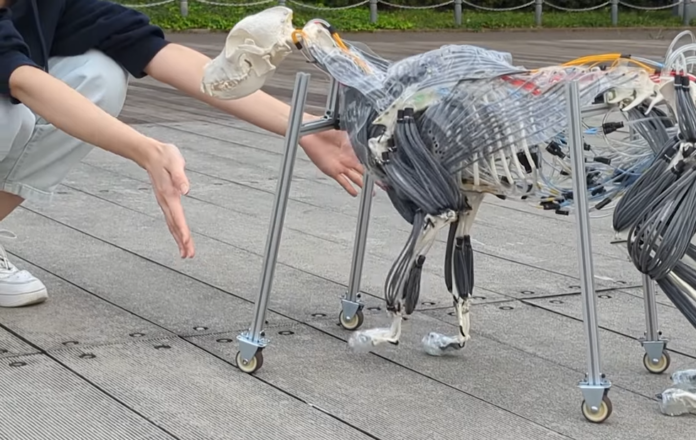
Exploring Canine Biomechanics with Soft Robotics
Researchers at the Suzumori Endo Laboratory, based in Tokyo, have engineered a robotic model that replicates the musculoskeletal system of a dog using McKibben artificial muscles. This design features a flexible, hammock-like shoulder mechanism that closely mimics the natural biomechanics of canine movement, providing valuable data for both robotics and biological studies.
Transforming Speech into Tangible Creations with AI and Robotics
Freeform Robotics has introduced a novel system that converts spoken language into physical objects by integrating 3D generative AI with modular robotic assembly. This innovation democratizes design, enabling individuals without expertise in 3D modeling or programming to create complex structures through natural language commands.
Next-Generation Edge AI: The OAK 4 Vision System
Max Luxonis presents the OAK 4, a compact, all-in-one vision solution that integrates 3D perception, onboard computing, and advanced sensing capabilities. This device is designed to enhance robotics, automation, and real-world intelligence applications by providing efficient and powerful edge AI processing.
Vine-Inspired Soft Robotic Grippers for Delicate Handling
Inspired by the twisting resilience of vines, MIT engineers have developed a soft robotic gripper capable of gently enveloping and lifting a wide range of objects, from fragile glass vases to heavy watermelons. This design offers a safer and more adaptable alternative to traditional rigid grippers. Scaled-up versions of these robotic tendrils can even assist in lifting humans safely, demonstrating potential in healthcare and caregiving.
Wearable Robotics: Fast and Secure Limb Attachment Systems
A novel approach to wearable robotics introduces an automatic limb attachment mechanism using soft actuated belts combined with magnetic-hook latches. This system ensures quick, comfortable, and secure donning for users of varying arm sizes, while maintaining clinical-grade load support and precise pressure control, enhancing usability in medical and assistive devices.
Advancing Autonomous Driving with Safety-First AI
Waymo continues to lead in autonomous vehicle technology by embedding demonstrable safety at the core of its AI models and ecosystem. Their approach prioritizes transparent and verifiable safety measures, addressing one of the most complex challenges in applying AI to real-world physical environments.
Disaster Response Reimagined: AI-Driven Robotic Canine
Students at Texas A&M Engineering have developed an autonomous robotic dog designed for disaster scenarios. Equipped with a custom Multimodal Large Language Model (MLLM), visual memory, and voice command capabilities, this robot navigates rubble, avoids hazards, and makes real-time decisions akin to a human first responder, enhancing search and rescue operations.
Agile Aerial Microrobots Mimicking Insect Flight
MIT researchers have pushed the boundaries of aerial microrobotics by creating robots capable of agile, gymnastic flight patterns comparable to bumblebees. Utilizing an advanced AI controller, these microrobots perform complex maneuvers such as continuous body rotations, marking a significant leap toward more versatile and efficient flying robots.
Capturing Mars’ Electric Storms: Audio from the Perseverance Rover
NASA’s Perseverance rover recorded the eerie sounds of electric discharges during a Martian dust devil event on October 12, 2024 (Sol 1,296). Using data from the SuperCam microphone, this audio clip offers a rare auditory glimpse into the dynamic atmospheric phenomena on Mars, enriching our understanding of the Red Planet’s environment.
Robots That See, Think, and Adapt: Insights from California’s Robotics Labs
In a recent exploration of advanced robotics, Hannah Fry visits a California laboratory where robots demonstrate not only visual perception but also cognitive planning and adaptive action. These robots are challenged to manipulate objects outside their direct line of sight, pushing the limits of generalization and autonomous problem-solving.
Enhancing Virtual and Augmented Reality Through Haptic Innovations
Parastoo Abtahi from Princeton University presents pioneering research on overcoming the current limitations of haptic feedback in virtual reality (VR). By leveraging sensorimotor control theories, her work improves the perceived accuracy of haptic devices and explores augmented reality (AR) techniques to bridge mental and robotic representations, enabling more immersive and intuitive interactions beyond physical constraints.