
Curiosity Rover Overcomes Unexpected Obstacle on Mars
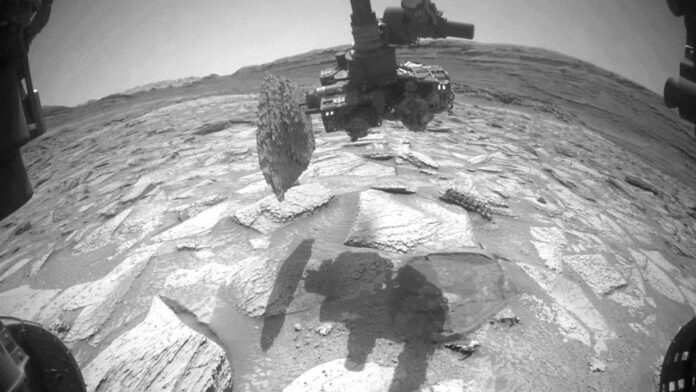
NASA’s Curiosity rover team recently experienced a tense moment when a rock became lodged on the end of the rover’s robotic arm, delaying its scientific operations for nearly a week. Video recordings captured the rover’s mechanical arm as it tilted, rotated, and vibrated vigorously in an effort to dislodge the stubborn rock.
The Curious Case of the Atacama Rock
The incident began when Curiosity encountered a seemingly ordinary rock, named Atacama after the arid Chilean desert on Earth, while traversing the slopes of Mount Sharp within Gale Crater near Mars’ equator. Measuring about 1.5 feet (46 cm) across, 6 inches (15 cm) thick, and weighing roughly 28.6 pounds (13 kg), Atacama was an ideal candidate for detailed examination.
However, when the rover retracted its arm after drilling, the rock unexpectedly lifted off the Martian surface, clinging to the drill’s fixed sleeve rather than detaching as anticipated. This phenomenon was unprecedented; although drilling had previously fractured rock layers, no rock had ever remained stuck to the drill sleeve before.
Engineering Challenges and Innovative Solutions
Faced with this novel challenge, the Curiosity team devised a strategy to free the drill bit from the rock. Initial attempts involved vibrating the drill to shake the rock loose, but these efforts only dislodged small sand-like particles. On April 29, the team combined vibration with arm repositioning, yet the rock remained firmly attached.
Persistence paid off on May 1, when a combination of tilting the drill, rotating, vibrating, and spinning the drill bit successfully separated Atacama from the sleeve. The rock broke into at least two fragments upon falling back to the Martian surface, as confirmed by images captured by the rover.

Unfortunately, the sample material, or drill tailings, were lost during the dislodging process. Consequently, the team is now focusing on identifying a more stable rock target to collect viable samples for analysis.
Recent Milestones in Curiosity’s Mars Mission
Since its arrival on Mars in 2012, Curiosity has made numerous groundbreaking discoveries, with the past few months standing out for their scientific significance.
In late April 2024, the rover achieved a record by detecting seven distinct organic molecules simultaneously-the largest single collection of such compounds on Mars to date. This discovery complements an earlier February finding of a complex chain of hydrocarbons, both of which provide valuable insights into the planet’s potential to have supported ancient microbial life.
Earlier in April, Curiosity captured images of unusual surface features resembling “dragon scales,” scattered across the Martian terrain. In March, the rover uncovered ruby-like crystals embedded within rocks similar to Atacama, hinting at diverse mineralogical processes.
Prior to these findings, Curiosity spent over six months investigating ridge-like formations known as boxwork-intricate, web-like rocky structures crisscrossing the Martian surface. Recent observations revealed these formations are coated with tiny, egg-shaped nodules, adding another layer of complexity to Mars’ geological history.
Test Your Mars Knowledge
How well do you know the Red Planet? Explore fascinating facts and challenge yourself with our Mars quiz to see if your knowledge is truly out of this world.