Why Are Robots Suddenly Folding Clothes Everywhere?
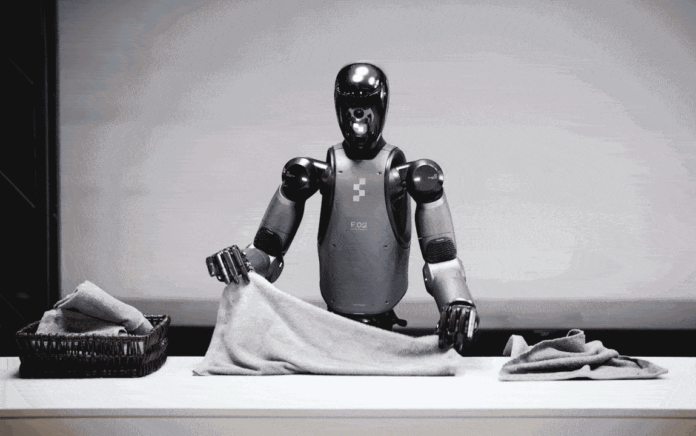
In recent times, videos showcasing robots folding clothes have become increasingly common, captivating audiences worldwide. From startups to research labs, the fascination with automating this mundane household chore is evident. Companies like Weave Robotics have released impressive semi-autonomous demonstrations on social platforms, while others such as Figure and Physical Intelligence have unveiled robots capable of folding garments right after unloading laundry machines. Robotics exhibitions frequently feature these innovations, and firms like ALOHA pioneered this niche even before tech giants entered the scene. Meanwhile, 7X Tech is gearing up to commercialize robots designed specifically for folding clothes.
Beyond clothing, related tasks like napkin folding have also gained attention. Dyna Robotics, for instance, showcased an extraordinary 18-hour continuous napkin-folding demonstration, highlighting the potential for robots to handle repetitive, delicate tasks with endurance. This surge in robotic manipulation projects begs the question: why has clothes folding become a focal point for roboticists now?
Overcoming Past Limitations: The Evolution of Robotic Folding
Attempts to automate clothes folding date back over a decade, but early efforts were hampered by slow, fragile systems that lacked robustness. These initial models often depended on precise camera calibrations and carefully engineered features, restricting their functionality to specific robots and controlled environments. For example, the UC Berkeley PR2 robot in 2014 could fold clothes using a neural network policy, but it operated slowly, only on a uniform green background, and struggled with diverse clothing types.
Fast forward ten years, and advancements in machine learning, particularly imitation learning powered by large-scale datasets, have transformed the landscape. Startups and hobbyists alike now leverage more generalized techniques and pre-trained models, enabling robots to fold a wider variety of garments with greater speed and reliability. Tools like LeRobot exemplify this democratization of robotic manipulation, reducing the need for highly specialized hardware or environments.
The Allure of Automated Folding: Why Consumers and Companies Care
The dream of a robotic assistant that handles tedious chores resonates deeply with many. Folding laundry is often cited as one of the most disliked household tasks, and the prospect of never having to do it again is highly appealing. This consumer desire fuels significant investment in robotics companies such as Figure and 7X Tech, which have raised substantial capital with promises of versatile home automation solutions starting with clothes folding.
Despite current robots being relatively slow and imperfect, their demonstrations spark imagination about a future where such technology seamlessly integrates into daily life, freeing up valuable time. The emotional appeal and practical benefits make clothes folding an ideal entry point for broader robotic adoption in homes.
Why Clothes Folding Suits Current Robotic Capabilities
Modern robotic folding relies heavily on imitation learning, where robots learn complex manipulation skills by mimicking expert human demonstrations. Techniques inspired by generative AI, such as Diffusion Policy, enable robots to execute intricate, dexterous movements based on thousands of recorded trajectories. For instance, Google’s ALOHA project required approximately 6,000 human-guided demonstrations to master tasks like tying shoelaces, illustrating the data-intensive nature of such learning.
Clothes folding presents unique advantages that align well with these learning methods:
- Tolerance for Variability: Unlike precision assembly tasks, folding clothes does not demand sub-millimeter accuracy. Human demonstrations naturally vary, but this inconsistency is acceptable and even beneficial, allowing the collection of more training data without discarding imperfect attempts.
- Cost-Effective Hardware: Since exact repeatability is less critical, robots can use less expensive, less precise components, making large-scale deployment more feasible.
- Controlled Environments: Folding typically occurs on flat, uncluttered surfaces with fixed camera setups, simplifying perception challenges and reducing the need for complex environmental adaptation.
- Task Reset Capability: Mistakes during folding are easily recoverable by simply picking up and repositioning the garment, unlike fragile tasks such as stacking glassware where errors can cause irreversible damage.
- Minimal Force Application: Folding involves gentle manipulation without exerting high pressure, avoiding risks of breakage and reducing the complexity of force feedback integration.
Looking Ahead: The Future of Robotic Manipulation
While current clothes-folding robots impress with their capabilities, there is still room for growth. Dyna Robotics’ zero-shot folding demonstrations-where robots fold items without additional training-have garnered attention at conferences like Actuate in San Francisco and the Conference on Robot Learning in Seoul, showcasing the potential for more adaptable systems.
Future advancements are expected to enable robots to handle more dynamic environments, operate at higher speeds, manipulate heavier objects, and navigate complex terrains, all while performing sophisticated tasks. As machine learning models continue to evolve, the balance between data efficiency and task complexity will improve, broadening the scope of robotic applications beyond laundry.
In summary, clothes folding represents an ideal convergence of current robotic strengths and consumer demand. As this technology matures, expect to see more homes equipped with robots that not only fold clothes but also tackle a wider array of everyday chores, transforming the way we live.