
makes it possible.
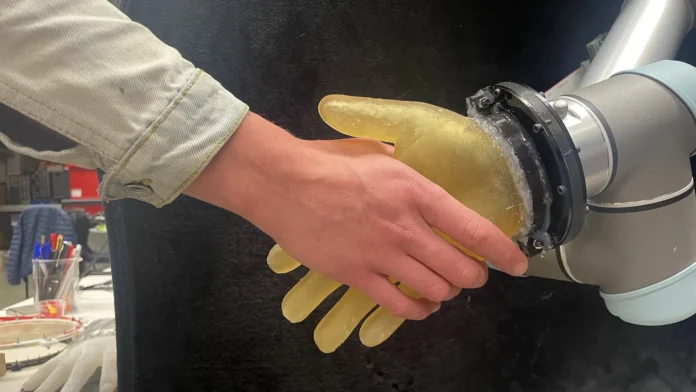
Scientists have developed an inexpensive, durable, and highly-sensitive robotic “skin” that can be attached to robotic hands as a glove. This allows robots to detect information in their environment in a similar way to humans.
The researchers from the University of Cambridge (UCL) and University College London have developed a flexible, conductive surface that is easy to fabricate, can be melted and formed into many complex shapes. The technology can sense and process a variety of physical inputs. This allows robots to interact more meaningfully with the physical world.
Unlike existing solutions for robotic touch that rely on sensors embedded in small areas, and require different sensors to detect various types of touch, all of the electronic skin developed and tested by Cambridge and UCL researchers acts as a sensor. This brings it closer to the human skin sensor system.
The robotic skin is not sensitive enough to detect human skin’s touch, but it can detect signals coming from 860,000 tiny pathways within the material. This allows it to recognize different types of pressure and touch – such as a finger tap, a cold or hot surface, damage caused by stabbing or cutting, or multiple points touched at once. Researchers used a combination physical tests and machine-learning techniques to help the robot skin ‘learn,’ which of these pathways are most important so that it can sense different types contact more efficiently. Researchers say that the robotic skin can be used in a variety of industries, including the automotive industry and disaster relief. The results were published in Science Robotics ().
The electronic skins convert physical information, such as temperature or pressure, into electronic signals. In most cases, different sensors are required for different types or touch. For example, one sensor may detect temperature, while another might detect pressure. These sensors are then embedded in soft, flexible materials. The signals from the different sensors can interfere, and the materials can be easily damaged. Lead author Dr David Hardman, from the Department of Engineering at Cambridge University, said
“Having different sensors for different types of touch leads to materials that are complex to make,” . Thomas George Thuruthel, co-author from UCL, said “We wanted to develop a solution that can detect multiple types of touch at once, but in a single material.”
“At the same time, we need something that’s cheap and durable, so that it’s suitable for widespread use,” that he was the co-author.
The solution relies on a sensor that responds differently to different types or touch, known as Multi-modal Sensing. Multi-modal sensing is easier to manufacture and more robust, even though it’s difficult to isolate the cause of each individual signal.
Researchers melted a soft, stretchy, electrically conductive hydrogel based on gelatine and cast it in the shape of a hand. They tested different electrode configurations in order to determine which provided the most useful information on different types of touch. The tiny pathways in the conductive materials allowed them to collect over 1,7 million pieces of data from just 32 electrodes at the wrist.
After that, the skin was tested with different types of touch. The researchers used a heat gun to blast it, pressed on it with their fingertips and a robotic hand, gently touched it using their fingers, or even cut it open with scalpel. The team used the data collected during these tests to create a machine-learning model that would allow the hand to recognize the different types touch. Hardman is a postdoctoral research fellow in the lab of coauthor Professor Fumiya Iida. “They’re measuring lots of different things at once, over a large surface area.”
“We’re not quite at the level where the robotic skin is as good as human skin, but we think it’s better than anything else out there at the moment,” said Thuruthel. The researchers hope to improve the durability and conduct further tests of real-world robot tasks in the future.
This research was supported by the Royal Society, the Engineering and Physical Sciences Research Council, and Samsung Global Research Outreach Program. Fumiya Iida, a Fellow at Corpus Christi College in Cambridge, is supported by Samsung Global Research Outreach Program, the Royal Society and the Engineering and Physical Sciences Research Council (EPSRC), part of UKRI.