
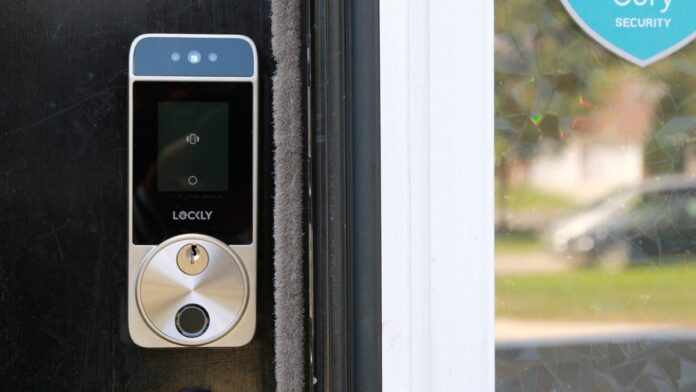
Lockly’s PIN Genie Technology has always attracted me. It displays a unique rotating layout keypad that changes its number of positions every time you use it. This prevents intruders from guessing the code by watching hand movements or smudge patterns.
This 2K video-doorbell had similar features to a Ring, but without the subscription fees.
Lockly’s lineup has since been upgraded with the
TheLockly Visage (also known as the Zeno Series) is alockly visage that can be found with its Zeno Series companions.
Lockly Vision
Lockly Secure Pro Zeno () and Lockly PIN Genie Pro Zeno. All the latest Zeno Series Locks have unique features. The Visage supports facial ID, the Vision includes a 2K resolution video-doorbell, and the Secure Pro has a sleeker design.
While using the Lockly Visage I have focused on its most impressive feature: the unlocking via facial recognition. We use facial recognition on our smartphones and tablets, so adding it to a smart lock seems like a logical next step. It was still a little unnerving to think that my door could be opened by a mere glance at my face.
I wondered how the lock would use my facial biometrics and how easy it would have been to unlock my front door using a photo. This would be a nightmare for security, not just in the case of intruders, but also domestic violence or stalking, as the perpetrators would have access to a large number of photos.
My air conditioner broke down during a heatwave – but this portable AC saved me
I installed the Lockly Visage and immediately set up and tested the facial recognition feature. The lock scans your facial features like an iPhone, when you first set up the Face ID feature. Each time I approach the door, it unlocks automatically before I can even raise my hand and open it with my Apple Watch.
I tried unlocking the lock with photos, using prints and an iPhone, and had no luck. Lockly says it leverages “binocular facial recognition,” which uses two cameras to scan a person’s face in 3D, making it harder for someone to fool the system with photos or videos. The system also uses radar detection to detect motion when someone approaches the lock, regardless of the visibility.
Also: I invested in a subscription-less video doorbell, and it’s paying off for my smart home
The Lockly Visage is easy to install, though I found it had a lot of thick wiring that didn’t seem to fit anywhere inside the housing. To avoid jamming the wiring, I had to route it around the deadbolt mechanism. Setting up with the Lockly app was very easy, and the app has had several updates since I began using this lock that have made it more user-friendly.
Installing the Lockly Visage Smart Lock is relatively easy.
Maria Diaz/ZDNET
You can edit and add different fingerprints, facial biometric data, or key codes for multiple users, which the app didn’t initially allow. This was a bit annoying, as I like to add different codes and fingerprints for my kids and don’t want to create a separate Lockly account for each. As a workaround, I added my older kids as alternative entry methods under my user account.
Also: This is the video doorbell I recommend to most Ring users – especially at its sale price
Thankfully, Lockly updated the app after my initial review so that I could add different users to my home, including codes and fingerprints for specific users. Adding these codes and fingerprints has made it easier for my guests to come and go as they please, which makes them feel more at home during their time here.
The Lockly Visage Smart Lock’s facial biometric capture system.
Maria Diaz/ZDNET
Before the Lockly, I used the Aqara U100 smart lock on my front door for a year. But the Lockly Visage replaced it, and I’m not looking back. Compared to the Aqara U100, which is half the price, the Lockly Visage feels sturdier, with an exterior metal construction compared to the Aqara’s plastic one. However, the Visage’s deadbolt mechanism doesn’t engage and disengage as smoothly as the U100’s and has an external system to detect door closures.
Also: Some of the clearest night footage I’ve seen comes from this 4K camera
While the U100 uses an internal gyroscope to detect when a door is closed by its movement, the Lockly Visage uses two sensors that detect a closed door when they’re lined up. One sensor is connected to the lock below it, while the other is installed on the door frame. This isn’t as convenient or visually pleasing as the U100’s lack of external sensors, but it works and is very accurate.
Still, the Lockly Visage blows the Aqara U100 out of the water in performance. It’s incredibly accurate at reading fingerprints, more so than any other fingerprint lock I’ve tested, and its facial recognition is consistently reliable. This smart lock has never given me an issue I’ve had to troubleshoot.
ZDNET’s buying advice
Aside from an initially annoying app experience, theLockly Visage Zeno Series (19659043) is a high-performance smart lock that supports a variety of unlocking methods including facial recognition, Apple Home Keys, fingerprints and key codes. It can be unlocked remotely via the app or with a physical key.
At $349, the lock is expensive but will likely be your only smart lock for many years. It’s different from most smart locks because it uses a Lockly battery pack that can be removed and recharged. Each Lockly Visage includes two rechargeable batteries. You can keep one fully-charged and replace it when the battery runs out.
The Lockly Visage has been the best smart lock that I have tested so far. It’s not just because it has so many innovative features like unlocking the front door with your facial recognition, but also due to how accurate and reliable it is. Since testing it as a smart home tester, I have chosen the Lockly Visage as my smart lock. It is as versatile and reliable today as it was on day one.
Originally published on September 5, 20,24, this story was updated on June 29, 2020.
Featured Reviews