
Over 25 years of serving tech enthusiasts.
Autonomous MIT robotic helps discover better materials to make solar panels. TechSpot is the place to go for tech advice and analysis you can trust.
Looking forward: At MIT, researchers have developed a fully automated robotic system to accelerate the search of advanced semiconductors. This technology is designed to solve a long-standing problem: the slow pace at which key properties of new materials are measured manually, which has slowed progress in fields like solar energy.
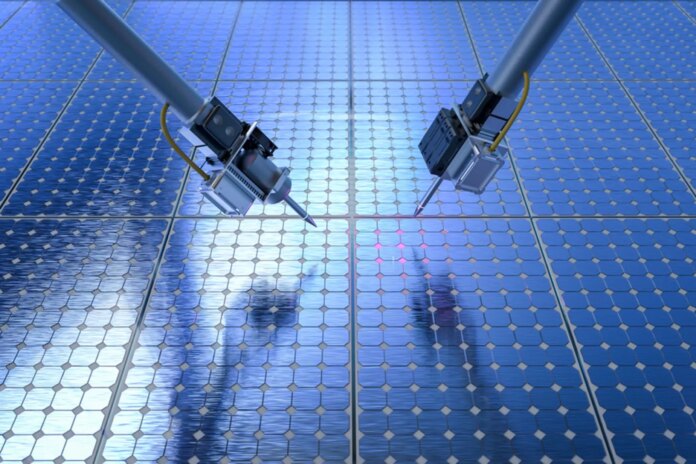
The system consists of a robotic probe that can measure photoconductance. This property reveals how materials respond to light. The robot can determine which points on a sample are most informative by integrating the expert knowledge of materials scientists into a model that uses machine-learning. Combining this approach with a specialized algorithm allows the robot to move efficiently and quickly between contact points.
During a rigorous 24-hour testing, the robot performed over 125 unique measurements an hour, surpassing previous artificial intelligence methods in terms of precision and reliability. This leap in accuracy and speed could accelerate the development and production of more efficient solar cells and other electronic devices. Tonio Buonassisi is a professor of mechanical engineers and senior author of this study. “Not every important property of a material can be measured in a contactless way. If you need to make contact with your sample, you want it to be fast and you want to maximize the amount of information that you gain.”
The team of researchers, led by graduate students Alexander Siemenn and Kangyu JI, as well as Fang Sheng as a graduate student, published their findings in Science Advances.
MIT graduates Eunice Aissi and Alexander Siemenn.
This innovation began in 2018 when Buonassisi’s lab set out on a journey to build a fully-autonomous materials discovery laboratory. Recent efforts have focused on perovskites – a class semiconductors used in solar cells. Despite previous advances that allowed for rapid synthesis, imaging-based analyses and accurate measurement of photoconductance, it still required direct contact to the material.
“To allow our experimental laboratory to operate as quickly and accurately as possible, we had to come up with a solution that would produce the best measurements while minimizing the time it takes to run the whole procedure,” Siemenn explained.
First, the system uses its onboard camera to capture an image of a perovskite. Computer vision divides the image in segments, which is then analyzed by a model of neural networks that incorporates expertise from chemists. Siemenn has been added.
Based on the sample’s composition and shape, the neural network identifies which probe contact points are the best. These points are then fed to a path planner which determines the most efficient route that the robot should follow. This approach must be flexible, as samples are often of unique shapes. “It is almost like measuring snowflakes – it is difficult to get two that are identical,” Buonassisi said.
The self-supervised nature is a key innovation. It allows the neural network to select optimal contact points from sample images, without the need for labeled training data. The team improved the path planning algorithm, introducing a little randomness to help the robot find shorter routes.
“As we progress in this age of autonomous labs, you really do need all three of these expertise – hardware building, software, and an understanding of materials science – coming together into the same team to be able to innovate quickly. And that is part of the secret sauce here,” Buonassisi said.
The researchers tested every component after building the system. The neural network was faster than seven other AI-based methods at identifying contact points, and the path planner generated shorter routes consistently than competing algorithms. In a 24-hour autonomous experiment the robot performed over 3,000 measurements of photoconductance, identifying areas of high performance and regions where materials were degrading. Siemenn stated.
The team will refine the system in the future as they work towards establishing a fully automated laboratory for materials discoveries. The project is funded by First Solar, Eni via the MIT Energy Initiative MathWorks, University of Toronto’s Acceleration Consortium and the US Department of Energy.