It is more than just a technological upgrade. It is a paradigm change. This new frontier allows the integration of cutting edge technologies to create a more autonomous environment where interconnected manufacturing facilities go beyond the limitations of traditional automation. Artificial intelligence, digital clones, and robotics are powerful tools that manufacturers use to create dynamic and intelligent systems. These systems not only perform tasks but also learn, take decisions, and evolve real-time.
This adaptive approach can transform the productivity, efficiency and innovation of a manufacturer. It can also have a positive impact on society, by boosting local economic growth, creating more attractive employment opportunities and supporting sustainability.
As efforts are intensified to revive and modernize manufacturing in regions across the globe, including North America, Europe, and Asia, adaptive production can help manufacturers overcome their biggest challenges, such as attracting and retaining talented employees. In a survey conducted in the US, nearly 60% of manufacturers listed this as their biggest challenge. Highly automated, technology led adaptive production methods offer new opportunities to attract talent into roles that are safer and less repetitive. They also pay better. Simon Johnson, codirector of MIT’s Shaping the future of work Initiative, says that the ideal scenario would be one in which AI enhanced human capabilities, led to new tasks, and empowered the people most at risk of automation’s impact, especially those without college education.
Secondly, the digitalization of manufacturing–embedded in the very foundation of adaptive production technologies–allows companies to better address complex sustainability challenges through process and resource optimization and a better understanding of data. Jelena Mitic, head of technology at Siemens’ Future of Automation, explains that by integrating these advanced technological solutions, we can gain a comprehensive view of the entire production process and the product lifecycle. This will allow for a faster and more efficient method of optimizing operations and ensuring that all safety and sustainability requirements during quality control are met.
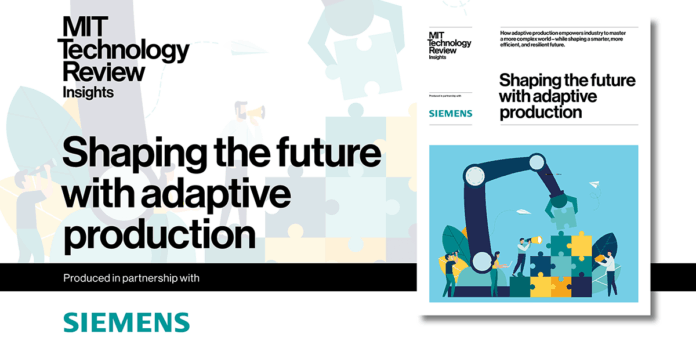
You can download the full report here.
Insights is the custom content arm at MIT Technology Review that produced this content. It was not written or edited by MIT Technology Review.
The content of this article was written, designed and researched by humans, including writers, editors and analysts. This includes the creation of surveys and the collection of data for surveys. AI tools were only used in secondary production processes, which had been thoroughly reviewed by humans.