Advancing AI and Robotics Research in Nigeria: The Journey of AIRLAB
Explore the evolving landscape of artificial intelligence in Africa, focusing on how research, education, and innovation are shaping the continent’s future in technology.
From Passion to Purpose: Dr. Yinka Banjo’s Vision for AI in Nigeria
Dr. Chika Yinka Banjo’s path to founding the Artificial Intelligence and Robotics Laboratory (AIRLAB) at the University of Lagos was shaped by a deep-rooted passion for technology and a commitment to nurturing local talent. After earning her undergraduate degree in mathematics, computer science, and robotics from the Federal University of Technology, Owerri, in 1999, she pursued advanced studies to bridge the gap between theory and practical application. Her academic journey included a Master’s in computer science from the University of Port Harcourt and a second Master’s in mathematical sciences, followed by a Ph.D. in computer science from Stellenbosch University, South Africa, completed in 2015.
Returning to Nigeria, Dr. Banjo was driven by a desire to contribute to the development of the next generation of African technologists. “I wanted to give back by creating opportunities for young people to engage with AI and robotics in meaningful ways,” she reflects.

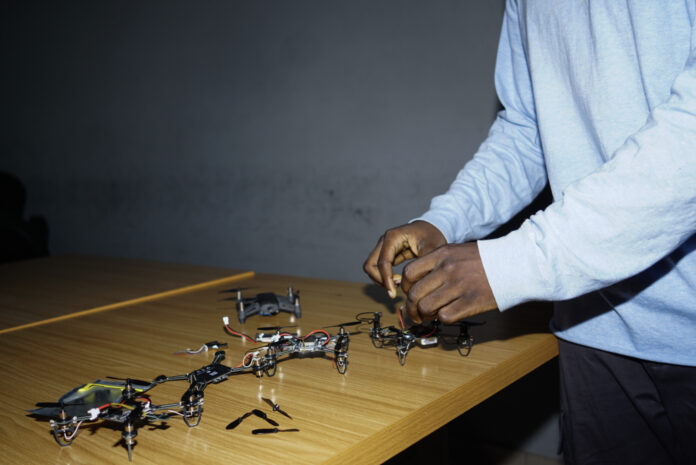
Photo credit: Maryam Shittu/Big Cabal Media
Building AIRLAB: A Hub for Innovation and Youth Empowerment
Starting as a modest office within the University of Lagos’ Computer Science Department, AIRLAB has grown into a vibrant research center housed in the Central Research Laboratory. The lab’s mission is to become a leading African institution for AI and robotics research, fostering innovation that addresses local challenges.
Since its inception, AIRLAB has actively participated in and won accolades at prestigious competitions such as the First Tech Challenge, showcasing the talents of Nigerian youth on international stages. The lab also runs free summer programs aimed at teenagers, equipping them with foundational skills in AI and robotics to inspire future careers in technology.
In collaboration with the Massachusetts Institute of Technology (MIT), AIRLAB hosted a Lagos edition of NaijaCoder in 2023, a program designed to train secondary school students in software development and computational thinking. Victory Yinka Banjo, a recent MIT graduate and program coordinator, emphasizes that the skills taught extend beyond coding-they are essential for research and scientific innovation in AI.
Challenges in Funding and Research Focus
Despite its successes, AIRLAB faces significant hurdles in securing sustainable funding, particularly for applied research projects that could directly benefit Nigerian communities. Dr. Banjo notes a trend where most grants favor extracurricular activities for younger children rather than research initiatives. “It’s puzzling that projects involving children receive more funding, while research that could lead to practical AI solutions struggles to find support,” she explains.
Government backing remains minimal, with officials citing budget constraints and pre-allocated funds for other priorities. Consequently, AIRLAB relies heavily on international grants, such as those from Canada’s International Development Research Centre (IDRC) and the UK Foreign, Commonwealth & Development Office, which recently funded a project to develop AI-powered educational tools for low-connectivity areas across Africa.
Historically, foreign funding has been crucial for AIRLAB’s work in sectors like agriculture and healthcare, enabling access to skilled researchers and resources. However, the ongoing “brain drain” remains a concern, as many talented Nigerians pursue education and careers abroad. For instance, applications from Nigerian students to Canadian universities surged by 260% between 2021 and 2023, reaching 46,000 applicants.
Nurturing Homegrown Talent: Stories from AIRLAB
Mariam Muhammed, a newly admitted Ph.D. candidate at AIRLAB, exemplifies the lab’s role in retaining talent. After completing her master’s in computer science at the University of Lagos in 2024, she was preparing to apply for opportunities abroad but chose to stay when she discovered AIRLAB’s AI for Education project. With a background in electrical engineering and experience developing AI-driven personalized learning platforms for startups, Mariam is eager to focus on research that addresses African educational needs.
She appreciates the structured support that comes with externally funded research projects, contrasting it with the limited funding options typically available for doctoral studies in Nigeria. “This kind of backing ensures accountability and meaningful outcomes,” she says.

Photo credit: Maryam Shittu/Big Cabal Media
Beyond the Classroom: Practical Experience and Aspirations
Owolala Olaoluwasubomi, a fourth-year mechanical engineering student, is currently completing a six-month industrial training at AIRLAB. He sought an environment that fosters both professional growth and personal development. “At AIRLAB, I’m not just contributing to projects; I’m also enhancing my own skills,” he shares.
Owolala is working on designing a remotely operated robotic arm and hopes to pursue graduate studies abroad to deepen his research expertise. He acknowledges that Nigeria’s robotics and AI sectors are still emerging compared to global standards, which motivates him to gain international exposure.
Looking Forward: The Future of AI Research in Africa
While Nigerian AI researchers like Dr. Banjo continue to face funding challenges, other African nations are making significant strides. Egypt, for example, is investing heavily in AI research infrastructure, aiming to produce 6,000 AI-related publications annually by 2030 and positioning itself as a regional hub for AI collaboration. This focus has propelled Egyptian universities to the top ranks in Africa, with South Africa also boasting six universities in the continent’s top ten.
In contrast, Nigeria’s leading institutions, such as the University of Ibadan and the University of Lagos, rank 50th and 74th respectively in Africa. Despite these disparities, AIRLAB’s research efforts contribute meaningfully to the broader AI ecosystem. AI policy expert Victor Famubode highlights that breakthroughs achieved in research labs often serve as the foundation for future startups, driving innovation and economic growth.