
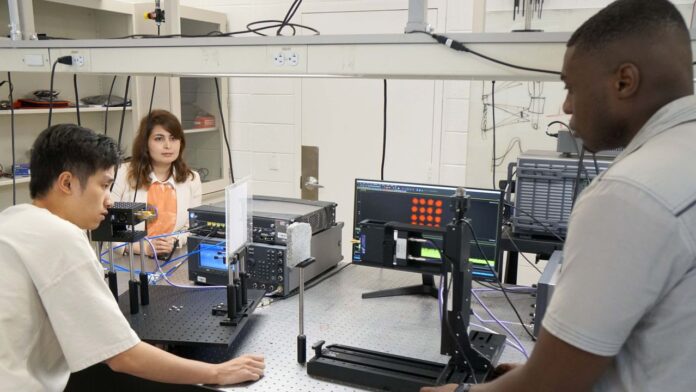
Revolutionizing Ultrahigh-Frequency Wireless Communication: Adaptive Beam Steering Breakthrough
Overcoming the Fragility of High-Frequency Signals
Ultrahigh-frequency (UHF) wireless signals, prized for their potential to deliver unprecedented data speeds, have long been hindered by their extreme sensitivity to physical obstructions. Everyday objects such as walls, furniture, or even moving individuals can disrupt these signals, causing them to degrade or collapse entirely. This vulnerability has posed a significant challenge for deploying next-generation wireless technologies that rely on these frequencies.
Innovative Neural Network Approach Inspired by Sports Training
Addressing this issue, engineers at Princeton University have developed a novel method that enables UHF signals to bend around obstacles dynamically, maintaining robust connectivity. Traditional attempts to manipulate signal paths have utilized “Airy beams,” which can curve predictably. However, practical application has been limited due to the complexity of calculating optimal beam trajectories in real-time environments.
Drawing inspiration from how athletes refine their skills through repetitive practice rather than complex calculations, the research team employed a neural network to “learn” effective beam paths. Instead of physically testing every possible scenario, doctoral researcher Atsutse Kludze created a sophisticated simulation environment where the system could virtually practice and adapt its beam steering strategies. This approach significantly accelerated training while grounding the model in the fundamental physics governing Airy beams.
Metasurfaces: Precision Control Embedded in Transmitters
Central to this advancement is the integration of metasurfaces directly into the transmitter hardware. Unlike conventional reflectors that rely on external structures to redirect signals, these engineered surfaces can precisely shape electromagnetic waves at the source. This capability allows the beams to curve around sudden obstructions, preserving signal integrity without requiring a direct line-of-sight path.
Real-World Applications and Future Prospects
The neural network-powered system demonstrated remarkable agility in selecting optimal beam trajectories amid cluttered and dynamic environments-scenarios where traditional methods falter. This breakthrough paves the way for harnessing the sub-terahertz spectrum, which experts estimate could support data rates up to ten times higher than current 5G networks, potentially reaching terabit-per-second speeds.
Lead researcher Yasaman Ghasempour emphasized the importance of overcoming physical barriers to unlock the full potential of these frequencies for demanding applications such as immersive virtual reality experiences and autonomous vehicle communication systems.
Challenges on the Road to Commercialization
Despite the promising laboratory results, several hurdles remain before this technology can be widely adopted. Scaling the metasurface hardware for mass production, refining the neural network’s training algorithms for real-time responsiveness, and validating performance in complex, real-world conditions are critical next steps. The journey toward terabit-class wireless communication is underway, but navigating the technical and practical obstacles will require continued innovation.
Additional Insights
- Exploring the latest AI tools transforming wireless communication
- Top compact computing devices optimized for high-frequency signal processing
- Recent government initiatives supporting semiconductor advancements