
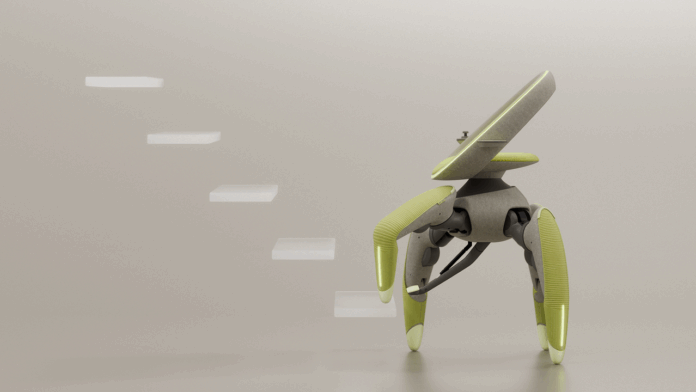
Innovative Robotic Wheelchair Unveiled at Japan Mobility Show 2025
At the 2025 Japan Mobility Show, Toyota introduced a groundbreaking robotic wheelchair capable of traversing challenging terrains using four independently articulated legs. This prototype aims to revolutionize mobility for individuals with limited physical capabilities by enabling them to overcome obstacles such as stairs and uneven surfaces, which are typically insurmountable for conventional wheelchairs.
Advanced Mobility Features for Enhanced Independence
Designed to assist users in climbing steps and crossing barriers, the robotic chair can also elevate its occupant to facilitate access to vehicles or raised platforms. Its legs, inspired by the locomotion of creatures like crabs, can bend, lift, and fold independently, allowing for exceptional maneuverability. When not in use, these legs fold compactly beneath the chair, making transportation and storage more convenient.
Cutting-Edge Sensor Technology for Safe Navigation
Equipped with LiDAR technology, the wheelchair scans its surroundings with laser light to generate precise 3D maps, enabling it to detect and avoid obstacles effectively. Additionally, radar sensors monitor for potential collisions with objects or pedestrians. Before ascending stairs, the front legs assess the step height, while the rear legs provide the necessary push to climb safely.
Ergonomic Design Focused on User Stability and Comfort
The system incorporates weight sensors to ensure the user remains securely seated and balanced. Toyota’s engineers conducted extensive research on human movement and weight distribution when navigating stairs, allowing the chair to automatically adjust leg positions and seat tilt to maintain comfort and stability. This adaptive response helps prevent falls and enhances user confidence.
Intuitive Controls and Autonomous Capabilities
Users can manually steer the chair using handles attached to the seat or operate it via a digital interface for precise movement control. Voice command functionality allows for hands-free operation, with preset destinations such as “living room” and speed adjustments like “slower” or “faster.” The wheelchair can also autonomously unfold and stabilize itself without user intervention.
Power and Endurance for Daily Use
Powered by a discreet battery located behind the seat, the robotic wheelchair offers a full day of operation on a single charge. Recharging is straightforward, requiring only a standard wall outlet overnight. This ensures users can rely on the device throughout their daily activities without frequent interruptions.
Part of Toyota’s Vision for Future Mobility
The robotic wheelchair is one element of Toyota’s broader showcase at the Tokyo Mobility Show, which also featured an autonomous, self-driving vehicle designed specifically for children. Dubbed the “Land Cruiser of wheelchairs,” this rugged model boasts all-terrain tires and a robust frame, engineered to handle off-road conditions. Inspired by the thrill of drifting and racing, it reflects Toyota’s commitment to combining functionality with fun in mobility solutions.