
Since 2020, Google’s electricity consumption has surged, complicating its ambitious energy goals for the decade ahead.
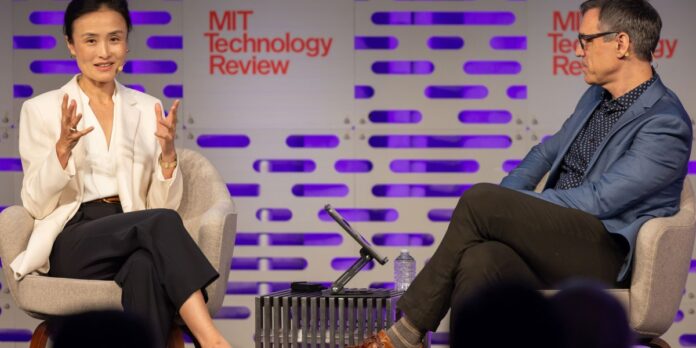
Last week, I attended EmTech MIT, the premier annual conference hosted by MIT Technology Review in Cambridge, Massachusetts. Over three days, I explored sessions covering breakthroughs in artificial intelligence, biotechnology, and robotics. However, the climate-focused discussions stood out as particularly compelling. One highlight was the dialogue between James Temple and Lucia Tian, Google’s head of advanced energy technology.
The conversation centered on Google’s escalating energy needs and the innovative strategies the company is deploying to address them. For those who missed the event, here’s an overview of how Google is navigating its energy challenges amid the rapid expansion of AI.
Throughout this year, I have closely monitored Google’s energy initiatives. Like many tech giants, Google faces soaring electricity demands at its data centers, which threatens to hinder its long-term sustainability objectives.
Back in 2020, Google unveiled a bold commitment: to operate entirely on carbon-free energy around the clock by 2030. This means purchasing renewable energy that matches its electricity consumption in real time across all its operational regions. The goal is to synchronize energy procurement so that clean power generation aligns precisely with Google’s usage. This approach represents one of the most ambitious clean energy pledges in the tech sector.
Despite this vision, Tian acknowledged on stage that achieving 24/7 carbon-free energy is increasingly challenging due to the explosive growth in AI workloads.
“It’s always been a moonshot,” Tian remarked. “Achieving this is incredibly difficult, and the rapid expansion of AI has made it even more so.” According to Google’s latest Environmental Report, its total energy consumption has more than doubled from 2020 to 2024.
Regarding the 24/7 carbon-free energy target, progress has been modest. In 2020, Google aimed for 67% of its data centers to run on carbon-free energy; last year, that figure was 66%. While maintaining this level amid soaring demand is notable, the company remains far from its ultimate goal.
To bridge this gap, Google has been actively securing new energy agreements. Tian highlighted two recent initiatives: a carbon capture and storage project linked to a natural gas plant in Illinois, and plans to revive a nuclear power facility in Iowa.
Starting with carbon capture, Google entered into a contract to purchase most of the electricity generated by a natural gas plant equipped to capture and sequester approximately 90% of its CO2 emissions.
This move sparked debate. Critics argue that carbon capture technology prolongs reliance on fossil fuels and continues to emit greenhouse gases and pollutants, albeit at reduced levels.
During the session, James questioned why Google opted to build a new natural gas facility with carbon capture rather than retrofitting an existing plant. Retrofitting could potentially reduce emissions from current operations without expanding fossil fuel infrastructure. Tian explained that many existing plants were evaluated, but retrofits are not always feasible due to spatial constraints or unsuitable underground geology for CO2 storage.
“We aimed to pioneer a large-scale project to demonstrate this technology’s viability,” Tian said. She noted that the selected site already operates a Class VI well, designed for permanent underground carbon storage, and does not require extensive pipeline construction.
On the nuclear front, Tian discussed Google’s collaboration with NextEra Energy to reopen the Duane Arnold Energy Center in Iowa, with plans for the plant to resume operations by 2029. Google will purchase electricity generated from this facility.
Earlier this year, I reported that Duane Arnold represents one of the few remaining opportunities in the U.S. to restart a previously closed nuclear plant. Tian reflected on the shifting landscape: “Just a few years ago, we were still witnessing nuclear plants shutting down across the country.”
She also praised the efforts to restart the Palisades nuclear plant in Michigan, the first such reopening announced last spring, calling those involved “the real heroes of this story.”
Observing how major tech companies approach energy challenges is always insightful. While I remain cautiously skeptical, I am eager to see how Google and its peers evolve their strategies in the coming years as they balance growth with sustainability.