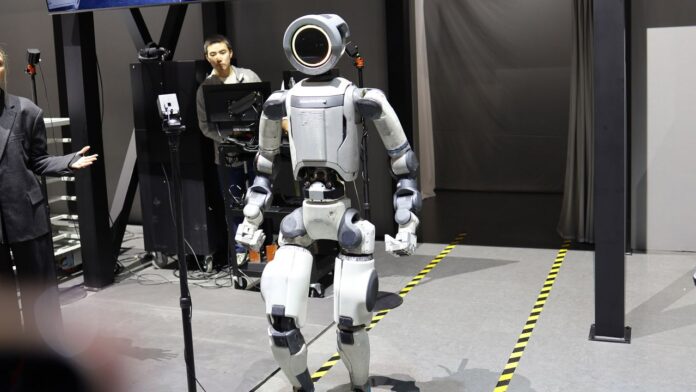
- Robots often falter when operating outside controlled industrial settings
- Microsoft’s Rho-alpha integrates language comprehension directly with robotic motion
- Incorporating tactile feedback is key to bridging software intelligence and physical execution
Challenges of Robotics Beyond Factory Floors
While robots excel in highly structured manufacturing environments, their performance significantly declines when faced with unpredictable or dynamic real-world scenarios. This limitation stems from their reliance on pre-programmed routines and lack of adaptability to changing surroundings.
Introducing Rho-alpha: A Leap Toward Physical AI
Addressing these challenges, Microsoft has unveiled Rho-alpha, a pioneering robotics model derived from the company’s Phi vision-language architecture. This system aims to empower robots with enhanced perception and understanding, enabling them to interpret natural language commands and translate them into precise physical actions.
Unlike traditional robotic systems confined to repetitive tasks on assembly lines, Rho-alpha is designed to adapt fluidly to varying conditions, allowing robots to operate effectively in less predictable environments.
How Rho-alpha Bridges Language, Perception, and Action
Rho-alpha exemplifies the emerging field of physical AI, where software models integrate sensory input, linguistic comprehension, and motor control to guide machines through complex, unstructured tasks. Central to its design is the ability to process natural language instructions and execute bimanual manipulation-coordinated movements involving two robotic arms requiring delicate precision.
By expanding the scope of vision-language-action (VLA) models, Rho-alpha incorporates multiple sensory modalities, including tactile and force feedback, to enhance the robot’s interaction with its environment.
Leveraging Simulation and Human Feedback for Robust Learning
One of the significant hurdles in robotics is the scarcity of extensive, diverse datasets-especially those involving tactile experiences. To overcome this, Microsoft employs advanced simulation tools like Nvidia Isaac Sim to generate synthetic training data through reinforcement learning. These simulated trajectories are then combined with real-world demonstrations sourced from commercial and open datasets, creating a rich training environment.
Deepu Talla, Vice President of Robotics and Edge AI at Nvidia, highlights the importance of this approach: “Utilizing NVIDIA Isaac Sim on Azure to produce physically accurate synthetic datasets accelerates the development of adaptable models like Rho-alpha, capable of mastering intricate manipulation tasks.”
Moreover, Rho-alpha’s training process incorporates human-in-the-loop corrections via teleoperation devices, allowing operators to provide real-time feedback. This iterative learning cycle blends simulation, empirical data, and human guidance, enhancing the system’s adaptability and precision.
Expert Insights on Data Collection and Model Training
Professor Abhishek Gupta from the University of Washington emphasizes the challenges of teleoperation in certain contexts: “While teleoperating robots to gather training data is common, many scenarios render this method impractical or unfeasible.” Collaborating with Microsoft Research, his team enriches pre-training datasets by integrating diverse synthetic demonstrations generated through simulation and reinforcement learning, broadening the model’s applicability.
The Future of Autonomous Robotics in Dynamic Environments
Rho-alpha represents a significant stride toward robots that can autonomously perceive, reason, and act in environments far less structured than factory floors. By fusing language understanding with multi-sensory perception and adaptive control, Microsoft is pushing the boundaries of what physical AI can achieve.
As robotics continues to evolve, integrating tactile sensing and leveraging synthetic data generation will be crucial in developing machines capable of complex, real-world interactions-ranging from healthcare assistance to household tasks and beyond.
Efosa has over seven years of experience writing about technology, driven by a deep passion and a strong academic background with a Master’s and PhD in sciences, equipping him with analytical expertise.