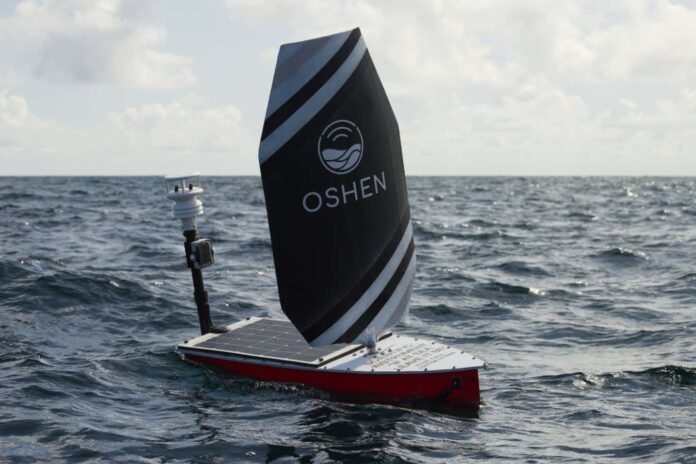
Oshen’s autonomous sailboats harness wind and solar energy for propulsion
Oshen
Reviving Sail Power: The Royal Navy’s Innovative Robotic Fleet
The Royal Navy of the United Kingdom is exploring a futuristic twist on traditional sailing by deploying a fleet of compact, wind-driven robotic vessels. These autonomous boats, developed by Oshen in Plymouth, UK, represent a cutting-edge approach to maritime surveillance and communication.
Design and Capabilities of the C-Star Fleet
Each C-Star vessel measures approximately 1.2 meters in length and weighs about 40 kilograms. Equipped with solar panels, these boats power their navigation systems, communication devices, and onboard sensors, while their sails utilize wind energy for movement. Operating collectively as a network, the C-Stars function as a distributed sensor array across vast oceanic regions.
“Think of C-Stars as autonomous, self-positioning ocean buoys,” explains Anahita Laverack, CEO of Oshen. These boats can maintain a steady position by harnessing wind power or travel at speeds near 2 knots, covering roughly 50 miles daily. Speed is secondary to their primary role as persistent monitoring platforms.
Strategic Deployment and Submarine Communication
In a recent trial, a larger autonomous vessel transported three C-Stars to a designated zone, where they were released to form a sensor network. These units relayed acoustic signals from an unmanned submarine, enhancing underwater communication capabilities. In operational scenarios, deploying hundreds of such vessels would create a complex and unpredictable detection environment for adversaries.
“A single unit reveals the approximate location of a submarine, but a hundred dispersed units make pinpointing the submarine’s position nearly impossible,” Laverack notes.
Endurance and Resilience in Harsh Conditions
Designed for long-term missions, C-Stars can remain at sea for over six months, enduring severe weather conditions. Notably, they were the first unmanned vessels to transmit live data from within a Category 5 hurricane during a collaborative research effort with the US National Oceanic and Atmospheric Administration (NOAA).
Expanding Roles: From Surveillance to Defense
Beyond submarine communication, these robotic sailboats have potential applications in maritime security, including forming early warning lines to detect vessels, missiles, or drones attempting to evade radar detection. Their hydrophones can monitor underwater activity by listening for submarine noises or detecting sonar reflections from nearby warships, effectively illuminating the surrounding waters for enhanced situational awareness.
Autonomy and Fleet Management
Professor Blair Thornton of the University of Southampton highlights the growing acceptance of solar- and wind-powered unmanned vessels, with approximately 100 units currently operational worldwide. He emphasizes that autonomy is crucial for managing large fleets efficiently.
“The key advantage lies not only in the cost of the platforms but also in minimizing the human oversight required. Combining extended endurance with reliable autonomous operation enables the deployment of extensive fleets with minimal intervention,” Thornton explains.
Future Prospects and Integration
The upcoming demonstration aims to validate the seamless integration of C-Stars with existing naval infrastructure. Oshen is prepared to supply up to 1,000 units within a nine-month timeframe should the Royal Navy proceed with procurement.
“Advancements in software will allow us to enhance sensor resolution and expand coverage areas, reducing the number of C-Stars needed for comprehensive monitoring,” says Laverack.